State-of-the-Art Transformer Variants for LLMs in 2025: MoE, Mamba, and Beyond
You might think the Transformer is a single, unchanging architecture. But if you look at what’s actually powering the biggest AI models today, that idea falls apart fast. By 2025, we aren’t just using the original 2017 design. We’re using a complex ecosystem of variants designed to solve specific problems: memory limits, slow inference speeds, and the need to process massive context windows. If you are building or deploying large language models (LLMs), understanding these shifts isn’t optional-it’s critical for staying efficient.
The Standard "2025 Stack" You Probably Already Use
Before we get into the exotic stuff, let’s talk about the baseline. Most modern open-weight models, from LLaMA to Mistral, have converged on a specific set of improvements over the original paper. This is often called the "standard stack." It’s not flashy, but it’s everywhere.
First, they ditched LayerNorm for RMSNorm. Why? Because RMSNorm is simpler and faster, stripping out the mean-centering step that didn’t add much value. Second, positional encoding has shifted almost entirely to RoPE (Rotary Position Embeddings). RoPE allows models to generalize better to longer sequences without retraining, which is why you see 128K or even 1M token contexts now.
Then there’s the activation function. The old ReLU is mostly gone. SwiGLU (Swish-Gated Linear Unit) is the new standard. It expands the hidden dimension by roughly 2.67x but delivers significantly better performance per parameter. Finally, attention heads don’t all work independently anymore. Thanks to Grouped-Query Attention (GQA), many query heads share fewer key-value heads. For example, LLaMA-2-70B uses 32 query heads but only 8 key-value heads. This cuts memory usage dramatically during inference without hurting quality.
Mixture of Experts: Scaling Width Without Scaling Compute
If you want a model with 400 billion parameters but don’t want to pay for 400 billion FLOPs per token, you use Mixture of Experts (MoE). This is how Google’s Gemini 2.5 Pro and Mixtral operate.
Here’s the trick: instead of every neuron firing for every word, the model routes each token to a small subset of "expert" networks. In many production models, only 2 experts are active per layer for any given token. This means you can have dozens of experts sitting idle while processing a specific sentence. You get the knowledge capacity of a huge dense model but the speed of a much smaller one.
| Feature | Dense Transformer | Sparse MoE Transformer |
|---|---|---|
| Parameter Activation | All weights used for every token | Subset of experts activated per token (e.g., 2 of 64) |
| Compute Cost | High and linear with size | Lower; scales with active experts, not total size |
| Memory Footprint | High (all weights loaded) | Very High (all weights stored, but less bandwidth needed) |
| Complexity | Simple routing | Requires robust load-balancing algorithms |
The catch? Routing. If your router sends too many tokens to one expert and ignores others, training becomes unstable. You need careful load-balancing losses to keep things fair. But when it works, MoE is the best way to push frontier capabilities right now.
FlashAttention-3: Making Hardware Work Harder
Architecture changes are great, but sometimes the bottleneck is just bad code interacting with hardware. Enter FlashAttention-3. This isn’t a new neural network layer; it’s a highly optimized kernel for NVIDIA H100 GPUs.
Standard attention requires loading huge matrices into GPU memory, causing bottlenecks. FlashAttention uses tiling to break calculations into chunks that fit in fast SRAM cache. FlashAttention-3 takes this further by optimizing specifically for GQA architectures. On H100s, it hits up to 740 TFLOPS in FP16, which is about 75% of the theoretical max. That’s nearly double the efficiency of previous versions.
If you are running long-context models (like 256K tokens), FlashAttention-3 is non-negotiable. It reduces memory scaling from quadratic to linear relative to sequence length. Without it, you’d run out of VRAM before you ran out of time. It also supports FP8 precision, cutting numerical errors by half compared to older implementations, which helps with stability during training.
Post-Transformers: Mamba and State Space Models
Now for the controversial part. Some researchers argue that self-attention is fundamentally inefficient because it scales quadratically ($O(n^2)$). As context gets longer, costs explode. Mamba, based on Selective State Space Models (SSMs), claims to fix this by operating in linear time ($O(n)$).
Mamba doesn’t look at every past token equally. Instead, it maintains a compressed state vector that updates selectively. Think of it like a human reading a book: you don’t re-read chapter 1 every time you reach chapter 10. You keep a mental summary. Mamba does this mathematically. A 3-billion parameter Mamba model can match the performance of a 6-billion parameter Transformer while being 5x faster at inference.
There’s also RWKV (Receptance Weighted Key Value). RWKV blends RNN-like recurrence with Transformer-like parallel training. It allows constant memory usage during inference, meaning you can run massive models on limited hardware. While Mamba focuses on continuous states, RWKV focuses on discrete time steps, making it surprisingly effective for time-series data and low-latency applications.
Hybrid Architectures and Efficient Attention
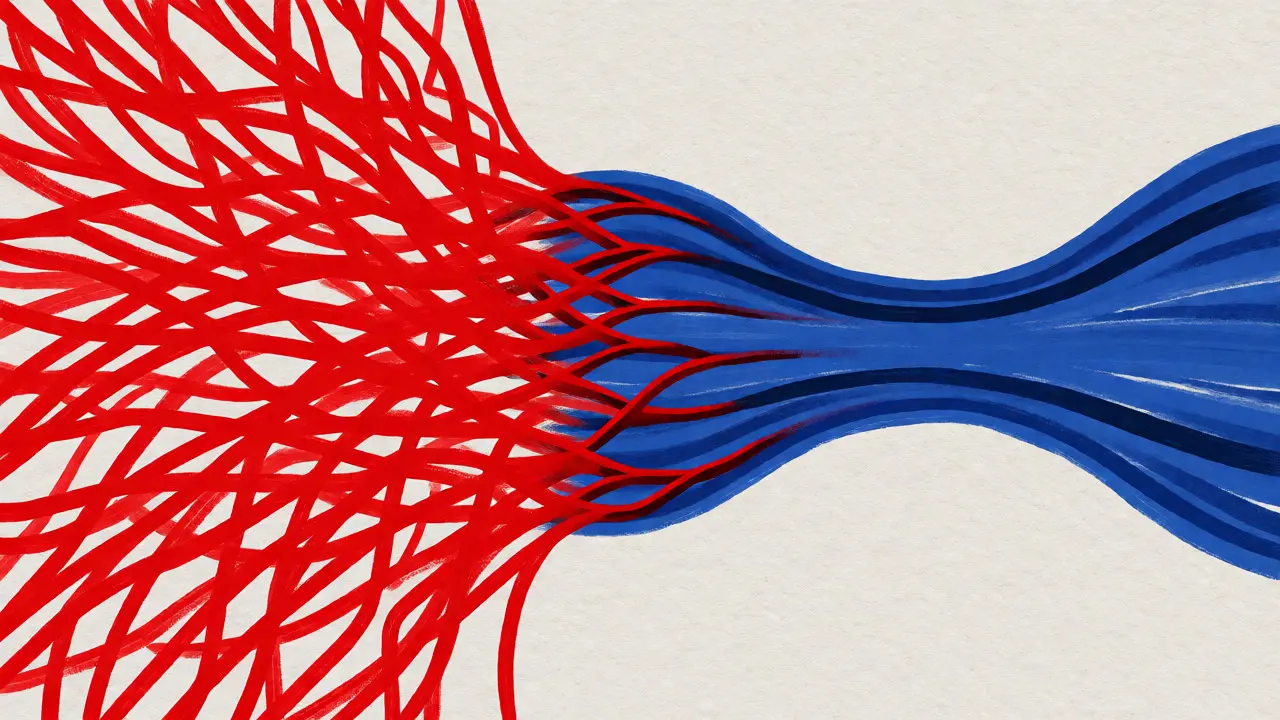
We aren’t seeing a clean swap where Transformers disappear. Instead, hybrids are emerging. Many top-tier models now mix layers. They might use Mamba for long-range dependency tracking and standard Attention for local precision. Or they use sparse attention patterns, like Longformer, where each token only attends to a local window plus a few global "memory" tokens.
Another trend is kernel-based attention. Methods like Performer approximate softmax attention using random features, allowing linear computation. While not yet dominant in frontier models, these techniques offer a middle ground between full attention’s accuracy and SSMs’ speed. If you’re dealing with extremely long documents-say, entire books or legal contracts-these hybrid approaches are becoming the go-to solution.
What This Means for Your Projects
So, what should you pick? There is no one-size-fits-all answer. Here’s a quick decision guide:
- Need maximum reasoning capability? Stick with Dense Transformers or MoE (like LLaMA-3 or Mixtral). They still lead in complex logic tasks.
- Dealing with massive context (100K+ tokens)? Look at Mamba-based models or hybrids. The linear scaling saves you from exponential cost increases.
- Constrained hardware (Edge devices)? RWKV or quantized MoE models are strong contenders due to their low memory footprint during inference.
- Balancing speed and quality? Use FlashAttention-3 with GQA. It’s the easiest win for most existing Transformer pipelines.
The landscape is moving fast. What was state-of-the-art in early 2024 is already legacy. Keep an eye on how MoE and SSMs integrate. The future likely belongs to models that know when to use attention and when to use state spaces, rather than choosing one exclusively.
Are Transformers obsolete in 2025?
No, Transformers are not obsolete. However, the "vanilla" Transformer from 2017 is rare. Modern LLMs use heavily modified Transformer variants featuring RMSNorm, RoPE, and SwiGLU activations, often combined with efficient attention kernels like FlashAttention-3 or sparse Mixture-of-Experts structures.
What is the main advantage of Mamba over Transformers?
The primary advantage is computational efficiency. Transformers scale quadratically ($O(n^2)$) with sequence length, making long contexts expensive. Mamba uses Selective State Space Models to achieve linear scaling ($O(n)$), resulting in up to 5x higher throughput for long sequences while maintaining comparable quality on many benchmarks.
Why do modern LLMs use Grouped-Query Attention (GQA)?
GQA reduces the memory bandwidth required during inference by sharing key and value projections across multiple query heads. This allows models to handle larger batch sizes and longer contexts more efficiently without a significant drop in performance, striking a balance between Multi-Head Attention (high quality, high cost) and Multi-Query Attention (low cost, lower quality).
Is FlashAttention-3 necessary for all LLM deployments?
It is highly recommended for any deployment using NVIDIA H100 or newer GPUs, especially for long-context scenarios. It offers 1.5-2.0x speedups over FlashAttention-2 and significantly reduces memory overhead. For smaller models or shorter contexts on older hardware, the gains may be marginal, but it remains the industry standard for efficiency.
How does Mixture of Experts (MoE) save compute resources?
MoE saves compute by activating only a small subset of the model's parameters for each input token. While the total number of parameters is huge (often hundreds of billions), only a fraction (e.g., 2 experts per layer) processes any given token. This keeps the floating-point operations (FLOPs) per token similar to a much smaller dense model, while retaining the knowledge capacity of a larger one.