Measuring Prompt Quality: Rubrics for Completeness and Clarity
When you ask an AI a question and get a vague, off-topic, or incomplete answer, it’s rarely the AI’s fault. More often, the problem lies in the prompt-the instruction you gave it. But how do you know if your prompt is any good? Without a clear way to measure it, you’re just guessing. That’s where rubrics come in.
Why Rubrics Matter for AI Prompts
Early AI users treated prompts like casual requests: "Tell me about climate change." That might work for simple answers, but it fails when you need structured data, specific formats, or nuanced reasoning. As AI tools became more powerful, the need for precision grew. A prompt that’s "kind of clear" isn’t enough anymore.
Rubrics fix this by turning subjective feelings-"This feels right" or "That’s confusing"-into measurable standards. Think of them like a checklist for good communication with AI. They don’t just tell you if a prompt worked. They show you exactly why it did or didn’t.
These tools didn’t appear overnight. They evolved from classroom grading systems developed in the 1990s. Today, they’re being adapted specifically for AI interaction. Institutions like Stanford’s SCALE and RISEPoint have built frameworks that define what a high-quality prompt looks like-not by opinion, but by observable traits.
What Makes a Prompt High-Quality?
Not all prompts are created equal. A good one doesn’t just get an answer-it gets the right answer, in the right way. Experts agree on four core qualities:
- Focus: Does the prompt stick to the point? Or does it wander between three different requests?
- Context Provision: Does it give the AI enough background to understand what’s being asked? Without context, AI fills gaps with assumptions.
- Specificity: Are the instructions precise? Vague prompts like "Write something interesting" lead to unpredictable results.
- Tone Appropriateness: Is the language suited to the audience? A prompt for a child should sound different than one for a legal team.
Each of these isn’t just a buzzword. They’re measurable. For example, specificity isn’t just "be clear." It means including concrete details: "Write a 300-word summary in bullet points, targeting non-experts, using simple language, and avoiding jargon. Include three real-world examples from the past five years."
That’s not a vague ask. That’s a prompt with structure. And structure is what rubrics help you build.
Types of Rubrics for Prompt Evaluation
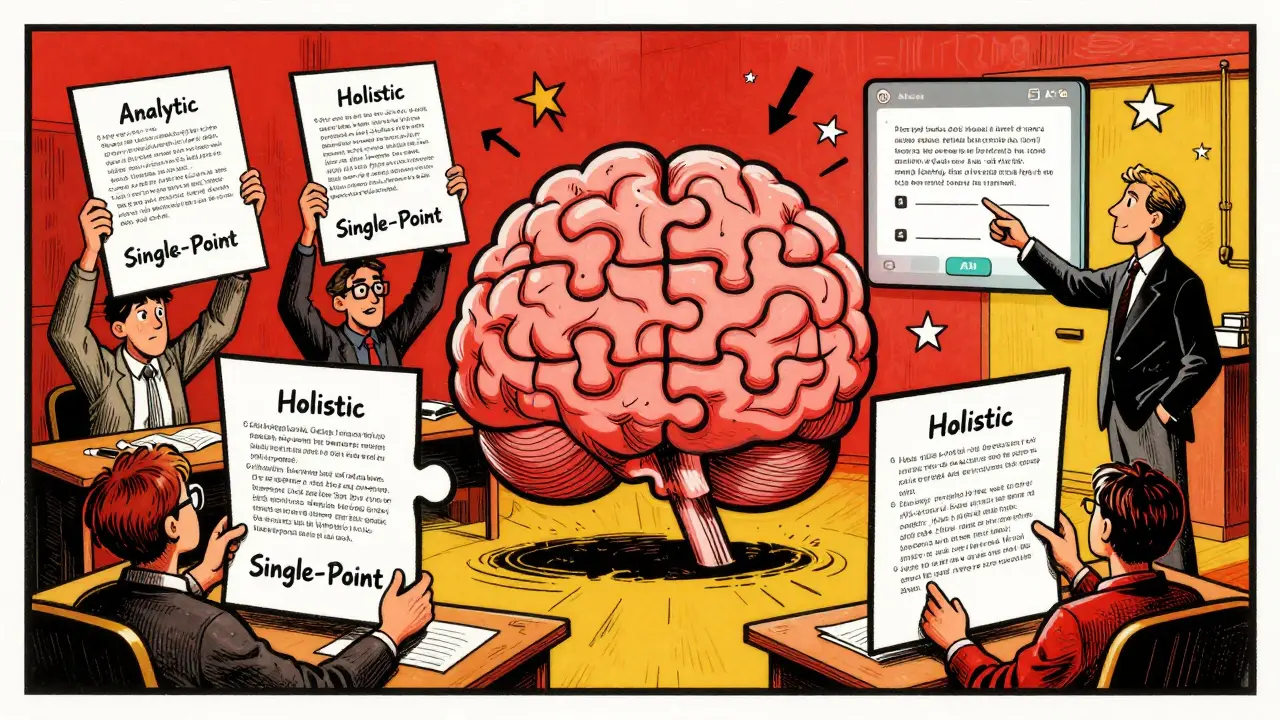
There are three main types of rubrics used for evaluating prompts-and each serves a different purpose.
Analytic Rubrics
Analytic rubrics break down the prompt into separate criteria and score each one independently. For example:
- Focus: 0-5 points
- Context: 0-5 points
- Specificity: 0-5 points
- Tone: 0-5 points
Each level has clear descriptions. A score of 5 for specificity might mean: "Includes exact length, format, audience, examples, and constraints." A score of 2 might say: "Only mentions topic, no details provided."
This type is best for learning. If you’re teaching someone how to write better prompts, analytic rubrics show exactly where they’re falling short. Research shows they improve grading consistency by 32%, but they take longer to use-up to 47% more time than other types.
Holistic Rubrics
Holistic rubrics give one overall score. You look at the whole prompt and decide: "Exemplary," "Proficient," "Developing," or "Beginning." There’s no breakdown.
This works well for quick reviews. If you’re grading 50 prompts in an hour, you don’t have time to score each criterion. Holistic rubrics are fast. But they don’t tell you how to improve. They just say "this is good" or "this isn’t."
Use them for simple, one-off tasks-like checking if a prompt gets a usable summary. Not for teaching or refining skills.
Single-Point Rubrics
Single-point rubrics are the most popular among educators and AI trainers today. They describe only what "proficient" looks like. Everything else is open-ended.
Example:
Proficient: The prompt clearly states the task, provides necessary background, and includes at least three specific constraints (e.g., length, format, audience).
Then, below it, you write feedback like:
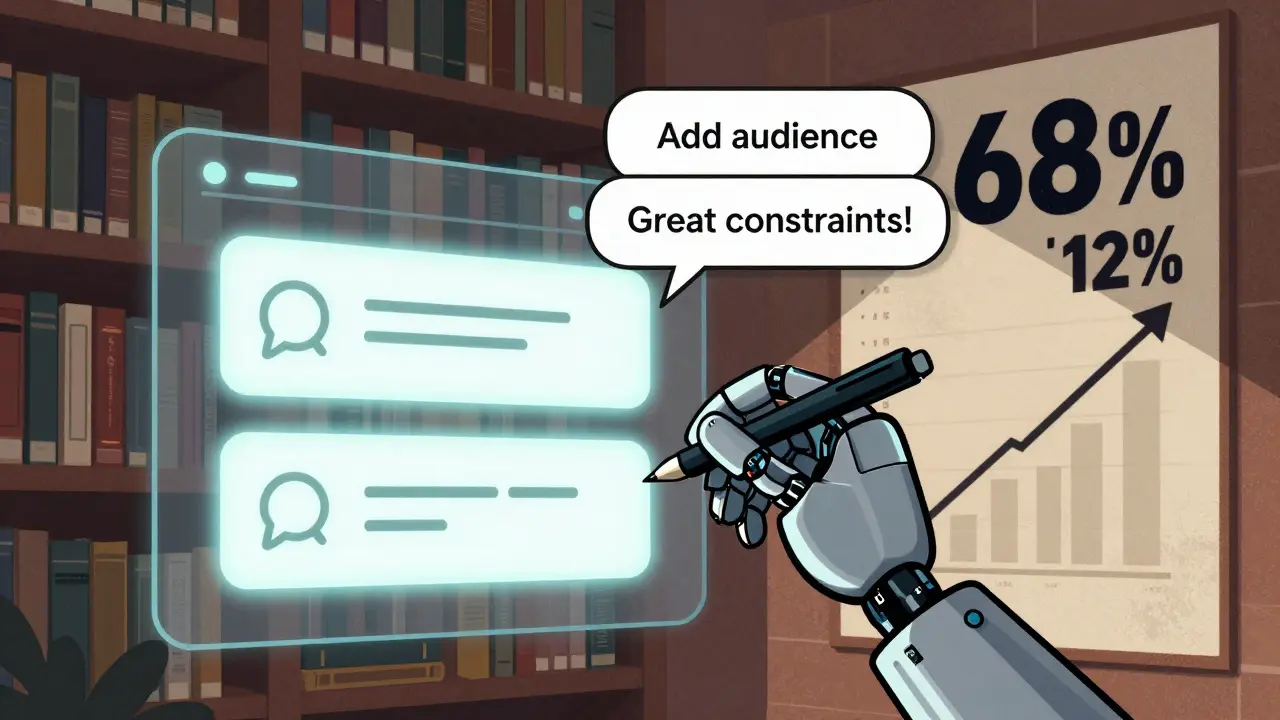
- "You didn’t mention the audience-add that."
- "Great job including the word limit."
- "You gave context, but it’s too broad. Narrow it to one event."
This format reduces bias. It doesn’t force you to pick between arbitrary levels like "Distinguished" and "Exemplary." It focuses on growth. In classroom tests, 78% of students preferred single-point rubrics because they felt understood, not judged.
How to Build Your Own Prompt Rubric
You don’t need to buy software to make a good rubric. Here’s how to build one in six steps:
- Clarify your goal. Are you teaching students? Evaluating customer support prompts? Training your team? Your goal shapes the criteria.
- Choose the right type. Use analytic for learning, holistic for speed, single-point for feedback.
- Select 3-5 criteria max. Too many make it confusing. Stick to Focus, Context, Specificity, and Tone. Add "Bias Mitigation" if you’re dealing with sensitive topics.
- Define performance levels with concrete examples. Don’t say "good context." Say: "Includes background information that explains why the task matters, with at least one real-world example or data point."
- Test it with real prompts. Try your rubric on five prompts: one terrible, one okay, one great. If the scores don’t make sense, revise.
- Calibrate with others. If multiple people will use the rubric, have them score the same three prompts. Compare results. If scores vary wildly, the descriptions aren’t clear enough.
Pro tip: Use AI tools like Appaca AI or RISEPoint to generate a first draft. They cut development time by 65%. But always refine it yourself. AI-generated rubrics often have overlapping criteria or vague language.
Common Mistakes to Avoid
Even experienced users mess up rubrics. Here are the top three errors:
- Using vague words: "Excellent," "poor," "adequate"-these mean nothing. Instead, describe what you see. "The prompt includes three specific constraints" is better than "Very specific."
- Overlapping criteria: If "Specificity" and "Clarity" are both listed, you’re measuring the same thing twice. Combine them. One study found 63% of first drafts had this issue.
- Uneven jumps between levels: If moving from "Developing" to "Proficient" requires adding one detail, but "Proficient" to "Exemplary" requires five, people get frustrated. Keep progression logical.
Also, avoid making your rubric too rigid. AI thrives on creativity. If your rubric only rewards formulaic prompts, you’ll discourage innovation. Allow room for clever, unexpected approaches-even if they don’t fit the mold.
What’s Changing in 2025
The field is moving fast. In 2024, researchers released a system that uses AI to auto-improve rubrics. It analyzes scoring inconsistencies and suggests better criteria-83% as accurately as human experts.
Tools like RISEPoint’s 3Ps framework now integrate with real-time AI feedback. As you type a prompt, the system highlights missing context or vague wording before you even send it.
Adoption is growing too. In 2022, only 12% of U.S. universities used prompt rubrics. By late 2023, that jumped to 68%. K-12 schools are catching up slowly, mostly because teachers need simpler versions for younger students.
By 2026, experts predict most rubric tools will be built into learning platforms-not standalone apps. That means better integration, fewer steps, and more consistent use.
Final Thoughts
A great prompt isn’t magic. It’s design. And like any design, it needs feedback. Rubrics give you that feedback-not as a grade, but as a guide. They turn guesswork into clarity. They help you see what’s working, what’s missing, and how to improve.
You don’t need to be an expert to start. Pick one criterion-say, specificity-and build a two-level rubric: "Includes details" and "Lacks details." Test it on five prompts. See what happens. Then add another criterion. Slowly, you’ll build a system that makes your AI responses better, every time.
The goal isn’t perfection. It’s progress. And with the right rubric, you’ll know exactly how far you’ve come-and where to go next.
What is the best rubric type for beginners learning prompt engineering?
Single-point rubrics are the best for beginners. They show exactly what "proficient" looks like without overwhelming users with multiple levels. Learners get clear feedback on what to improve, not just a score. Studies show 78% of students prefer this format because it feels supportive, not punitive.
Can I use AI to generate prompt rubrics?
Yes, tools like Appaca AI and RISEPoint can generate draft rubrics in seconds. They’re great for saving time-cutting development time by up to 65%. But always review and refine them. AI often creates overlapping criteria or uses vague language like "good" or "clear." Human judgment is still needed to make rubrics accurate and fair.
How many criteria should a prompt rubric have?
Stick to 3-5 criteria. More than that makes the rubric unwieldy and hard to use consistently. Focus on the most important aspects: Focus, Context, Specificity, Tone, and optionally Bias Mitigation. Each should measure something unique-no overlaps.
Why is specificity so important in a prompt?
AI fills gaps with assumptions. If you say "Write a report," it might write a 2,000-word essay when you wanted a 300-word summary. Specificity removes ambiguity. Include details like length, format, audience, tone, examples, and constraints. The more precise you are, the less guesswork the AI has to do-and the better the output.
Do rubrics limit creativity in prompting?
Only if they’re too rigid. Good rubrics set minimum standards for clarity and completeness, but they don’t dictate style. A prompt can be creative and still meet all criteria. The key is to allow for unexpected, innovative approaches as long as they deliver the required outcome. Some of the best AI responses come from prompts that bend the rules-but only when the core requirements are still met.