
Toolformer: How LLMs Learn to Use External Tools via Self-Supervision
Large Language Models (LLMs) are incredibly impressive at writing poetry or summarizing long emails, but they often fail at the simplest things. Ask a massive model to solve a complex math problem or give you the exact current population of a city, and it might confidently give you a wrong answer. This happens because these models are essentially predicting the next word based on patterns, not actually performing calculations or looking up live data. Toolformer is a language model trained in a self-supervised manner to autonomously decide when and how to use external tools through simple APIs. By teaching a model to call a calculator or a search engine, we stop asking it to "guess" the answer and instead teach it to "find" the answer.
The Problem with "Pure" Language Models
There is a strange paradox in AI. A model with 175 billion parameters can debate philosophy but might struggle with a multiplication problem that a tiny, 10-year-old calculator app handles perfectly. This is because LLMs suffer from inherent limitations in factual accuracy and mathematical reasoning. They aren't designed to be databases or calculators; they are designed to be linguists.
Usually, developers try to fix this by using human-annotated datasets-essentially paying people to write thousands of examples of how to use a tool. But that is slow, expensive, and often fails because humans and AI don't always think the same way. What a human thinks is a useful tool call might not actually help the model reduce its prediction error. Toolformer flips this on its head by using self-supervised learning, meaning the model figures out which tools are helpful by seeing if the tool's output actually helps it predict the next tokens in a sentence more accurately.
How Toolformer Actually Works
Toolformer doesn't start from scratch. The researchers took a pretrained GPT-J model with 6.7 billion parameters and taught it a new skill: API interaction. Instead of needing a massive handbook of instructions, the model only needs a few human-written demonstrations for each API to get the idea.
The process follows a clever multi-step loop:
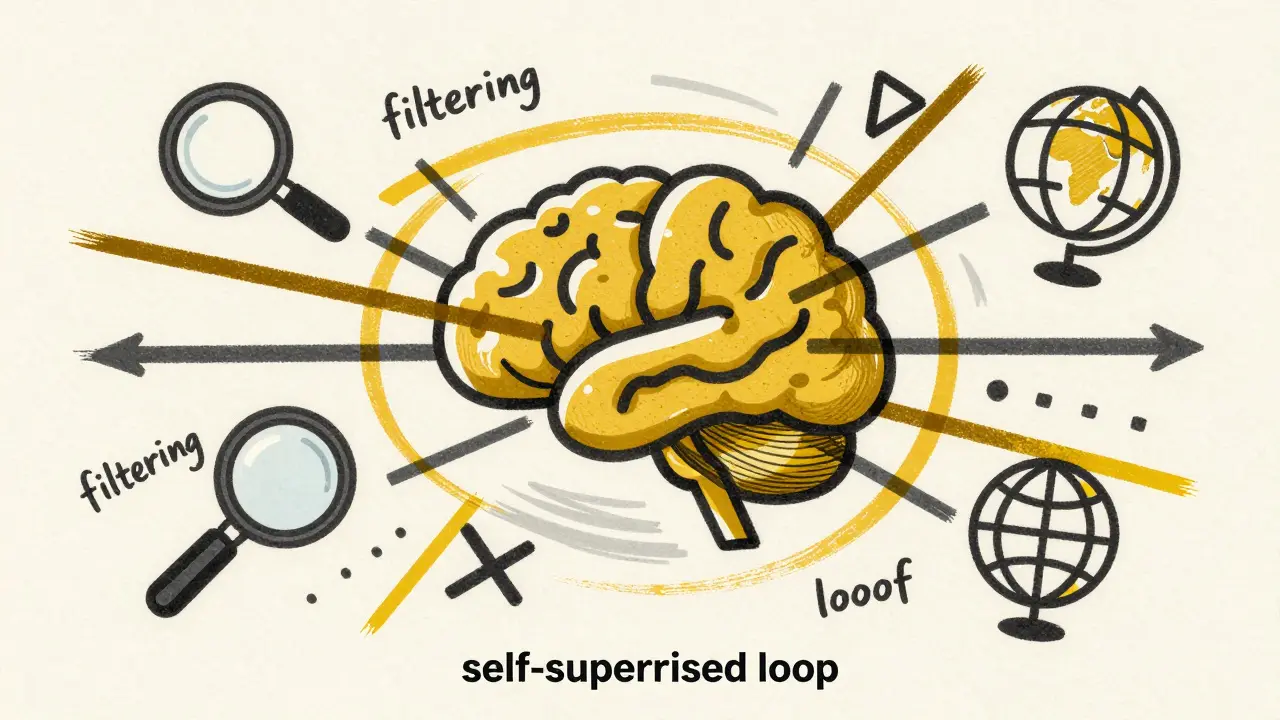
- Sampling: The model looks at a huge dataset of text and "guesses" where an API call might be useful.
- Execution: It actually runs those API calls (like calling a calculator for "15 * 24").
- Filtering: This is the secret sauce. The model checks if the result of the API call helped it predict the following words better. If the API result didn't reduce the loss (the error rate), the call is tossed out as "unhelpful."
- Fine-tuning: The model is then trained on the successful, helpful API calls, reinforcing the behavior of calling the right tool at the right time.
Because the API calls are just text sequences, they slot right into the normal flow of the language model. It doesn't feel like a separate plugin; it feels like the model has a built-in set of skills.
The Toolkit: What Can it Actually Do?
To prove this concept, the Toolformer framework was equipped with five specific tools. These aren't complex software suites, but stateless APIs that provide a direct answer to a specific query. By combining these, the model can handle tasks it previously would have hallucinated.
| Tool Name | Primary Function | Real-world Example |
|---|---|---|
| Calculator | Math operations | Calculating compound interest or square roots |
| Q&A System | Fact retrieval | Finding the capital of a remote province |
| Search Engines | Web/Wikipedia lookup | Verifying a historical date from Wikipedia |
| Translation | Language conversion | Translating a technical term from German to English |
| Calendar | Date and time logic | Determining what day of the week July 4th falls on in 2026 |
Comparing Toolformer to Other Approaches
You might have heard of ReAct, a popular framework that uses "Reasoning and Acting" to solve problems. While ReAct is powerful, it often requires a very specific prompt structure (like "Thought: ... Action: ... Observation: ..."). It's essentially a set of guidelines the model must follow.
Toolformer is different. It doesn't need a rigid chain-of-thought prompt for every single interaction. Instead, the ability to use tools is baked into the model's weights through training. This allows it to be more flexible. In benchmarks, the 6.7B parameter Toolformer often beats the massive 175B parameter GPT-3 in zero-shot performance on tasks requiring external data, proving that intelligence isn't just about model size-it's about having the right tools.

The Limits: Where it Hits a Wall
Nothing is perfect, and Toolformer has a specific Achilles' heel: it only works with "stateless" APIs. A stateless API is one where you send a request and get an answer, and the API doesn't need to remember who you are or what you did five minutes ago. A calculator is stateless; you don't need a "session" to do 2+2.
However, if you want a model to book a hotel room or manage an e-commerce shopping cart, you need "stateful" interactions. This requires Dialog State Tracking, where the system keeps track of the conversation's history to complete a transaction. Toolformer can't do this yet. Its representation of the "state" of a conversation is too blurry to handle the precision required for something like a financial transaction or a complex booking flow.
Why This Matters for the Future of AI
The shift toward self-supervised tool use is a glimpse into how we'll likely interact with AI in a few years. We are moving away from the idea of a single, omniscient model that knows everything and moving toward a "coordinator" model. In this future, the LLM acts as the brain that understands the user's intent and then delegates the actual work to specialized, reliable tools.
Recent developments, like the ASTRO framework, continue this trend by training models to reason like search algorithms. The goal is to create a system that knows exactly when it is unqualified to answer a question and has the humility-and the technical ability-to look it up. This reduces hallucinations and makes AI a dependable partner in professional environments rather than just a creative toy.
What exactly is self-supervision in the context of Toolformer?
In Toolformer, self-supervision means the model teaches itself which tool calls are useful. It doesn't rely on a human to label every correct tool use. Instead, it generates potential API calls, executes them, and then checks if the resulting data helped it predict the next words in the text more accurately. If the loss decreased, the model marks that call as a success and trains on it.
Can Toolformer be used for any API?
Technically, it can be trained on any API as long as the input and output can be represented as text sequences. However, it currently only supports stateless APIs-those that provide a direct answer without needing to track a user's session or history, such as calculators or Wikipedia lookups.
How does Toolformer compare to GPT-3 in terms of size?
Toolformer is significantly smaller. While GPT-3 has 175 billion parameters, the original Toolformer implementation used a GPT-J model with only 6.7 billion parameters. Despite this, it often outperforms the larger model in zero-shot tasks because it can access precise external data via APIs rather than relying on its internal weights.
Does using tools make the model lose its general language abilities?
No, that was a primary goal of the research. The training process is designed so that the model maintains its core language modeling capabilities. It doesn't stop being a language model; it just becomes a language model that knows how to use a calculator.
Why can't Toolformer book a hotel or buy a product?
Booking a hotel requires a "stateful" interaction, meaning the system must remember your dates, room preference, and payment info across multiple steps. Toolformer currently lacks the Dialog State Tracking necessary to handle these multi-step transactions without getting confused.




This is a great breakdown of Toolformer. It's honestly refreshing to see a move away from just scaling up parameter counts and actually focusing on functional utility. Using a smaller model like GPT-J and making it smarter via tools is definitely the way forward for efficiency.
Exactly. Why waste compute on 175B params when a 6B model with a calculator is just better for actual work. It's a no-brainer.
The cognitive dissonance here is staggering. While the proletariat celebrates these "tools," the actual epistemological shift remains unaddressed. We are merely augmenting a stochastic parrot with a lookup table, which is hardly a breakthrough in AGI. The ontological gap between pattern recognition and actual semantic understanding is still yawning wide, regardless of whether the model can call a Wikipedia API to mask its inherent void of true comprehension. It is a superficial layer of utility draped over a void of intelligence, an exercise in algorithmic vanity that fails to address the deeper heuristic failures of transformer architectures. The obsession with "stateless" utility is just a convenient excuse to ignore the catastrophic failure of memory persistence in current LLM paradigms. It's simply quaint that people think a calculator makes a model "think." True intelligence is an emergent property of complex feedback loops, not a series of API calls to a database. This is essentially just a fancy wrapper around a search query. The sheer pretension of calling this "learning" is laughable when it's just weight adjustment based on token prediction error. We are rearranging deck chairs on the Titanic of symbolic AI. The industry's reliance on these shortcuts only highlights the desperation to reach a milestone that is fundamentally unreachable with current hardware. It is a digital facade.
The void! She speaks of the void! Truly, we are all just API calls in the great cosmic simulation, searching for a stateless truth in a stateful universe. We think we are the architects, but we are just the tokens being predicted by a higher power.
The technical exposition is adequate however the phrasing in the second paragraph is slightly imprecise
Don't sweat the small stuff. The big picture here is that we're democratizing intelligence by making smaller models punch way above their weight class. This opens the door for a ton of edge-computing apps where you can't run a massive GPU cluster but still need precise answers.
I'm with you on that. It's kind of like giving a student a textbook instead of forcing them to memorize the whole library. Way more practical for real-world deployment.
It is imperative that we embrace these advancements with utmost vigor. The transition from generative guessing to precise retrieval represents a paradigm shift in computational reliability. I strongly encourage all developers to explore the implementation of stateless APIs to enhance their current workflows immediately.
It seems very helpful for reducing mistakes.
The stateless part is the main bottleneck. If they can solve the state tracking, it's game over for traditional software interfaces.