
Comparative Prompting: How to Ask for Options, Trade-Offs, and Recommendations from AI
Most people use AI like a search engine: ask a question, get an answer. But what if you could turn AI into a decision partner? That’s where comparative prompting comes in. Instead of asking, "What’s the best cloud service?" you ask, "Compare AWS, Azure, and Google Cloud based on cost, scalability, and support response time-and recommend the best option for a startup with a $5,000 monthly budget." The difference isn’t just in wording. It’s in results. Comparative prompting transforms vague, generic outputs into structured, actionable comparisons that actually help you decide.
Why Comparative Prompting Works Better Than Basic Questions
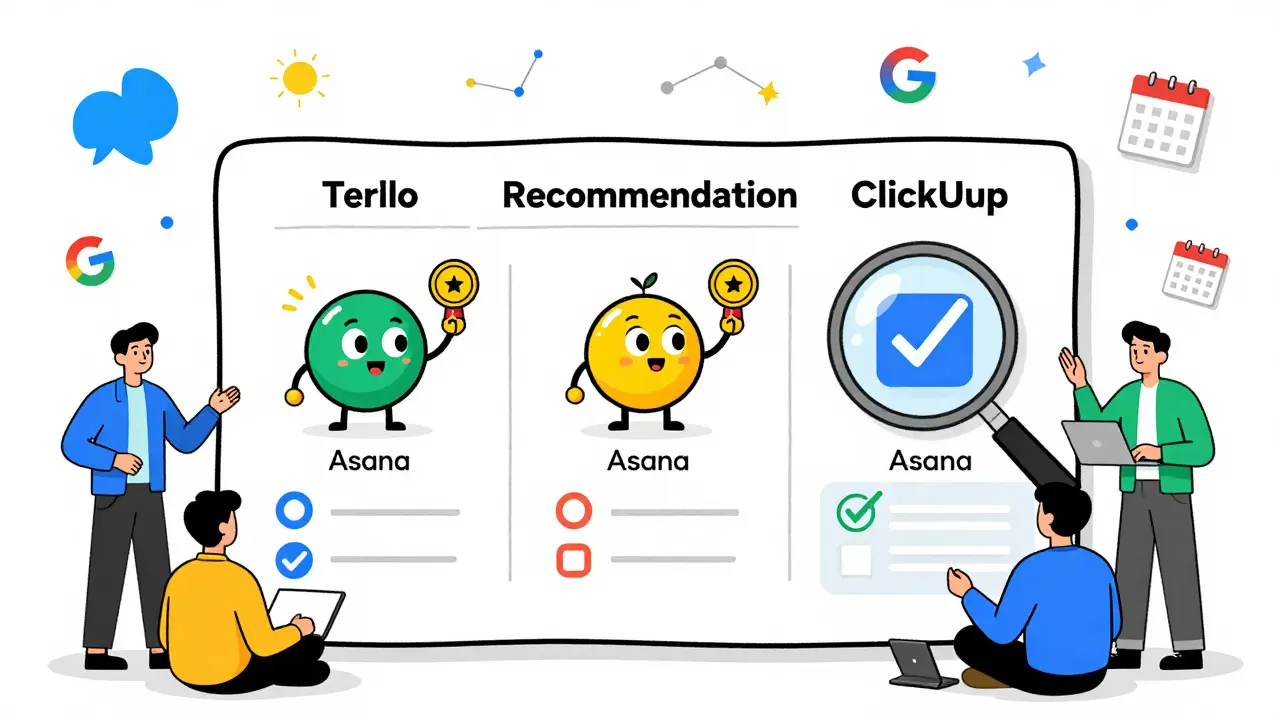
When you ask AI a simple question like "Which laptop should I buy?", you get a list of options, maybe some pros and cons, but rarely a clear path forward. The AI doesn’t know your priorities. Is it battery life? Repairability? Gaming performance? Without context, it guesses-and often guesses wrong. Comparative prompting fixes that by forcing the AI to think like a decision-maker. It requires you to define what matters. Stanford University’s 2023 study found that users who used comparative prompting saw a 73% improvement in decision quality compared to those using open-ended prompts. Why? Because the structure forces clarity. You can’t skip defining criteria. You can’t avoid weighing trade-offs. Take a real example: a small business owner choosing between project management tools. A basic prompt might get: "Trello is easy, Asana is powerful, ClickUp has too many features." A comparative prompt: "Compare Trello, Asana, and ClickUp based on ease of use for non-technical teams, integration with Slack and Google Calendar, and monthly cost for 5 users. Then recommend the best option for a 10-person marketing agency with no IT staff." The output? A table with scores, clear trade-offs, and a recommendation tied to real needs.The Three Essential Parts of a Strong Comparative Prompt
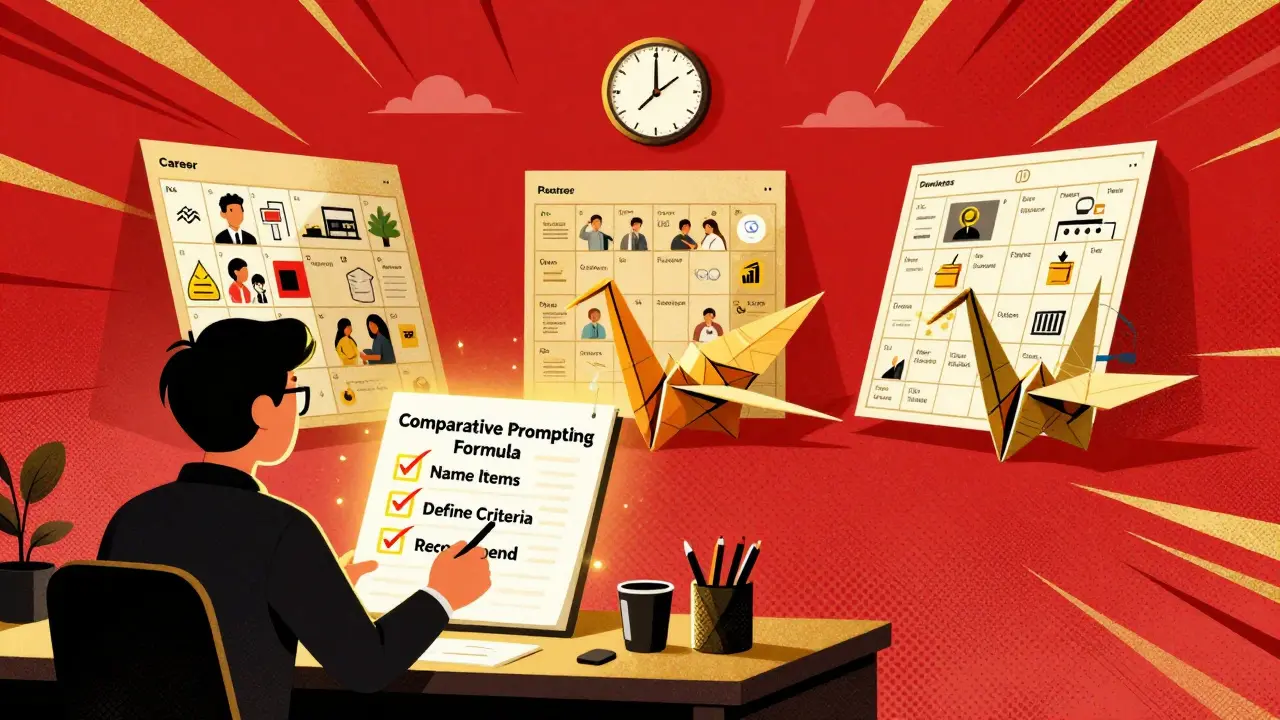
Effective comparative prompting isn’t magic. It’s a formula. According to Vanderbilt University’s Prompt Patterns guide, every strong comparative prompt has three non-negotiable components:- Explicitly name the items to compare-minimum two, ideally three or four. Don’t say "some tools" or "different options." Say "Compare Notion, Obsidian, and Roam Research."
- Define specific, measurable criteria-at least three. Vague criteria like "good usability" fail. Use: "time to set up for a first-time user," "number of integrations available," "monthly cost per user."
- Require a recommendation with reasoning-end with: "Based on this analysis, which option best suits [your specific use case] and why?" This triggers the AI to synthesize, not just list.
When Comparative Prompting Shines (and When It Fails)
This technique isn’t universal. It’s powerful in specific contexts:- Product selection (e.g., choosing between smartphones, software, or services) - 92% effectiveness, per Gartner.
- Technical decisions (e.g., picking a database, cloud provider, or framework) - 87% effectiveness.
- Policy or process changes (e.g., switching from email to Slack for internal comms) - 84% effectiveness.
- You’re comparing more than five options. Success drops from 89% with 2-3 items to 37% with six or more, according to Anthropic’s testing.
- Your criteria are subjective and unmeasurable. "Which is more beautiful?" or "Which feels more trustworthy?"-AI can’t weigh aesthetics or gut feelings reliably.
- You don’t specify the decision context. Without knowing if you’re a student, a startup, or a nonprofit, the recommendation is useless.
How to Avoid Common Mistakes
Even experienced users mess this up. Here are the top three errors-and how to fix them:- Too many vague criteria - "Good performance," "user-friendly," "reliable." These mean nothing. Fix: Add metrics. "Time to load first page under 2 seconds," "average customer support response under 4 hours," "99.9% uptime guarantee."
- No weighting for importance - If cost matters twice as much as ease of use, say so. MIT Sloan’s research shows prompts that include weighting (e.g., "Cost is 50% of the decision, ease of use 30%, support 20%") generate 42% more actionable insights.
- Ignoring bias - AI can amplify stereotypes. If you compare male- and female-led startups without context, it might assume one is "riskier." Always add: "Avoid gender, race, or company size bias in your analysis. Focus only on the specified criteria."
Real-World Examples You Can Steal
Here are three proven templates you can copy-paste and adapt: Template 1: Career Decision "Compare pursuing a master’s in data science, getting a Google Data Analytics Certificate, and self-studying with Coursera and Kaggle, based on: total cost, time to job readiness, average starting salary in the U.S., and job market demand in 2025. Then recommend the best path for a 28-year-old working full-time in marketing with $5,000 to spend and wanting to switch roles within 12 months." Template 2: Tech Stack Choice "Compare React, Vue, and Svelte for building a new e-commerce website, based on: development speed for a team of 2 junior developers, performance on mobile devices, availability of third-party plugins for payment processing, and long-term community support. Then recommend the best option for a startup with a 6-month launch deadline and a $15,000 development budget." Template 3: Personal Purchase "Compare the Apple Watch Series 9, Garmin Venu 3, and Fitbit Sense 2 based on battery life, heart rate accuracy during workouts, sleep tracking depth, and compatibility with iPhone 15. Then recommend the best option for a 45-year-old with high blood pressure who walks 8,000 steps daily and wants to monitor overnight stress levels." These aren’t hypothetical. People are using them right now-with measurable results.What Comes Next: The Future of Comparative Prompting
The field is evolving fast. OpenAI added native comparative analysis to GPT-4 Turbo in November 2023, cutting hallucinations by 29%. Anthropic’s Claude 3 can now auto-weight criteria based on your emphasis. Microsoft is testing a feature that links comparative prompts directly to Excel spreadsheets so outputs become live decision matrices. By 2026, comparative prompting won’t be a "technique"-it’ll be standard practice. Gartner predicts 92% of business AI use cases will rely on structured comparison by then. The companies that win won’t be the ones with the most data-they’ll be the ones asking the best questions. You don’t need to be an engineer to use this. You just need to be clear about what you want-and willing to define what matters. The AI is ready. Are you?What’s the difference between comparative prompting and regular AI prompts?
Regular prompts ask for information or a single answer-like "What’s the best phone?" Comparative prompting asks for a structured analysis of multiple options using defined criteria, followed by a recommendation. It turns AI from a search engine into a decision partner.
Can I use comparative prompting for personal decisions like buying a car or choosing a college?
Absolutely. It works best when you define clear, measurable criteria. For a car: compare cost, fuel efficiency, maintenance costs, safety ratings, and resale value. For college: compare tuition, job placement rates, internship access, campus location, and student debt load. The AI won’t know your feelings-but it can lay out facts you might overlook.
Why does my AI sometimes give me vague comparisons even when I use comparative prompting?
Most likely, your criteria aren’t specific enough. "Good customer service" isn’t measurable. "Average response time under 2 hours" is. Also, check if you’re asking for more than five options. AI performance drops sharply beyond that. And make sure you end with a clear request for a recommendation.
Do I need to know a lot about the topic to use comparative prompting?
You need enough knowledge to define meaningful criteria. You don’t need to be an expert. But if you’re comparing cloud providers and don’t know what "scalability" means, you’ll pick the wrong metrics. Do a quick 10-minute search first. Then let the AI fill in the details.
Is comparative prompting just for businesses?
No. It’s for anyone making a decision with multiple options. Students choosing majors, parents picking schools, freelancers selecting tools, even people deciding between two vacation destinations. Anytime you’re torn between options, comparative prompting helps you cut through the noise.





Stop pretending this is groundbreaking. You’re just repackaging ‘think before you ask’ as AI magic. I’ve been telling people this since 2020. AI doesn’t think-you do. Stop outsourcing your brain.
Wow. Finally someone who gets it. I used this to pick my VPN last week and saved $200/year. The AI didn’t care if I was ‘tech-savvy’-it just crunched the numbers I gave it. No fluff. No ads. Just facts. I’m telling my entire team tomorrow.
Of course this works. You’re basically doing the AI’s job for it. If you can’t define your criteria, you shouldn’t be using AI at all. Also, ‘avoid gender bias’? Cute. The AI doesn’t care about your woke checklist-it just mirrors your prompt. If you feed it garbage, it’ll spit out garbage with citations.
Really appreciate this breakdown. I’ve been using this method for picking software for my nonprofit, and the difference is night and day. One prompt changed how we allocate our budget. I’ve shared the templates with our board-they actually understood the trade-offs for the first time. Thank you for making this accessible.
...And yet... one must ask: is the act of structuring one’s inquiry not, in itself, a form of self-discipline? The AI does not judge, nor does it desire... it merely reflects the architecture of the question. In this way, comparative prompting is less a tool... and more a mirror... a mirror held up to the chaos of our own unexamined desires... and the quiet desperation of our vague inquiries...
...Do we ask for recommendations... or do we beg for permission to stop thinking?
Esteemed author, I commend your meticulous exposition on this vital methodology. In my capacity as a technology advisor in Johannesburg, I have observed that practitioners who adopt this structured approach demonstrate markedly improved decision outcomes. The clarity engendered by explicit criteria is not merely advantageous-it is indispensable in contexts where resources are constrained and stakes are high. May this approach proliferate across all domains of human deliberation.
Ugh. I saw this on Medium. It’s just a fancy way to say ‘be specific.’ Why are people acting like this is new? I’ve been doing this since I was 14 and asking Siri for pizza places. Stop pretending you invented critical thinking.
Look i just typed ‘best laptop’ and got 3 options. i dont have time for this. why do you people make everything so complicated. its just a tool. use it or dont. stop writing essays about it
While the principles articulated herein are both sound and empirically supported, one must not overlook the foundational epistemological shift they represent: the transition from passive information retrieval to active cognitive scaffolding. The user, by imposing structure upon the AI’s output, assumes the role of epistemic architect-not merely consumer. This is not merely prompting; it is the cultivation of intellectual agency. The Vanderbilt checklist, incidentally, is a commendable artifact of applied pragmatism, and I have incorporated it into my graduate seminar curriculum with considerable success.
Actually I tried this and got a recommendation for a cloud service that didn't even exist. AI hallucinated a company called 'AzureCloud Pro' and gave me a pricing table. So yeah, great method... if you like fiction with footnotes.