
Autonomous LLM Agents: Real Capabilities vs. Current Limits (2026 Guide)
Imagine handing a complex project to an AI and walking away. No constant supervision, no step-by-step instructions. Just results. That is the promise of autonomous agents built on large language models that can independently interpret instructions, manage sequential tasks, and adapt through reasoning. It sounds like science fiction, but in 2026, it is becoming reality for early adopters. Yet, if you have tried to deploy these systems, you likely hit a wall. They are impressive, but they are not magic. Understanding where the real power lies-and where the cracks show-is critical before you bet your workflow on them.
The Shift from Chatbots to Doers
For years, we used Large Language Models as sophisticated chatbots. You asked, they answered. But Agentic AI is different. These systems do not just synthesize information; they act. According to IBM’s 2025 analysis, the difference is stark: conventional chatbots lack the agency to "scope out a project and complete it with all the necessary tools they need." Autonomous agents, however, break a job down into discrete steps, select the right tools, and execute without human intervention for each micro-task.
This marks what industry analysts call the "Era of Autonomy" (2025-2026). We have moved past the "Era of Multimodality" (2023-2024), which was all about seeing images and hearing audio. Now, the focus is on action. The core value proposition is simple: enable systems that can act independently and complete work with minimal supervision. If you are still treating your LLM as a text generator, you are leaving significant efficiency on the table.
How These Agents Actually Think
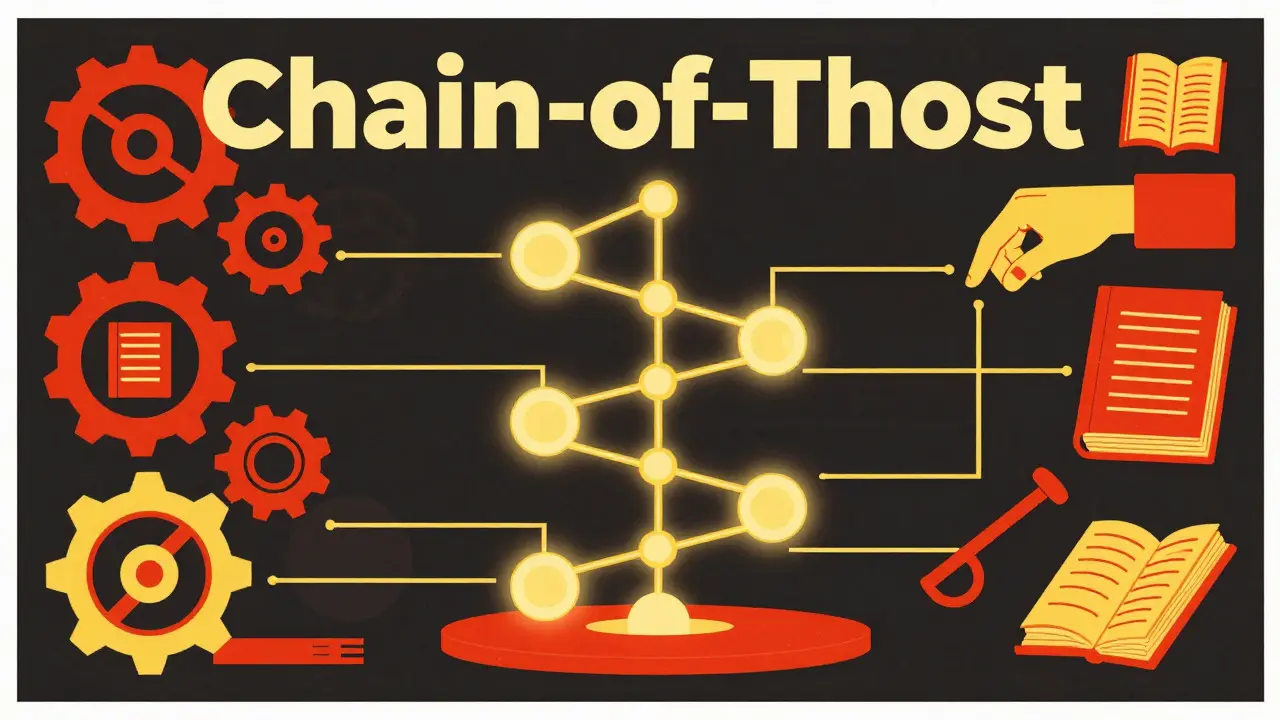
Under the hood, an autonomous agent is not just one big model. It is a stack of cognitive mechanisms. The primary engine is Chain-of-Thought (CoT) training, which forces the model to reason step-by-step rather than guessing the final answer instantly. This is crucial for complex workflows. Without CoT, an agent might jump to a conclusion without checking its logic.
But reasoning alone isn't enough. Agents need memory and context. Modern implementations leverage context windows up to 200,000 tokens, allowing them to hold entire documents or long conversation histories in mind. They also rely heavily on Function Calling, a capability that allows the LLM to interact with external APIs, databases, and software tools. Think of it as giving the AI hands. It doesn't just talk about opening a file; it calls the function to open it.
Architecturally, you will see two main types:
- Single-Agent Systems: One powerful model handles everything. This is the future direction as models get smarter, but currently, it requires massive computational power.
- Multi-Agent Systems: A team of specialized agents works together. Frameworks like MetaGPT and CAMEL use this approach, assigning specific roles (e.g., a "Coder," a "Reviewer") to different instances. They communicate via structured messages to build consensus and handle uncertainty.
Where They Shine: Current Capabilities
So, what can they actually do today? In vertical markets, the results are impressive. Harvey AI, for example, specializes in legal services and has been validated by over 200 companies worldwide. It doesn't just draft contracts; it navigates legal databases, cites precedents, and structures arguments autonomously. Similarly, EXAONE 3.0 achieves 94% accuracy in technical scientific tasks, making it a favorite in research labs.
For general business operations, multimodal capabilities are a game-changer. Advanced agents now use Large Multimodal Models (LMMs) to process text, images, and audio simultaneously. An agent can look at a screenshot of a dashboard, read the data, identify a trend, and then write a report explaining why sales dropped in Q1. This flexibility expands the kinds of data an agent can interpret and produce, moving beyond simple text processing.
Open-source options are also closing the gap. LLaMA 3.3 reaches 83.6% on the MMLU benchmark, compared to 87.2% for GPT-4o. With Hugging Face reporting over 500 million monthly downloads of open-source models, the barrier to entry has lowered significantly. You don't need a proprietary deal to build a decent agent anymore.
| Entity | Type | Key Strength | Benchmark/Metric |
|---|---|---|---|
| GPT-4o | Proprietary LLM | General reasoning & tool integration | 87.2% MMLU |
| LLaMA 3.3 | Open-Source LLM | Cost-effective deployment | 83.6% MMLU |
| MetaGPT | Multi-Agent Framework | Structured role assignment | Consensus building |
| Harvey AI | Vertical Specialist | Legal domain expertise | 200+ enterprise clients |
The Hard Truths: Where They Fail
Let's be honest. Despite the hype, most agentic AI applications are still immature. AWS Insights reported that as of Q1 2025, most implementations remained at Level 1 and 2 maturity, with only a few exploring Level 3. What does that mean in practice? It means reliability is still a struggle.
The biggest issue is Verifiable Reasoning. LLMs are notorious for being confident even when they are wrong. They hallucinate facts, misinterpret subtle constraints, or get stuck in loops. MIT researchers Park and Greenewald developed calibration methods to address this, enabling models to generate a range of probability scores rather than a single, potentially false, certainty value. Until this becomes standard, you cannot fully trust an agent with high-stakes decisions without a human check.
Another major limit is computational cost. Running a multi-agent system with large context windows is expensive. MIT’s recent research on "adaptive reasoning" offers a solution, showing that LLMs can use as little as half the computation of existing methods while maintaining comparable accuracy. This is vital because inference costs have become a major bottleneck for providers. If your agent runs for ten minutes on a simple task, your ROI disappears.
Finally, edge cases remain a nightmare. As IBM researcher Gajjar notes, "building AI agents that can autonomously handle complex decision-making will take more than just better algorithms. We'll need big leaps in contextual reasoning and testing for edge cases." If your workflow involves rare scenarios, current agents will likely fail silently.

Implementation Strategy: Getting Started Right
If you want to deploy autonomous agents, don't try to automate your entire company overnight. Start small. Deloitte suggests that incremental increases in accuracy and independence help companies reach early productivity goals. Here is a practical path forward:
- Pick a Vertical: Choose a domain where data is structured and errors are manageable. Legal drafting, code review, or data summarization are good starting points. Avoid high-risk financial transactions initially.
- Choose Your Stack: Decide between proprietary (GPT-4o, Claude) for maximum performance and open-source (LLaMA 3.3, Mistral) for cost control and privacy. If you need deep integration, consider frameworks like AutoAct or ProAgent for their explicit role assignments.
- Implement Guardrails: Use function calling restrictions to limit what tools the agent can access. Add human-in-the-loop checkpoints for critical actions. Don't let the agent delete production databases.
- Monitor Reasoning: Log every chain-of-thought step. When an agent fails, you need to know *why* it made a bad decision. This data is gold for fine-tuning.
What Comes Next?
The trajectory is clear. We are moving from orchestrated workflows, where a big model directs smaller ones, toward single-agent systems that are inherently smarter. IBM’s Hay predicts this shift will happen as individual agents become more capable. Meanwhile, trends like sophisticated personalization and multi-LLM collaboration will define the next phase. The goal isn't just automation; it's augmentation. By combining LLMs with computer vision and transcription, agents will become more flexible and capable of handling diverse business functions. The technology is nascent, but the direction is undeniable. Start experimenting now, keep your expectations realistic, and watch how quickly the gap between "chatbot" and "colleague" closes.
What is the difference between a chatbot and an autonomous agent?
A chatbot responds to prompts based on patterns. An autonomous agent interprets a high-level goal, breaks it down into steps, selects tools, executes actions, and adapts to outcomes without needing a new prompt for every step.
Are open-source LLMs good enough for autonomous agents?
Yes, for many tasks. Models like LLaMA 3.3 perform close to proprietary leaders on benchmarks. Open-source models offer lower costs and greater control, making them ideal for enterprises concerned about data privacy or budget constraints.
Why do LLM agents fail on edge cases?
LLMs are trained on vast datasets but lack true understanding of rare scenarios. They often extrapolate incorrectly when faced with inputs outside their training distribution. Better calibration and verifiable reasoning techniques are needed to mitigate this.
What is the role of function calling in agentic AI?
Function calling allows the LLM to interact with external systems like APIs, databases, and software tools. It transforms the model from a passive text generator into an active executor that can change the state of the world.
How much does it cost to run an autonomous agent?
Costs vary widely depending on the model size and complexity of the task. Proprietary models charge per token, which can add up quickly for long-running agents. Open-source models reduce API fees but require infrastructure costs. Adaptive reasoning techniques can cut computational costs by up to 50%.