Stochastic Depth and Regularization in Deep Transformer LLMs: A Practical Guide
Training a Deep Transformer is like trying to teach a student who forgets everything after three chapters. As you add more layers, the model becomes harder to optimize and prone to memorizing noise instead of learning patterns. This is where Stochastic Depth comes in. It’s a technique that randomly skips entire blocks of the network during training, forcing the model to learn robust representations that don’t rely on any single layer. For Large Language Models (LLMs), this isn’t just a trick; it’s a critical tool for balancing performance, efficiency, and generalization.
What Stochastic Depth Actually Does
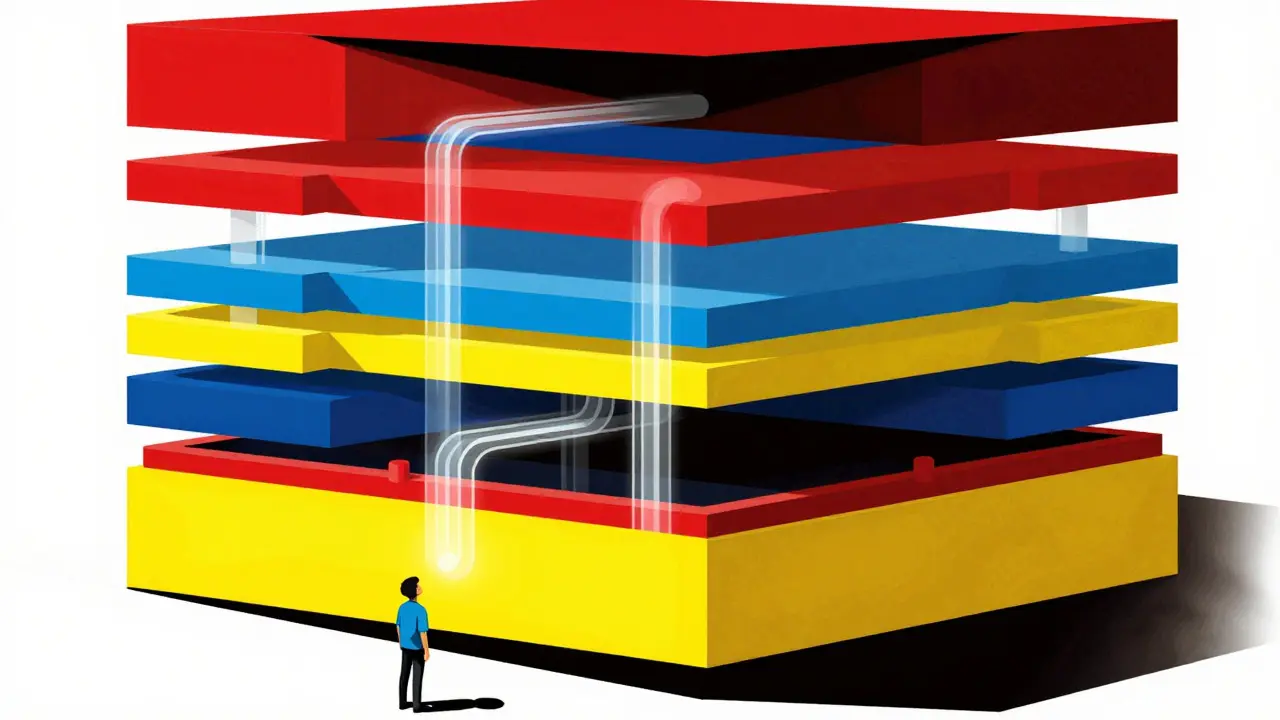
Stochastic Depth is a regularization method that randomly deactivates transformer blocks during the forward pass of training. Imagine you have a 100-layer transformer. In a standard setup, every layer processes the data. With stochastic depth, you might randomly skip layer 50, then layer 73, then layer 12 in different training steps. The remaining layers have to carry the load. This forces the network to distribute information processing across many paths rather than relying on specific deep pathways.
The key benefit? It reduces overfitting and makes training deeper models feasible. Without it, very deep transformers often suffer from vanishing gradients or optimization instability. By dropping layers, you effectively create an ensemble of many sub-networks within a single model. Each step trains a slightly different architecture, leading to a final model that is more robust to variations in input data.
The Theory Behind the Magic: Neural Collapse
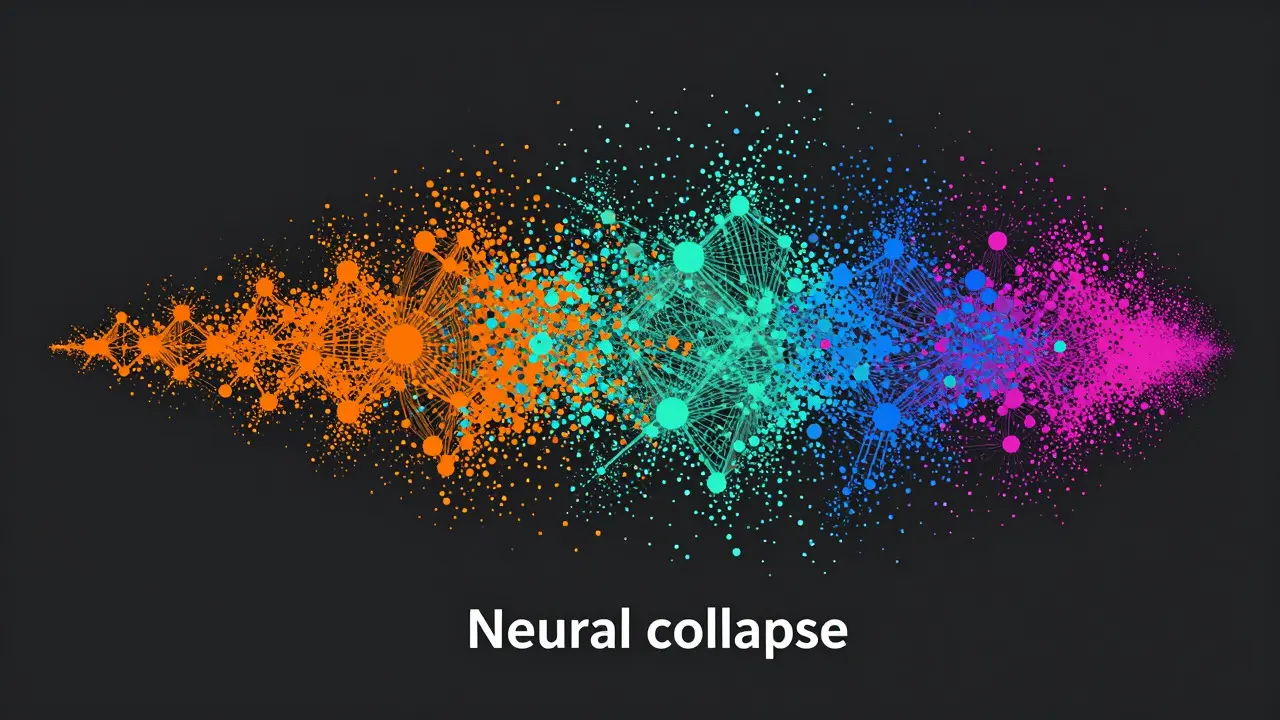
Why does skipping layers work so well? Recent research points to a phenomenon called Neural Collapse. When you train deep regularized networks with constant regularization strength, the features tend to collapse into tight clusters around their class means as the number of blocks approaches infinity. In simple terms, the model learns to represent data in a way that is geometrically stable and optimal for classification tasks.
This theoretical insight explains why stochastic depth guides networks toward better solutions. It doesn’t just reduce complexity; it steers the optimization process toward these naturally stable, collapsed representations. Experiments on vision transformers confirm that the amount of neural collapse increases with architecture depth when regularization is applied. This suggests that the benefits of stochastic depth are not accidental but are rooted in the fundamental mathematics of deep learning optimization.
Calibrating Drop Probabilities: The Critical Step
Implementing stochastic depth isn’t just about turning it on. You need to get the drop schedule right. The most common approach is a linear ramp-up, where the probability of dropping a layer increases with its depth. Early layers are kept almost always because they handle basic feature extraction. Deeper layers are dropped more frequently because they contain more redundant information.
Here is a practical heuristic:
- Shallow Layers (1-10%): Drop probability near 0. These layers are essential for foundational representations.
- Middle Layers (10-80%): Linear increase in drop probability. This is where the bulk of the regularization effect happens.
- Deep Layers (80-100%): High drop probability, often up to 0.5 or higher. These layers are the most expendable.
If you set the drop rate too low, you miss out on the regularization benefits. If you set it too high, you damage the model’s capacity and slow down convergence. Empirical validation on your specific dataset is crucial. Start with a conservative ramp and monitor both training loss and validation accuracy. If validation accuracy plateaus early while training loss continues to drop, you might be under-regularizing. If both losses spike, you might be over-regularizing.
Combining Stochastic Depth with Other Techniques
Stochastic depth works best as part of a hybrid strategy. It operates at the architectural block level, while other techniques like dropout, weight decay, and batch normalization operate at finer granularities. Combining them creates complementary benefits. Dropout prevents individual neurons from co-adapting, while stochastic depth prevents entire blocks from becoming bottlenecks. Weight decay controls the magnitude of weights, ensuring the model doesn’t become overly complex.
One emerging area is attention-level regularization. Techniques like AttentionDrop encourage diversity and stability in attention maps. This addresses a different kind of overfitting: pathological specialization where the model relies too heavily on particular attention pathways. By combining stochastic depth with attention regularization, you tackle overfitting from multiple angles-structural, activation-based, and attention-based.
Efficiency Gains and Model Compression
One of the most practical advantages of stochastic depth is computational efficiency. During training, dropped layers require no forward or backward pass computation. This can significantly reduce training time for very deep models. But the benefits extend beyond training. Insights gained from stochastic depth training can inform model compression strategies.
For example, if certain layers are consistently dropped without hurting performance, they might be candidates for permanent removal. Methods like ReplaceMe use learned linear operations to replace pruned blocks, preserving model performance without introducing additional parameters. This two-stage process-first identifying important layers through stochastic depth training, then permanently removing redundant ones-achieves aggressive compression ratios while maintaining accuracy. It’s a powerful tool for deploying LLMs on resource-constrained devices.

Practical Implementation Tips
When implementing stochastic depth in your LLM training pipeline, keep these tips in mind:
- Start Simple: Use a linear ramp-up schedule. Avoid complex adaptive schedules until you have a baseline.
- Monitor Convergence: Expect slower convergence initially. The effective gradient is computed on subsets of the network, so you may need longer training periods to reach equivalent performance.
- Watch Attention Patterns: In early training phases, extreme stochastic depth can interfere with attention pattern learning. Ramp up the drop probability gradually rather than starting at full strength.
- Combine with Weight Decay: Use standard weight decay alongside stochastic depth. They address different aspects of overfitting and work synergistically.
- Validate on Downstream Tasks: Don’t just look at perplexity. Evaluate on specific downstream tasks to ensure the model generalizes well.
Common Pitfalls to Avoid
Even with a solid understanding, you can still trip up. One common mistake is applying stochastic depth to specialized layers without consideration. Attention mechanisms have specific functional requirements, and dropping them randomly can disrupt the flow of information. Be cautious with layers that perform critical routing or gating functions. Another pitfall is ignoring the interaction with other hyperparameters. Changing the drop rate can affect the optimal learning rate and batch size. Re-tune these parameters when you introduce stochastic depth. Finally, don’t assume one-size-fits-all. The optimal drop schedule varies by task, dataset, and model architecture. Always validate empirically.
Future Directions
Research is moving toward adaptive stochastic depth, where layers are dropped conditionally based on input difficulty or task requirements. This promises to maintain or improve performance while reducing computational demands further. Understanding how stochastic depth affects scaling laws-how model size, training compute, and final performance relate-is also an active area. Early evidence suggests that stochastic depth training enables better generalization at fixed model sizes, effectively shifting scaling law curves favorably. As LLMs continue to grow in scale, these insights will become increasingly important for efficient training and deployment.
What is the typical drop probability for stochastic depth?
There is no single fixed value, but a common practice is to use a linear ramp-up from 0 at the first layer to a maximum value (often 0.2 to 0.5) at the last layer. The exact maximum depends on the model depth and task complexity.
Does stochastic depth work for all types of transformers?
It works well for standard encoder-decoder and decoder-only architectures used in LLMs. However, care is needed with specialized layers like attention mechanisms or gating units, where random dropping might disrupt critical information flow.
How does stochastic depth compare to dropout?
Dropout operates at the neuron level, preventing individual units from co-adapting. Stochastic depth operates at the block level, preventing entire layers from becoming bottlenecks. They are complementary and often used together for stronger regularization.
Will stochastic depth slow down my training?
Initially, yes, because convergence is slower due to the varying network structure. However, the reduced computational cost per step (due to skipped layers) can offset this, especially for very deep models. The net effect is often a faster overall training process for large-scale models.
Can I use stochastic depth for inference?
Typically, no. Stochastic depth is a training-time technique. At inference, you usually run the full model without dropping layers. However, insights from stochastic depth training can guide pruning decisions for creating smaller, faster inference models.








Really appreciate the clear breakdown here. The distinction between neuron-level dropout and block-level stochastic depth is something I’ve struggled to articulate in my own notes for a while now.
You’re doing it wrong, obviously. Because if you read the paper properly, you’d know that the linear ramp-up is just a crutch for people who don’t understand the underlying math! It’s not about the schedule; it’s about the geometry of the loss landscape. Most practitioners treat this like a magic trick instead of a rigorous optimization problem. You need to respect the process, or else you’ll end up with a model that looks good on validation but collapses under real-world pressure. Don’t let the simplicity fool you into thinking it’s easy. It’s actually quite delicate work, and most blogs oversimplify it to death. So, yes, use the heuristic, but keep your eyes open for the subtle failure modes that won’t show up in your first ten epochs. That’s where the real learning happens, not in the config file.
This article misses the point entirely. The only reason stochastic depth works is because we are all too lazy to tune our hyperparameters manually. It’s a band-aid for bad engineering. If your architecture is sound, you shouldn’t need to randomly delete layers just to get a stable gradient. This technique is a symptom of the industry’s inability to build robust models from the ground up. We are patching over cracks in the foundation rather than fixing the structure itself. And don’t get me started on the 'efficiency' claims. Skipping layers during training saves compute, sure, but the complexity of managing these schedules adds overhead that few people account for. It’s a trade-off that favors convenience over correctness. Until we have a theoretical proof that this doesn’t distort the representation space in harmful ways, it should be treated with extreme skepticism. The field moves too fast and cares too little about why things work, only that they do.
Good reminder to monitor attention patterns early on. I’ve seen cases where high drop rates in the first few blocks really messed up the initial feature extraction, leading to a very slow start. Gradual ramp-up definitely helps.
Oh, look at us, pretending this is science! It’s just another way for Big Tech to offload their computational costs onto us, the poor users who have to wait longer for inference because they trained on garbage data! They tell you it’s for 'generalization,' but really, it’s just to make their models cheaper to run so they can sell more API calls! Have you noticed how every new technique comes out right when GPU prices spike? Coincidence? I think not! The neural collapse theory is just a fancy word for 'the model gives up halfway through.' They want you to believe that skipping layers is smart, but it’s really just a way to hide the fact that deep networks are fundamentally broken! Wake up, sheeple! The next step is they’ll start dropping tokens during inference, and then we’ll all be typing gibberish into our phones and calling it progress!
Wait, hold on. Let’s flip this around for a second. What if the entire premise of 'regularization' is just a coping mechanism for our lack of understanding of high-dimensional spaces? We drop layers because we’re scared of the vanishing gradients, but what if the gradients *should* vanish? Maybe the instability is a feature, not a bug. By forcing stability, aren’t we just creating brittle models that fail catastrophically when the distribution shifts? I’ve seen plenty of 'robust' models fall apart on edge cases precisely because they were over-regularized. So maybe stochastic depth isn’t helping us learn better representations; maybe it’s just making them smoother and less expressive. We’re trading peak performance for safety, and in a world where we need maximum capability, that’s a terrible trade. Who decided that stability was the goal anyway? Probably the same people who wrote this guide. Convenient narrative, isn’t it?
Fair points. I've found that combining it with weight decay is pretty standard now, but the interaction with learning rate is still tricky to nail down without a lot of trial and error.