Context Windows in LLMs: Limits, Trade-Offs, and Best Practices for 2026
You’ve probably hit the wall. You’re feeding a massive codebase or a 500-page legal contract into your favorite Large Language Model (LLM), expecting it to synthesize everything perfectly. Instead, you get a truncated response, a hallucination, or an error message about exceeding maximum tokens. This isn’t just bad luck; it’s the hard limit of the model’s context window (the maximum amount of text data, measured in tokens, that a model can process in a single prompt).
In 2026, context windows are no longer a niche technical spec. They are the primary bottleneck between raw AI capability and practical enterprise application. We’ve moved past the era where 4,096 tokens was considered 'long.' Today, models like Claude 3.7 Sonnet (Anthropic's model supporting up to 200,000 tokens) and Gemini 1.5 Pro (Google's model with experimental support for 1,000,000 tokens) boast capacities that dwarf their predecessors. But bigger isn’t always better. As we push toward million-token contexts, we run into severe trade-offs regarding cost, speed, and-most critically-comprehension quality.
This guide cuts through the marketing hype. We’ll look at what context windows actually are, why they fail when pushed too far, and how to structure your prompts and architectures to get reliable results without burning through your compute budget.
Understanding Context Windows and Tokens
To manage context effectively, you first need to understand what you’re measuring. A context window is not measured in words or characters. It is measured in tokens (discrete units of text used by LLMs, which can be whole words, word fragments, or individual characters). Tokenization schemes vary by model architecture. For example, the word 'email' might be one token, while 'mail' could be another, and complex words might split into multiple fragments.
The context window encompasses both the input you send (the prompt) and the output the model generates. If a model has a 128,000-token window, and you send 120,000 tokens of input, you only have 8,000 tokens left for the answer. Once that limit is hit, the model stops generating. If you exceed the limit entirely, the model must truncate earlier content. Most modern systems use techniques like sliding windows or automatic summarization to handle this overflow, but these methods introduce their own risks of losing critical information.
Think of the context window as short-term memory. McKinsey analysts described it in April 2024 as the mechanism that determines how much information an LLM can 'look at' simultaneously. Unlike human memory, which fades gradually, LLM context is rigid. If a key fact falls outside the window or gets diluted by noise, the model simply cannot access it reliably.
The Current Landscape: Model Capabilities in 2026
The race for longer context windows has accelerated dramatically. Here is how the major players stack up as of mid-2026:
| Model | Max Context Window | Key Strength | Notable Limitation |
|---|---|---|---|
| Claude 3.7 Sonnet | 200,000 tokens | High accuracy in document summarization (>100k tokens) | Response quality drops 8.3% beyond 100k tokens due to attention dilution |
| GPT-4 Turbo | 128,000 tokens | Strong general-purpose reasoning and coding | Larger degradation in multi-document reasoning vs. Claude |
| Gemini 1.5 Pro | 1,000,000 tokens (experimental) | Unmatched capacity for massive datasets | Higher hallucination rates in very long contracts/documents |
| Llama 3 70B | 8,192 tokens | Efficient local deployment | 34.2% degradation in multi-document tasks compared to long-context models |
While Gemini’s million-token window sounds impressive, real-world testing reveals cracks. A May 2025 Capterra review from a legal professional noted that Gemini occasionally hallucinates details in contracts exceeding 500 pages despite its vast capacity. Meanwhile, Anthropic’s Claude 3.7 Sonnet outperforms GPT-4 Turbo in document summarization tasks exceeding 100,000 tokens by nearly 20%, according to Stanford’s CRFM Benchmark. However, even Claude suffers from 'attention dilution,' where the model’s focus spreads too thin across excessive tokens, causing subtle errors in reasoning.

The Hidden Costs: Performance and Price Trade-Offs
Longer context windows come with steep penalties. The most immediate impact is on inference time and hardware requirements. Processing 200,000 tokens requires approximately 3.2GB of VRAM on NVIDIA A100 GPUs, resulting in inference times of 18-22 seconds per 1,000 tokens. Compare that to models with 8,000-token windows, which complete similar chunks in 2-3 seconds. This latency makes real-time interaction difficult for extremely long contexts.
Cost is another major factor. Inference costs increase by roughly 47% per token processed in long-context scenarios compared to standard windows. Why? Because the computational complexity of transformer attention mechanisms scales quadratically with sequence length. As NVIDIA Chief Scientist Bill Dally warned at GTC 2025, 'scaling context windows linearly increases computational complexity quadratically.' This means doubling the context doesn’t just double the work; it quadruples it.
Furthermore, quality degrades as context grows. Anthropic’s internal testing in Q1 2025 showed that response quality for 200,000-token contexts drops by an average of 8.3% compared to 100,000-token contexts. Microsoft Research found that coherence degrades beyond 150,000 tokens in 63% of conversational threads. The model begins to lose track of earlier instructions or facts, leading to inconsistent outputs.
Best Practices for Managing Context Windows
Given these limitations, throwing more data at the model is rarely the solution. Strategic management of context is essential for reliable performance. Here are proven techniques used by top developers in 2026:
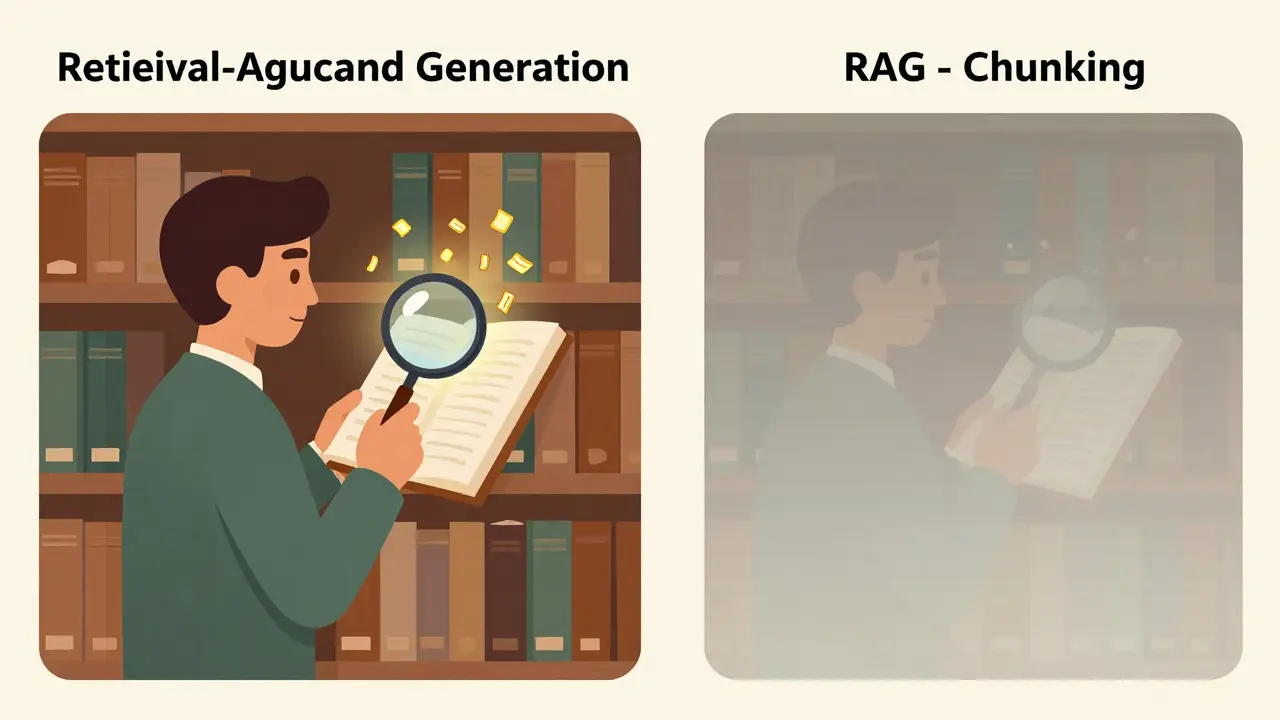
- Chunking with Overlap: When processing large documents, break them into smaller chunks. A common heuristic is to chunk documents at 75% of the model’s maximum context capacity, with a 10% overlap between chunks. This ensures that information near the boundaries isn’t lost. LangChain users report optimal results using this method, maintaining coherence across extended analyses.
- Retrieval-Augmented Generation (RAG): Instead of loading entire datasets into the context window, use RAG to retrieve only the most relevant snippets. This keeps the context small and focused. Combine this with semantic search to ensure high relevance. Swimm.io’s 2025 survey found that 87% of contributors recommend RAG over pure context expansion for enterprise applications.
- Automatic Summarization: Implement a two-step process. First, ask the model to summarize long sections of text. Then, feed those summaries into the final analysis prompt. This reduces token count significantly while preserving key insights. Developers who implemented automatic summarization when exceeding 80% capacity saw a 31% reduction in coherence errors.
- Prompt Pruning: Remove unnecessary filler words, redundant instructions, and verbose examples from your system prompts. Every token counts. Include the context window size in your system prompts to remind yourself of the limits. Always place the most critical instructions at the beginning or end of the prompt, as models tend to pay more attention to these areas.
- Dynamic Context Allocation: Leverage new features like Anthropic’s 'Dynamic Context Allocation,' introduced in May 2025. This feature prioritizes relevant segments within the context window, improving response quality by 14.2% in enterprise testing. If your provider offers such tools, enable them immediately.
Common Pitfalls and How to Avoid Them
Even experienced developers make mistakes with context windows. One of the most frequent issues is token miscalculation. Many assume one token equals one word, which is incorrect. Complex languages or code can result in higher token-to-word ratios. Always use a tokenizer tool specific to the model you’re using to estimate token counts accurately. Stack Overflow data shows that 43% of questions tagged 'LLM-context' stem from miscalculating token usage.
Another pitfall is ignoring the 'needle in a haystack' problem. While some models claim to find specific facts in massive contexts, retrieval accuracy drops sharply as noise increases. Don’t rely on the model to sift through irrelevant data. Pre-filter your inputs. If you’re analyzing financial reports, strip out boilerplate text before sending the data to the LLM.
Finally, avoid mixing disparate types of data in a single context window unless necessary. Combining code, natural language, and structured data (like JSON) can confuse the model’s attention mechanisms. Keep contexts homogeneous whenever possible. For example, separate code analysis from documentation review.
Future Outlook: Where Are We Headed?
The trajectory for context windows is clear: they will continue to grow. McKinsey predicts that commercial models will reach 1 million tokens by 2027. However, hardware constraints may cap practical implementations at 500,000 tokens before 2030 without fundamental architectural changes. NVIDIA research suggests that current GPU architectures struggle with the memory bandwidth required for larger contexts.
Architectural innovations are emerging to address these limits. Meta’s Llama 3.1 roadmap targets 32,000-token windows with 40% faster inference through optimized KV caching. Techniques like Sliding Window Attention, which maintains 97.3% coherence for documents exceeding 150,000 tokens, are becoming standard. These advancements aim to reduce the quadratic cost scaling that currently plagues long-context processing.
Regulatory considerations are also evolving. The EU AI Office’s May 2025 guidance requires disclosure of context window sizes for high-risk applications under the AI Act. This affects 22% of current enterprise deployments, pushing companies to document and justify their context management strategies. Transparency around context limits is no longer optional-it’s a compliance requirement.
What is the difference between context window and memory in LLMs?
A context window is the fixed amount of text an LLM can process in a single request, acting as temporary working memory. It does not persist between sessions unless explicitly saved by the application. True 'memory' implies long-term storage and recall, which standard LLMs lack without external databases or vector stores.
Why does response quality drop with larger context windows?
As context grows, the model's attention mechanism spreads thinly across all tokens, leading to 'attention dilution.' Important details get lost in the noise, and the model struggles to maintain coherent reasoning across distant parts of the text. This results in lower accuracy and higher hallucination rates.
How many tokens are in a typical page of text?
A standard page of text contains approximately 300-400 words, which translates to roughly 400-500 tokens depending on the tokenizer. Therefore, a 128,000-token context window can hold about 250-300 pages of text. However, code and technical documents often use more tokens per character, reducing this capacity.
Is Retrieval-Augmented Generation (RAG) better than long context windows?
For most enterprise applications, yes. RAG allows you to keep the context window small and focused, improving speed, cost-efficiency, and accuracy. Long context windows are useful for holistic analysis of entire documents, but RAG is superior for precise question-answering and reducing hallucinations.
What happens if I exceed the context window limit?
Most APIs will return an error if you exceed the hard limit. Some models automatically truncate the earliest parts of the context using sliding windows or summarization. This can lead to loss of critical information, so it’s best to manage token counts proactively rather than relying on automatic truncation.