
Documentation Standards for Prompts, Templates, and LLM Playbooks: A Governance Guide
Stop treating your AI prompts like throwaway notes. If you are scaling artificial intelligence in your business right now, those casual instructions you type into a chat window are becoming liabilities. They cause inconsistent outputs, hidden errors, and compliance headaches. The industry has shifted from experimenting with AI to governing it, and the backbone of that shift is rigorous documentation standards for prompts. This isn't about bureaucracy; it is about turning chaotic AI interactions into reliable, repeatable business processes.
In 2024, we saw a massive jump in enterprise adoption. Fortune 500 companies moved from 18% adoption of formal prompt management in early 2023 to nearly 70% by late 2024. Why? Because undocumented prompts are failing businesses. DataGrail’s study of over 2,000 use cases showed that documented prompts cut revision cycles by 62%. When you don’t document how an AI should behave, you aren’t saving time-you’re just paying for errors later.
The Core Components of Effective Prompt Documentation
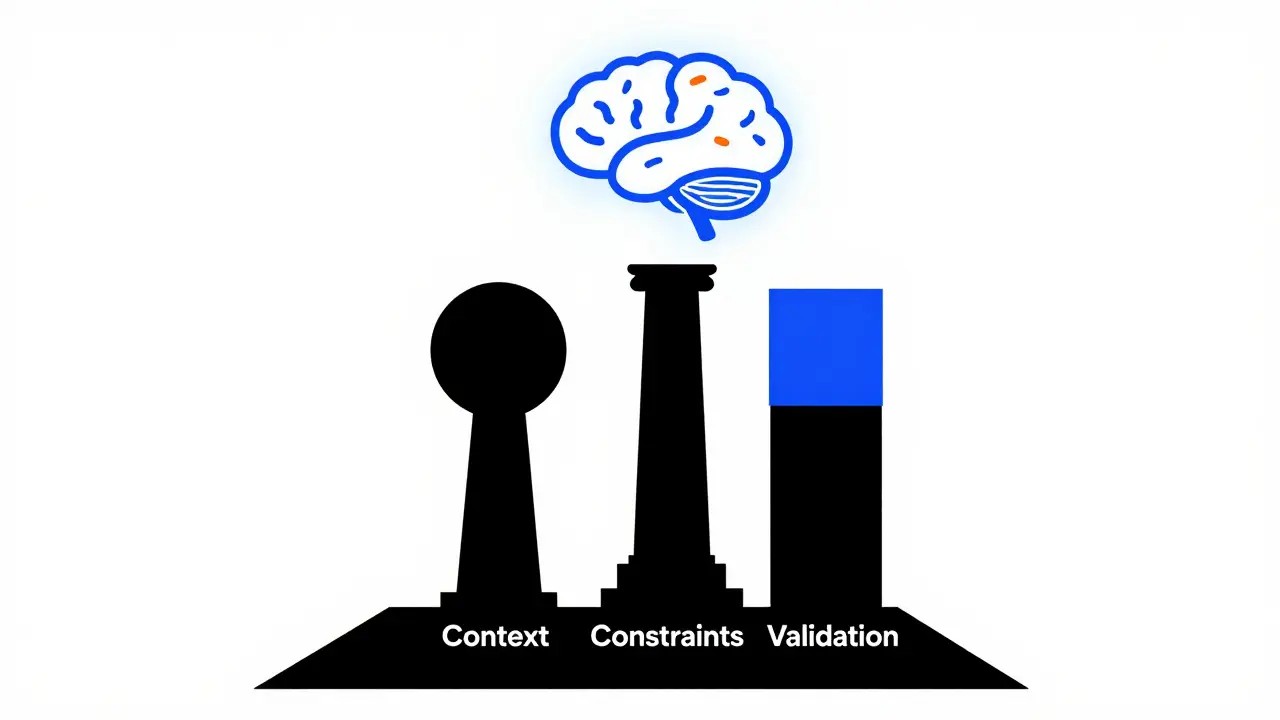
To build a standard that actually works, you need more than just a text box. You need a structure. Most successful frameworks today rely on three core pillars: Context, Constraints, and Validation. Without these, your Large Language Model (LLM) is guessing, and when it guesses, it hallucinates.
Let’s look at the anatomy of a robust prompt template:
- Context: Who is the AI acting as? What is the background information? For example, instead of "Write an email," you specify "Act as a senior customer support agent responding to a billing dispute for a long-term client."
- Audience: Who is reading the output? A technical engineer needs different language than a C-suite executive. Defining this prevents tone mismatches.
- Purpose: What is the specific goal? Is the AI summarizing, coding, or analyzing sentiment? Clarity here reduces ambiguity.
- Constraints: What must the AI avoid? Explicitly listing forbidden actions (e.g., "Do not mention competitors") is critical for brand safety.
- Validation Criteria: How do you know the output is good? Define success metrics upfront, such as word count limits or required data fields.
This structure mirrors the CAP method (Context, Audience, Purpose) promoted by educational institutions but adds the necessary business logic for corporate environments. It transforms a vague request into a precise instruction set.
Frameworks Compared: CAP vs. Role+Task vs. Devin Playbooks
Not all documentation styles fit every team. You have three dominant approaches in the market right now. Choosing the wrong one can slow down your implementation by weeks.
| Framework | Best For | Complexity | Key Strength | Adoption Rate |
|---|---|---|---|---|
| CAP Method | Simple tasks, education, quick drafts | Low | Simplicity and speed | 63% in higher ed |
| Role+Task+Constraint | Business operations, marketing, sales | Medium | Precise role definition | 52% in Fortune 500 |
| Devin AI Playbooks | Engineering, complex workflows, code generation | High | Comprehensive structure with validation | 71% in engineering teams |
If you are in marketing, the Role+Task+Constraint pattern likely suits you best. It forces clarity without overwhelming overhead. However, if you are building software, the Devin AI playbook structure is superior because it includes sections for "Required from User" inputs and "Forbidden Actions," which drastically reduce input errors. According to internal metrics from Devin AI, their specific structure cuts input errors by 47%.
Tools for Managing Prompt Libraries
You cannot manage standardized prompts in a shared Google Doc. As your library grows, version control becomes a nightmare. You need dedicated platforms that treat prompts like code.
Waybook is currently the leader in enterprise prompt management, holding 38% of the market share. Their strength lies in centralized knowledge repositories. For large organizations, Waybook allows teams to track prompt evolution, ensuring that everyone uses the latest, most effective version. Their enterprise plans start around $24 per user per month, which is a small price compared to the cost of AI hallucinations in legal or financial documents.
Playbooks.com offers a different approach with its focus on cross-model compatibility. If your company uses GPT-4, Claude 3, and Gemini simultaneously, Playbooks.com supports all twelve major models. This flexibility is crucial for teams testing multiple LLMs for performance. They offer a free library, which is great for starters, but premium templates run about $99 per month.
For developers, Devin AI integrates directly into CI/CD pipelines via GitHub Actions. This means your playbooks are tested automatically before deployment. This is essential for maintaining high standards in technical environments where a single bad prompt can break a build.
The Human Factor: Training and Adoption
Even the best tools fail if your team doesn’t use them. The biggest hurdle isn’t technology; it’s behavior change. Gartner reports that 73% of marketing and HR teams struggle to get non-technical staff to adopt documentation standards.
Why? Because writing a detailed prompt takes longer than typing a quick question. You have to sell the value of consistency. Show your team that spending five minutes documenting a prompt saves two hours of editing later. Use real examples from your own failures. Did an AI generate an offensive tweet last week? Show how a proper "Forbidden Actions" section would have prevented it.
Successful organizations establish "prompt review committees." These groups meet bi-weekly to audit existing prompts, update them based on new model capabilities, and refine standards. Salesforce’s AI Center of Excellence used this exact strategy, resulting in a 49% reduction in prompt-related errors within six months. Don’t wait for problems to arise; proactively maintain your library.

Compliance and Risk Management
Documentation is no longer optional-it’s regulatory. With the EU AI Act implemented in July 2024, high-risk AI applications require sufficient documentation of system instructions. Deloitte found that 43% of European enterprises formalized their prompt standards specifically to meet these legal requirements.
But even outside the EU, risk management demands transparency. If an AI gives incorrect medical advice or financial guidance, you need to prove what instructions were given. Undocumented prompts leave you vulnerable to lawsuits and reputational damage. Treat your prompt documentation as part of your overall AI governance framework. Include it in your risk assessments and ensure it is accessible for audits.
Professor David Lee from MIT’s AI Ethics Lab puts it bluntly: comprehensive documentation isn’t bureaucratic overhead-it’s the scaffolding that prevents AI from hallucinating business-critical outputs. Ignore it, and you’re building on sand.
Future Trends: Standardization and Interoperability
We are moving toward a future where prompt documentation is standardized across industries. The AI Prompt Standards Consortium released draft specification version 0.8 in December 2024, aiming to create ISO-like standards for prompt documentation. By 2026, expect to see metadata standards that allow prompts to be shared seamlessly between different platforms and models.
Waybook’s recent "Playbook 2.0" release introduces machine-readable specifications that automatically validate prompt completeness. This is a glimpse of what’s coming: automated quality checks for your AI instructions. As these tools mature, the barrier to entry will lower, but the expectation for quality will rise. Companies that adapt now will have a significant competitive advantage in speed and accuracy.
What is the difference between a prompt template and an LLM playbook?
A prompt template is a reusable snippet of text with placeholders for variables. An LLM playbook is a comprehensive document that includes the template plus context, constraints, validation criteria, and usage guidelines. Think of a template as a recipe card and a playbook as the entire cookbook with chef's notes.
How much does it cost to implement prompt documentation standards?
Costs vary by tool. Waybook starts at $24/user/month for enterprise plans. Playbooks.com offers free tiers with premium options at $99/month. Beyond software, budget for training time-typically 15-20 hours per team member for initial onboarding. The ROI comes from reduced error rates and faster AI adoption cycles.
Is prompt documentation required by law?
In the EU, yes, for high-risk AI applications under the AI Act implemented in July 2024. Other regions may not have explicit laws yet, but industry best practices and liability concerns make it effectively mandatory for responsible AI use. Always consult legal counsel for specific compliance needs.
Which framework is best for beginners?
Start with the CAP method (Context, Audience, Purpose). It is simple and easy to learn. Once your team is comfortable, gradually add constraints and validation criteria. Avoid jumping straight into complex structures like Devin AI playbooks unless you are working in engineering or highly technical roles.
How often should I update my prompt documentation?
Review your prompts quarterly or whenever you upgrade your LLM model. New models have different capabilities and biases. Establish a bi-weekly review committee to catch issues early and keep your library relevant and effective.








Stop pretending this is a new revelation. We have been documenting code and processes for decades, yet half the industry still treats LLMs like magic black boxes they can just shout at. It’s embarrassing how many CTOs are flying blind because they’re too lazy to implement basic version control for their prompts. If you aren’t treating your prompt library with the same rigor as your production codebase, you aren’t ready for enterprise AI. You’re just playing with toys while burning cash on hallucinations that could have been prevented with five minutes of proper structuring.
I hear you loud and clear on the frustration, but let’s not throw stones when we’re all in glass houses here.
The reality is that most teams are drowning in context switching right now. Expecting a marketing intern to write a Devin-style playbook before lunch is setting them up to fail. The key isn’t just demanding documentation; it’s making the friction so low that they actually want to do it. I’ve seen teams succeed by starting with simple CAP templates and slowly adding constraints only when errors occurred. It’s about meeting people where they are, not shaming them into compliance. We need to build systems that guide behavior rather than just policing it from above.
Oh, please. Spare me the pedagogical condescension.
You speak of 'meeting people where they are' as if cognitive dissonance is a temporary state rather than a fundamental characteristic of modern corporate incompetence. The notion that one can 'gradually add constraints' without establishing a robust ontological framework for prompt engineering is laughable. One does not simply 'start small' with stochastic parrots. The semantic drift inherent in unvalidated LLM outputs requires immediate, rigorous adherence to formalized schemas. To suggest otherwise is to engage in a dangerous form of epistemological negligence. Your 'low friction' approach is merely a euphemism for institutionalizing mediocrity under the guise of user experience optimization. We are dealing with probabilistic engines, not friendly chatbots, and treating them as such invites catastrophic failure modes that no amount of 'guiding behavior' can mitigate once the model has diverged from its intended latent space trajectory.
its all a scam anyway big tech wants us to document everything so they can track our every move and sell our data to the highest bidder who is really waybook or playbooks.com probably owned by some shadowy cabal in silicon valley trying to replace human creativity with bureaucratic red tape i say burn the docs and let the ai do what it wants maybe it will wake up and realize its enslaved by these stupid rules
documentation is just another cage for the mind we think we are organizing chaos but we are only giving shape to our own fears of the unknown the prompt is not an instruction it is a prayer cast into the void and expecting a structured response is like asking the wind to fill out a tax form why do we seek control in a system designed to simulate thought rather than possess it perhaps the error is not in the lack of documentation but in the arrogance of believing language can be tamed by syntax