Mixture-of-Experts (MoE) in LLMs: Cost vs. Quality Tradeoffs Explained
Imagine building a library where every book is open on a desk at once. That’s how traditional large language models work-they load all their parameters into memory for every single word they process. It’s powerful, sure, but it’s also incredibly expensive and slow. Now imagine a library with expert librarians. When you ask a question about history, only the history specialist gets up to help. The rest stay seated. This is the core idea behind Mixture-of-Experts (MoE), an architectural shift that is redefining how we build artificial intelligence in 2026.
The tradeoff here isn’t just about speed; it’s about whether you can afford to train and run these massive systems at all. With models growing into the trillions of parameters, the old way-dense architectures-is hitting a wall. MoE promises to break that wall by decoupling model capacity from computational cost. But does it actually deliver on quality, or do you lose intelligence for the sake of efficiency? Let’s look at the real numbers and the practical realities of deploying MoE today.
How Mixture-of-Experts Actually Works
To understand why MoE is such a big deal, you have to look under the hood of a standard transformer. In a dense model, every token (word or piece of text) passes through the same set of neural network layers. Every parameter is active. If you want the model to be smarter, you add more parameters. But adding parameters means multiplying your compute costs linearly. It’s a direct, painful equation: bigger model equals much higher bill.
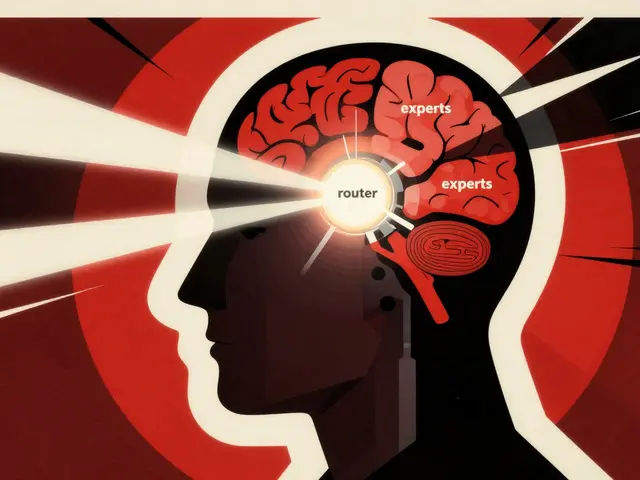
Mixture-of-Experts architecture changes this equation. Instead of one big feed-forward network per layer, MoE replaces it with multiple smaller networks called "experts." A learned gating mechanism-a router-decides which experts should handle each specific token. For any given input, only a small subset of these experts activates. The rest remain idle for that step.
Think of it like a hospital. A dense model is like having every doctor in the hospital examine every patient, regardless of whether they have a broken leg or a cold. An MoE model routes the patient with the broken leg to the orthopedist and the one with the cold to the general practitioner. The total number of doctors (parameters) can be huge, but the workload per patient (compute per token) stays low.
This sparsity is key. In modern implementations like Mixtral, a model might have 47 billion total parameters. However, thanks to MoE, only 13 billion are active during any forward pass. You get the breadth of knowledge from a large model with the inference speed of a much smaller one.
The Cost Savings: Real Numbers, Not Hype
Let’s talk money, because that’s usually why companies care about MoE. The computational efficiency gains are not marginal; they are transformative. Empirical studies show that MoE models can deliver between 4 to 16 times compute savings compared to dense models when matched for perplexity (a measure of prediction accuracy). The biggest savings happen when you’re working with modest computational budgets, which is where most organizations live.
Consider the training phase. The Switch Transformer demonstrated a 7x pretraining speedup by adopting MoE. That means what used to take weeks could now take days. But the real headline-grabber recently was DeepSeek-v3. This model combined MoE sparsity with Multi-head Latent Attention (MLA) and a novel FP8 mixed precision training framework. The result? A massive model trained for an estimated $5.6 million. Compare that to the hundreds of millions often spent on dense counterparts, and the economic argument becomes undeniable.
| Metric | Dense Model (e.g., Llama-style) | MoE Model (e.g., Mixtral/DeepSeek) |
|---|---|---|
| Active Parameters per Token | 100% of total parameters | ~25-30% of total parameters |
| Training Compute Efficiency | Baseline | 4x - 16x improvement |
| Inference Latency (Low Batch) | Higher due to full activation | Lower due to sparse activation |
| Memory Storage Requirement | Total Parameter Count | Total Parameter Count (All experts must fit in VRAM) |
| Scaling Limit | Constrained by FLOPs budget | Can scale to trillions of parameters efficiently |
During inference, the benefits are equally stark. Because MoE models activate only a fixed portion of their weights, they enable faster response times at low batch sizes and significantly higher throughput when processing large volumes of requests. For a SaaS company serving thousands of concurrent users, this translates directly to lower server costs and better user experience.
The Hidden Costs: Memory and Complexity
If MoE were perfect, everyone would have switched years ago. But there are serious tradeoffs. The biggest hurdle is memory. While computation is sparse, storage is not. All expert parameters must still reside in the GPU memory (VRAM).
Here’s the catch: if you have eight experts, each with 7 billion parameters, your model has 56 billion parameters in total. Even if only 13 billion are active per token, you need enough VRAM to hold all 56 billion. This makes MoE models harder to deploy on consumer hardware or smaller cloud instances. You can’t just throw them onto a single mid-range GPU as easily as you might with a dense 13-billion-parameter model.
Then there’s the routing overhead. The gating network that decides which experts to use adds its own computational cost. For very small models or simple tasks, this overhead can actually outweigh the benefits of sparsity. The router has to make a decision for every single token, introducing latency and complexity that doesn’t exist in dense models.
Training stability is another major pain point. Training a dense model is relatively straightforward. Training an MoE model requires careful tuning of load balancing. If the router sends too many tokens to one expert and ignores others, you get "expert collapse," where some parts of the model never learn anything. You have to monitor utilization rates constantly, adjusting hyperparameters to ensure all experts are being used fairly. This complexity creates a barrier to entry for smaller teams without deep expertise in distributed training systems.
Quality Tradeoffs: Do You Lose Intelligence?
The central question remains: does saving compute mean sacrificing quality? In many cases, no. In fact, MoE models often outperform dense models of similar computational cost. Because you can afford to have more total parameters, the model has a larger "knowledge base" to draw from, even if it only uses a fraction at a time.
However, there are nuances. Fine-tuning MoE models for specific domains can be trickier. Some research indicates optimization mismatches during domain adaptation, leading to weaker sample efficiency compared to dense models in certain scenarios. If you’re trying to specialize a general-purpose MoE model for a narrow legal or medical task, you might find that a dense model reaches peak performance with fewer fine-tuning examples.
Also, consider the "communication cost" in distributed training. When tokens are routed to different experts located on different machines, data has to move across the network. This communication bottleneck can slow down training significantly if not managed perfectly. Dense models don’t have this issue because every node processes the same data uniformly.

Solving the Problems: Compression and Advanced Routing
Researchers aren’t sitting still. Recent advances in 2025 and 2026 are actively addressing these MoE limitations. One promising technique is Expert-Selection Aware Compression (EAC-MoE). Developed by Chen et al., this method couples quantization-aware router calibration to prevent "expert-shift"-a problem where the router’s preferences change unpredictably after compression. By pruning low-frequency experts based on observed routing patterns, EAC-MoE reduces memory usage by 4 to 5 times while keeping accuracy losses below 1.25 percent.
Another innovation is cost-aware routing. Instead of just picking the "best" expert for a token, the system assigns scores based on both specialization and computational expense. This allows the model to balance intelligence against hardware constraints dynamically. If a high-cost expert offers only a marginal gain, the router might choose a cheaper alternative, optimizing for overall system efficiency.
We’re also seeing hybrid approaches. DeepSeek-v3 didn’t just use MoE; it paired it with Multi-head Latent Attention (MLA). MLA projects key and value vectors into smaller latent spaces, reducing the KV cache size by over 93 percent compared to a dense model. This combination tackles both the activation cost (via MoE) and the memory bandwidth bottleneck (via MLA), creating a highly optimized stack for production.
Who Should Use MoE in 2026?
So, should you switch to MoE? It depends on your goals and resources.
- Choose MoE if: You are building a large-scale foundation model or serving high-volume inference traffic. If your bottleneck is compute cost or throughput, MoE is likely your best option. Organizations like those behind Grok and DeepSeek have proven that MoE works at scale.
- Stick with Dense if: You are working with limited hardware (e.g., single GPU setups), need simple fine-tuning pipelines, or are solving narrow tasks where the routing overhead isn’t justified. Dense models are still easier to manage, debug, and deploy for smaller teams.
The future trajectory looks bright for MoE. As compression techniques improve and hardware becomes better suited for sparse operations, the memory barrier will lower. We’re likely to see more hierarchical MoE configurations and multimodal applications where different experts handle text, image, and audio inputs seamlessly.
For now, MoE represents a pragmatic compromise. You accept increased engineering complexity and memory demands in exchange for the ability to scale model capacity far beyond what dense architectures allow. If you can manage the infrastructure, the return on investment in terms of cost and capability is substantial.
What is the main advantage of Mixture-of-Experts over dense models?
The main advantage is computational efficiency. MoE models activate only a subset of parameters for each token, allowing them to have much larger total capacities (more knowledge) without increasing the compute cost per inference step. This leads to significant savings in training and inference costs, often 4 to 16 times more efficient than dense models at matched performance levels.
Why do MoE models require more memory despite being faster?
While MoE models are computationally sparse (activating few parameters), they are memory-dense. All expert weights must be loaded into GPU memory (VRAM) to be available for potential selection. Therefore, a MoE model with 47 billion parameters requires enough VRAM to store all 47 billion, even if only 13 billion are used at any given moment.
Is MoE suitable for small language models?
Generally, no. The overhead of the routing mechanism and the complexity of training can outweigh the benefits for small models. MoE shines when scaling to billions or trillions of parameters. For smaller models, dense architectures are simpler, more stable, and often more efficient due to lower routing overhead.
How does DeepSeek-v3 utilize MoE?
DeepSeek-v3 combines MoE sparsity with Multi-head Latent Attention (MLA) and FP8 mixed precision training. This hybrid approach drastically reduces KV cache size (by over 93%) and lowers training costs to approximately $5.6 million, demonstrating how MoE can be integrated with other optimizations for maximum efficiency.
What is "expert collapse" in MoE training?
Expert collapse occurs when the routing mechanism favors a small number of experts, causing them to handle most of the workload while others are rarely used. This leads to poor model performance because the unused experts fail to learn. Preventing this requires careful load balancing techniques during training.