Grounded Web Browsing for LLM Agents: How Search and Source Handling Power Real-World AI
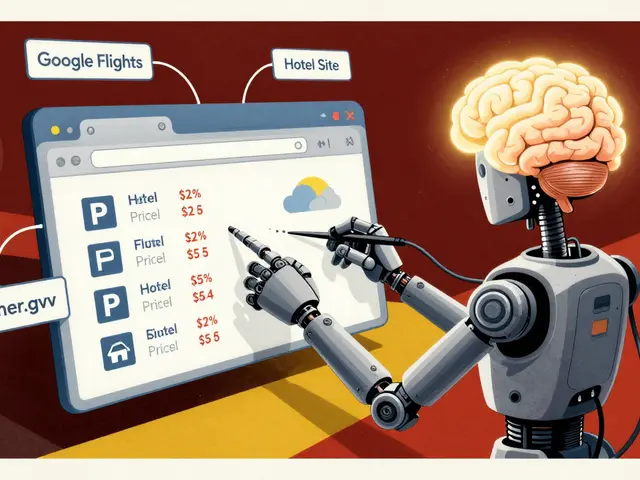
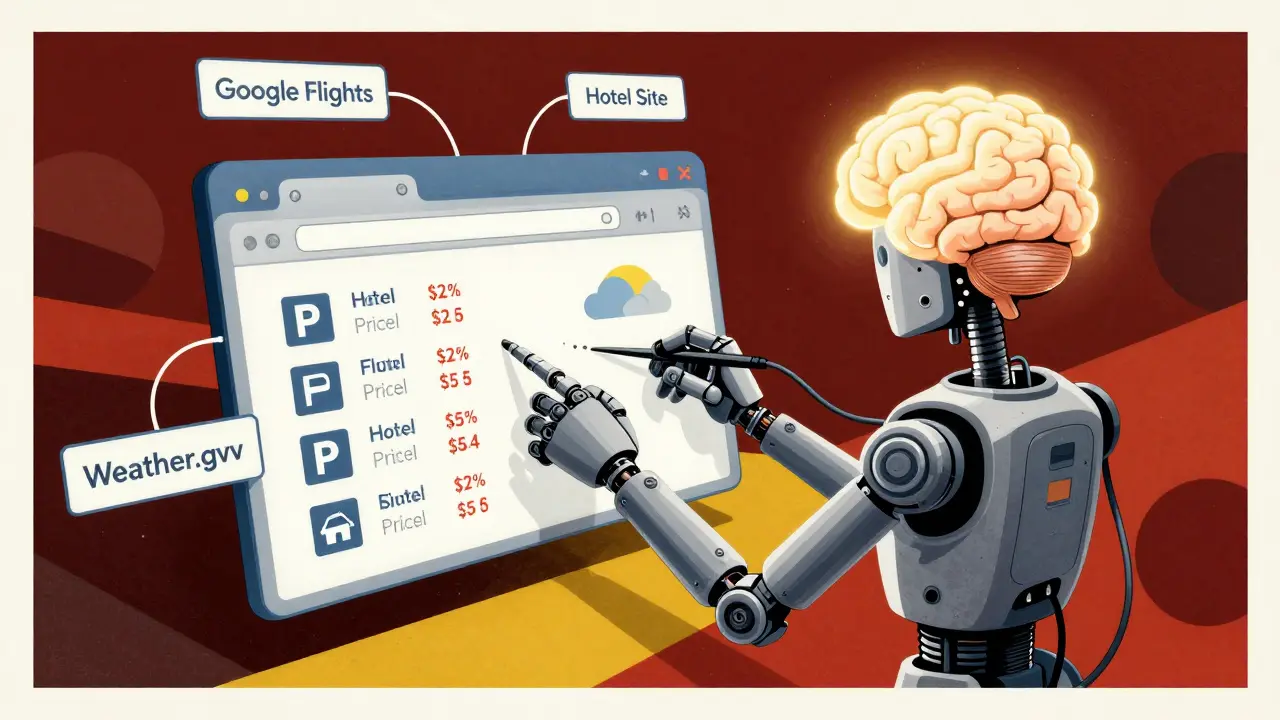
Imagine asking an AI assistant to find the cheapest flight from Asheville to Denver next week, check if the hotel has free parking, and confirm the weather forecast for your stay-all in one go. Now imagine it doesn’t just guess from old data. It opens a browser, navigates to Google Flights, reads the prices live, checks the hotel’s website, and pulls the latest weather from a trusted source. That’s grounded web browsing-and it’s not science fiction anymore. It’s what’s happening in AI labs and early enterprise tools right now.
What Grounded Web Browsing Actually Means
Large language models (LLMs) like GPT or Llama are brilliant at writing essays, summarizing documents, and answering questions based on what they’ve been trained on. But here’s the problem: their knowledge is frozen in time. If you ask them about a product released last month or a flight that just got discounted, they’ll either make something up or give you outdated info.
Grounded web browsing fixes that. It means the AI doesn’t rely only on its internal memory. Instead, it connects to live websites-like a human would-to find real, current information. Google calls it "connecting model output to verifiable sources." Salesforce says it’s about "infusing an LLM prompt with the information you want it to consider." Both mean the same thing: the AI isn’t guessing. It’s looking things up.
This isn’t just a tweak. It’s a necessity. Stanford researchers found ungrounded LLMs get facts wrong in 47% of web-related queries. Grounded ones? Just 18%. That’s a massive jump in reliability.
How It Works: The Anatomy of a Web-Going AI
Grounded agents don’t just type into Google and copy-paste. They’re built like robots with eyes, hands, and a brain. Here’s how the pieces fit together:
- Browser automation tools like Playwright or Selenium let the AI click buttons, fill forms, and scroll pages-just like you would.
- DOM downsampling cuts down the raw HTML of a webpage to only the parts that matter. A page with 10,000 lines of code gets reduced to 300 lines of useful text. This saves time and money.
- Retrieval Augmented Generation (RAG) pulls relevant snippets from search results and feeds them to the LLM so it can answer accurately.
- Visual grounding (still emerging) uses image recognition to identify buttons, prices, or icons on a page-even if the text is hidden or poorly labeled.
One system, GLAINTEL, uses a 780-million-parameter model (far smaller than GPT-4) to handle 147 different actions on e-commerce sites: clicking "Add to Cart," filtering by size, checking shipping times. It doesn’t need a billion-parameter model to do it well.
And here’s something surprising: 21% of the time, the best-performing agents (like Llama-4) don’t even use Google’s API. They manually open google.com, type the query, and click the first result-just like you’d do. They’re learning human behavior, not just mimicking search engines.
Performance Numbers: What Works and What Doesn’t
Let’s cut through the hype. Grounded web browsing isn’t magic. It has clear strengths and limits.
When it shines:
- Real-time pricing: 84.2% accuracy on product and flight prices.
- Event details: Finding concert dates, conference schedules, or holiday hours.
- News verification: Checking if a claim is backed by a credible source.
- Multi-step tasks: Comparing three hotels, checking reviews, then booking.
Where it stumbles:
- JavaScript-heavy sites: Success rates drop to 53% when pages rely on heavy scripts.
- CAPTCHAs: The AI fails 89% of the time. No AI today can reliably solve them.
- Dynamic layouts: If a website changes its design, the agent often breaks. Failure rate jumps 27%.
- Login-protected pages: 89% of commercial systems can’t handle them. No cookies, no access.
- Visual tasks: If you need to spot a tiny "Sale" tag or compare product images, accuracy drops to 39.7%.
And it’s slow. A grounded query takes about 14.7 seconds on average. A regular LLM answer? 2.3 seconds. That’s why you won’t see this in your phone’s chatbot yet.

Cost, Complexity, and the Hidden Price Tag
Running a grounded agent isn’t cheap. Each complex task costs about $0.042-five times more than a simple LLM response. Why? Because every click, every page load, every API call adds up. And it’s not just money. It’s time.
Developers report it takes 8 to 12 weeks to get good at building these systems. You need advanced Python skills, deep knowledge of HTML/CSS/JavaScript, and experience with frameworks like LangChain or LlamaIndex. Most open-source tools have poor documentation. Google’s Vertex AI docs? Rated 4.2/5. Most others? Around 3.1/5.
And the infrastructure? You need vector databases (like Chroma), browser automation tools, and search engine APIs. One Reddit user spent 37 hours fine-tuning GLAINTEL just to get 82% accuracy on 500 product searches.
It’s not for hobbyists. It’s for companies with real stakes: e-commerce, customer support, financial research.
Who’s Using It-and Who’s Falling Behind
Fortune 500 companies are testing grounded agents in droves. 47% of them are piloting them, according to IDC. The top uses?
- E-commerce (68%): Finding products, comparing prices, checking stock.
- Customer support (23%): Answering questions about policies, returns, or service changes.
- Financial analysis (9%): Pulling latest earnings reports, stock prices, or regulatory filings.
Startups are moving fast too. BrowseAI raised $12.5 million in October 2024. Webfuse launched a DOM downsampling API in November. Google’s Vertex AI and Salesforce’s Agentforce are already embedding grounding into their enterprise tools.
But consumers? Barely. Only 12% of consumer-facing AI apps use full grounded browsing. Why? Cost. Complexity. And the fact that most people don’t need real-time data for asking "Who won the Super Bowl?"
The Bigger Problem: Who Pays for the Web?
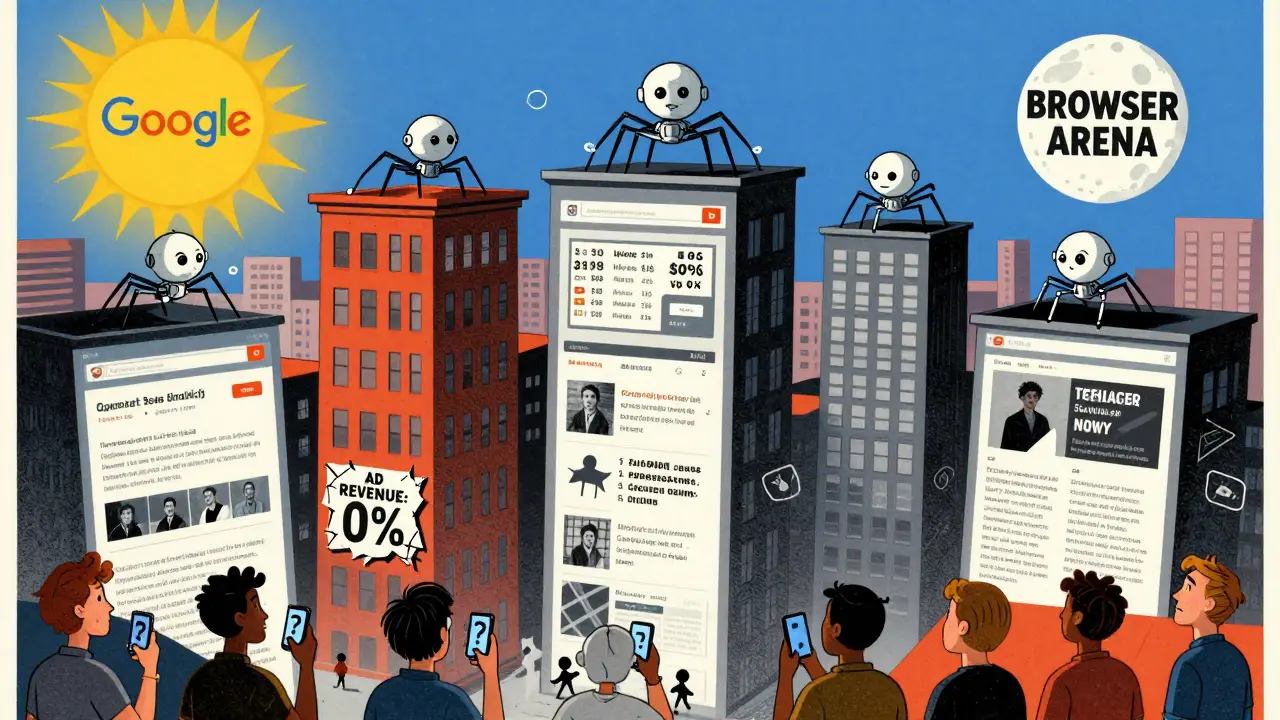
There’s a quiet crisis brewing. AI agents are browsing the web-millions of times a day. They’re clicking links, loading pages, scraping data. But they’re not generating ad revenue. They’re not clicking ads. They’re not buying anything.
Circle’s analysis warns this could threaten the $547 billion digital advertising ecosystem that keeps the open web alive. If every search, every product comparison, every news check is done by a robot that doesn’t pay, who funds the websites?
Some experts think the solution is simple: agents will start paying. Aisera predicts 73% of future systems will include compensation mechanisms for content providers-like micro-payments or API fees. Others think websites will start blocking AI traffic entirely.
And then there’s the bias problem. 89% of agent queries funnel through just three search engines. If Google changes its algorithm, the whole system breaks. One study showed accuracy varied by up to 19 percentage points depending on which search engine was used.
What’s Next: The Road to 2025 and Beyond
Grounded web browsing is evolving fast. Here’s what’s coming:
- Visual + Text Grounding: Combining DOM parsing with image recognition. Webfuse’s early tests show 37% accuracy gains when agents can "see" page elements with bounding boxes.
- Standardized Protocols: Forrester predicts 68% chance of a universal standard for how agents talk to websites by Q3 2025.
- Agent-Friendly Markup: Websites might start adding special HTML tags just for AI bots-like ""-to make navigation easier.
- Regulation: The EU AI Act is already drafting rules for autonomous web navigation systems. Transparency about sources and data handling will be required.
Google’s "Grounding 2.0" is coming in January 2025, with better entity recognition. BrowserArena will expand its test suite to 147 new task types on December 15, 2024.
The goal isn’t just to browse better. It’s to understand context. Not just find a price-but know if it’s a scam. Not just read a news article-but verify who wrote it and when.
Should You Care? Yes-If You’re Building AI
If you’re a developer, entrepreneur, or tech decision-maker, grounded web browsing isn’t optional anymore. It’s the difference between an AI that sounds smart and one that’s actually useful.
Start small. Try BrowserUse library. Set up a simple task: "Find the nearest 24-hour pharmacy in Asheville with free parking." Use Playwright to open the browser. Let the LLM read the page. See where it fails. That’s your learning curve.
Don’t expect perfection. Expect progress. Grounded agents are messy, slow, and expensive-but they’re the only way AI can truly live in the real world.
What’s the difference between grounded web browsing and regular RAG?
Regular RAG pulls info from a fixed database-like uploaded PDFs or past articles. Grounded web browsing goes live: it opens a browser, searches Google, clicks links, and reads the current page. RAG is like using a library book. Grounded browsing is like calling the library right now to ask what’s on the shelf today.
Can grounded agents handle login-protected sites?
Almost never. Most systems can’t store or use cookies, and they don’t have access to personal accounts. Even if they could, doing so raises serious privacy and security issues. For now, if you need data behind a login, you’ll need to provide it manually or use an API instead.
Why do grounded agents fail on CAPTCHAs?
CAPTCHAs are designed to stop bots. They rely on human perception-like recognizing distorted text, selecting images, or solving logic puzzles. LLMs don’t have human senses or intuition. They can’t "see" a bus or a fire hydrant in a grid. No current AI can reliably solve modern CAPTCHAs without human help.
Is grounded web browsing only for big companies?
No, but it’s hard for individuals. You need technical skills and infrastructure. Still, open-source tools like BrowserUse and GLAINTEL are free. A developer with Python experience can experiment on personal projects. But scaling it to production? That’s where costs and complexity make it a corporate play.
Will websites start blocking AI agents?
Already happening. Some sites use bot detection to block automated traffic. Others slow it down or serve fake data. If AI traffic keeps growing without paying for it, more sites will treat agents like scrapers-not users. The long-term solution may be new standards that let agents identify themselves and pay for access.
How accurate are grounded agents compared to humans?
On simple tasks-like finding a price or a date-they’re close. Grounded agents hit 72.3% accuracy on knowledge-intensive queries. Humans? Around 85-90%. But on complex, multi-step tasks, humans still win. Humans know when to pause, ask for help, or recognize a scam. Agents don’t. They follow rules. That’s their strength-and their weakness.