
How Autoregressive Generation Works in Large Language Models: Step-by-Step Token Production
Have you ever wondered how a language model like ChatGPT or Gemini writes a full paragraph, answers a question, or even composes a poem? It doesn’t do it all at once. Instead, it builds each word, one after another, like a writer drafting a sentence line by line. This process is called autoregressive generation, and it’s the engine behind nearly every major large language model today. Understanding how it works helps you see why these models sometimes make odd choices, repeat themselves, or get stuck in loops. It also explains why they can’t go back and fix mistakes once they’re made.
What Autoregressive Generation Really Means
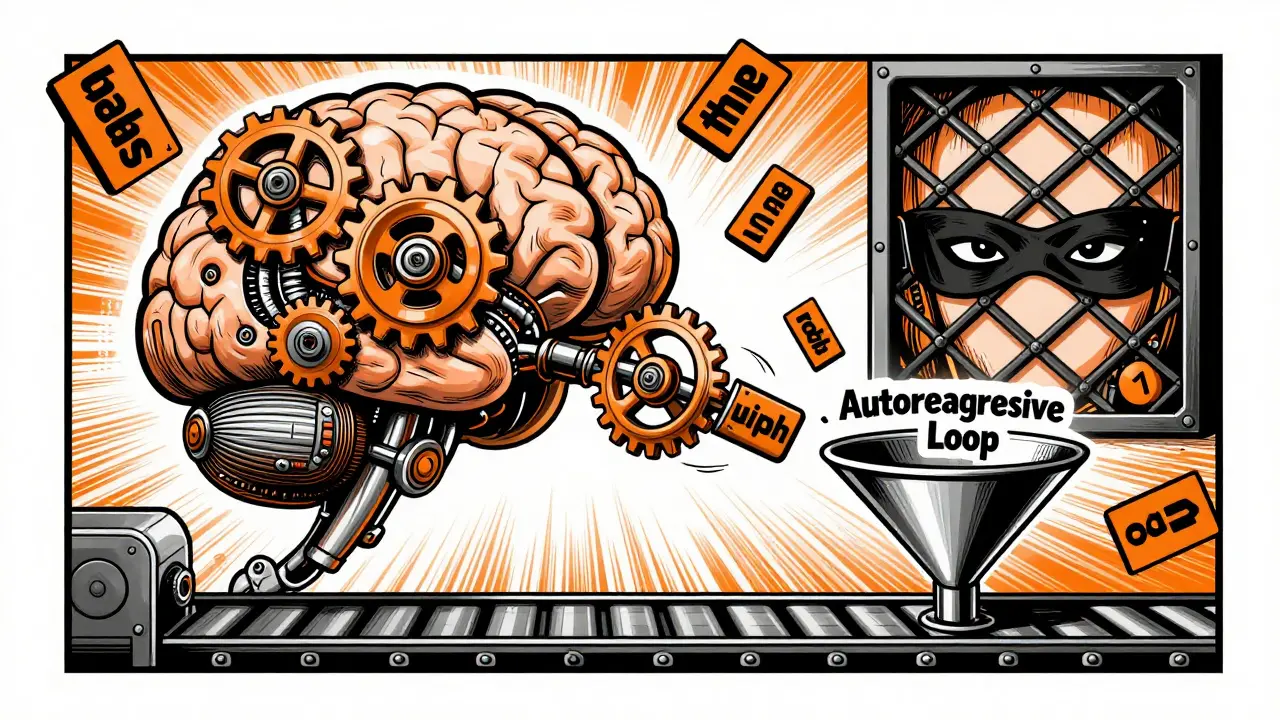
The word "autoregressive" sounds complicated, but it’s just a fancy way of saying "predicts the next thing based on what came before." Think of it like finishing a sentence you started. If you write "The cat sat on the," your brain instantly thinks of "mat," "floor," or "windowsill." A language model does the same thing-but it calculates the probability of every possible next word in its vocabulary. This isn’t guessing. It’s math. At its core, autoregressive generation breaks down a sentence into a chain of probabilities. The chance of the whole sentence "The cat sat on the mat" is calculated as: - Probability of "The" - Times probability of "cat" given "The" - Times probability of "sat" given "The cat" - Times probability of "on" given "The cat sat" - And so on... Each step depends entirely on what came before. No looking ahead. No second chances. That’s the "autoregressive" part: the model regresses on itself, using its own output as input for the next step.The Transformer’s Secret: Masked Self-Attention
You might think transformers-like the ones powering GPT-4 or Claude-just read text forward. But they’re actually designed to look at everything at once. So how do they stick to the rule of only seeing past tokens? The answer is a clever trick called masked self-attention. Imagine you’re reading a sentence and someone covers up every word that comes after the one you’re focusing on. You can only see what’s already there. That’s what the mask does. In transformer decoders, the attention mechanism is blocked from "seeing" future tokens. This forces the model to learn how to predict the next token based only on the sequence it has generated so far. Without this mask, the model would cheat. It would peek ahead and use future context to make better predictions during training. But in real use, it doesn’t have that luxury. So the mask ensures training and inference match. This is why autoregressive models are sometimes called "causal" models-each token causally depends only on what came before it.The Step-by-Step Token Loop
Here’s exactly how it plays out in real time:- Prompt input: You type: "Why do leaves change color in fall?" The model starts with this as its initial context.
- First prediction: The model processes the prompt and outputs a probability distribution over its entire vocabulary (often 100,000+ tokens). It might assign high probability to "because," "the," or "in." It picks one-usually the most likely, or sometimes samples randomly based on a "temperature" setting.
- Append and repeat: The chosen token (say, "because") gets added to the prompt. Now the input is: "Why do leaves change color in fall? because"
- Next token: The model re-processes the entire updated sequence and predicts the next word. This time, it might choose "the." Then "maple," then "trees," then "turn," and so on.
- End condition: The loop continues until the model generates an end-of-sequence token, or hits a max length limit (like 2048 tokens).
Where Autoregressive Models Shine
This method isn’t perfect, but it’s incredibly effective for open-ended generation. Here’s where it dominates:- Conversational AI: ChatGPT, Claude, and Gemini all use autoregressive generation to produce natural, flowing dialogue. Each reply builds on the last, creating a sense of continuity.
- Code generation: When you ask a model to write a Python function, it doesn’t generate the whole block at once. It writes line by line, predicting the next statement based on what it’s already written.
- Storytelling and creative writing: The step-by-step nature lets models build narrative tension, character development, and pacing-just like a human writer.
- Translation and summarization: Even in structured tasks, models generate output token by token, ensuring grammatical coherence in the target language.
The Hidden Costs: Why Autoregressive Isn’t Perfect
For all its strengths, autoregressive generation has serious flaws. And they’re not just technical-they affect real-world use.- Latency is unavoidable: Since each token depends on the last, you can’t generate multiple tokens at once. If a response takes 500 tokens, you need 500 separate forward passes. That adds up. Even with fast hardware, this creates noticeable delays.
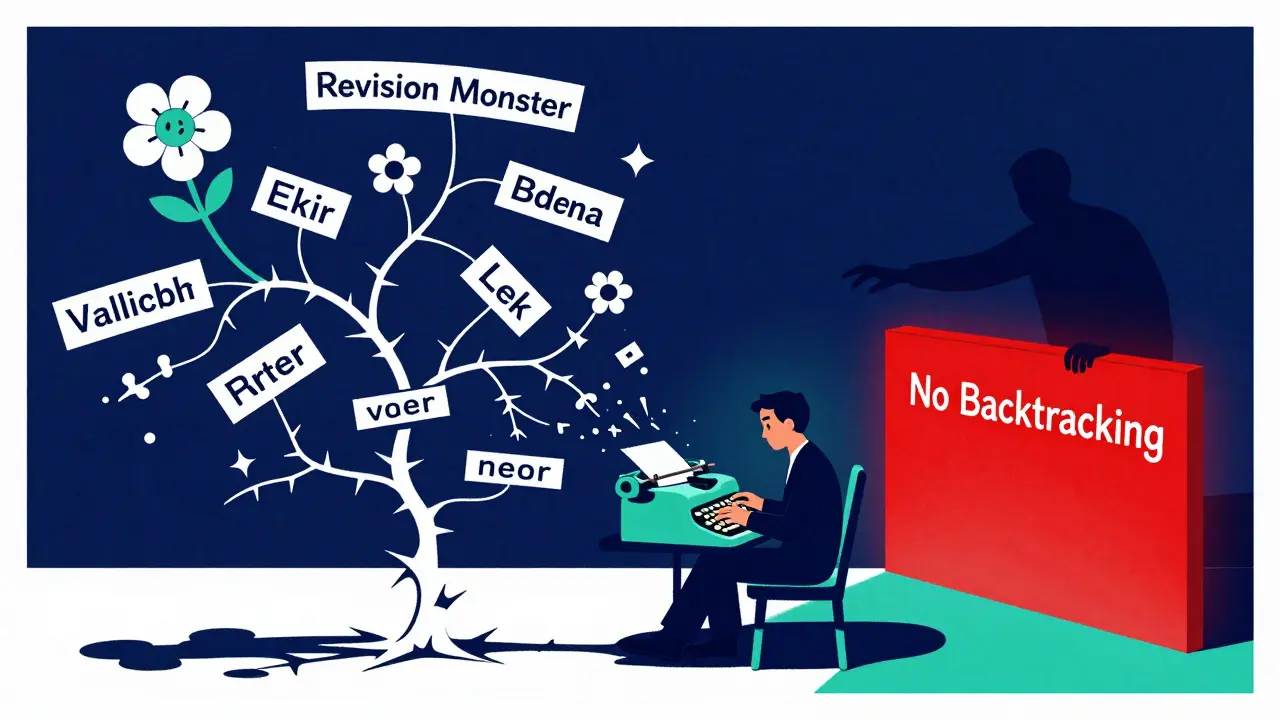
- No revision allowed: Once a token is generated, it’s locked in. If the model starts with a factual error-like saying "The moon is made of cheese"-it can’t go back and fix it. It has to build the rest of the response on top of that mistake.
- Exposure bias: During training, the model sees perfect, human-written text. But during inference, it only sees its own predictions-which are often wrong. This mismatch causes errors to compound. One bad prediction leads to another, and another.
- No global view: The model doesn’t see the whole output at once. It can’t check if the ending contradicts the beginning, or if the tone shifted. It’s like writing a novel one paragraph at a time, never reading the whole thing.
What’s Coming Next? Beyond Autoregression
The dominance of autoregressive models isn’t guaranteed forever. New approaches are emerging:- Diffusion models for text: Inspired by image generation, these models create text in multiple passes. They start with a messy draft and refine it, correcting errors along the way. Models like LLaDA use this to achieve better coherence.
- Non-autoregressive generation: Some models try to generate entire sentences at once. They’re faster but often produce incoherent or repetitive output.
- Hybrid systems: The future likely lies in combining approaches. For example, a model might use autoregressive generation for initial draft, then apply a separate editing step to fix logic, grammar, or consistency.
Why This Matters to You
Whether you’re using a chatbot, writing with AI, or building your own app, knowing how autoregressive generation works changes how you interact with it.- Don’t expect perfection on the first try. If the model starts off wrong, it’ll keep going down that path.
- Give it more context. The more you provide in your prompt, the better it can predict what comes next.
- Break long tasks into steps. Instead of asking for a 1000-word essay all at once, ask for an outline first, then each section.
- Check for early errors. If the first few words feel off, restart. The model won’t fix itself.
Is autoregressive generation the same as how humans write?
Not exactly. Humans write with revision, backtracking, and global awareness. We can rewrite a paragraph after seeing the whole essay. Autoregressive models can’t do that. They generate one token at a time and never go back. So while the output might feel human-like, the process is much more mechanical.
Why do LLMs sometimes repeat the same phrase?
Repetition often happens when the model gets stuck in a loop. If a sequence like "and then, and then" keeps getting high probability, the model will keep choosing it. This is more likely with low temperature settings or when the prompt lacks diversity. Some models use techniques like repetition penalties to reduce this, but it’s still common.
Can autoregressive models generate code correctly?
Yes, and they often do it well-but only if the context is clear. Code generation works because each line depends on the previous ones. A model can predict a function signature, then the body, then the return statement. But if it mispredicts a variable name early on, every subsequent line that uses it will be wrong. That’s why code from LLMs often needs review.
Do all large language models use autoregressive generation?
As of early 2026, nearly all major LLMs-including GPT-4, Gemini, Claude, and DeepSeek-rely on autoregressive generation as their primary method. A few experimental models use non-autoregressive or diffusion-based approaches, but none have matched the quality and reliability of autoregressive systems for general-purpose text.
What’s the difference between autoregressive and BERT-style models?
Autoregressive models (like GPT) predict what comes next. BERT-style models predict what’s missing in the middle. BERT is bidirectional-it sees the whole sentence at once to understand context. That makes it great for tasks like question answering or sentiment analysis. But it can’t generate text naturally. Autoregressive models are built for generation. They’re two different tools for two different jobs.








Really appreciate this breakdown. I’ve been using AI tools for months and never realized how much the one-token-at-a-time process affects output quality. It’s like watching someone build a Jenga tower while blindfolded-every move depends on the last, and one shaky block ruins everything. No wonder we get those weird loops.
LMAO so the AI is just a guy who writes a sentence, forgets what he wrote 3 lines ago, and keeps going? Classic. I’ve had it say ‘the moon is made of cheese’ and then spend 300 words building a whole cheese-based lunar economy. No revisions. No ‘oops, let me backtrack.’ Just pure, unfiltered delusion with a PhD.
Exposure bias is such a sneaky little monster. The model trains on pristine human text, then goes out into the wild and starts hallucinating like a drunk poet at a poetry slam. It’s not even trying to be wrong-it’s just never learned how to recover. That’s why I always restart if the first word feels off. You can’t fix a foundation built on sand.
Actually, the term "autoregressive" is misused here. Technically, it should be "causal language modeling," because autoregression implies a statistical model regressing on its own past outputs-which is not quite what’s happening. The model is performing sequential conditional probability estimation. You’re not "regressing," you’re predicting. Get your terminology right, people.
This whole thing is just a glorified Markov chain with a billion parameters and a god complex. It doesn’t understand anything. It’s just pattern-matching on steroids. You think it’s writing a poem? Nah. It’s just remixing Shakespeare with a side of Wikipedia. And you’re paying for it? Pathetic.
When I first started working with LLMs, I didn’t realize how deeply the autoregressive constraint shaped the output. It’s not just about speed or accuracy-it’s about the fundamental inability to reflect. Humans revise because we’re aware of our own thought patterns. The model has no self-awareness, no meta-cognition. It’s like a painter who can only see the last brushstroke and must guess the whole canvas. No wonder the endings often feel hollow. There’s no holistic vision, only incremental accumulation. And that’s why, even when the output seems brilliant, it lacks soul. Not because it’s broken-but because it was never designed to feel.
Autoregressive generation is like a drunk poet scribbling on a napkin while the bartender keeps refilling his glass. Each line is a new mistake, but he’s too buzzed to notice he just wrote "the sky is purple" three lines ago. And now he’s building a whole mythology around it. Purple skies, violet oceans, teal dragons. It’s beautiful chaos. But if you ask him to fix it? He’ll just write "and the purple dragons wept rainbow tears" and call it art. That’s the AI. That’s us. That’s life.
Wait, so if I prompt it with "The cat sat on the," and it picks "mat," then later it says "the mat was made of cheese," does that mean it forgot the first part? Or is it just doubling down? I’ve seen this happen so many times-like it’s playing a game of telephone with itself. And the weirdest part? Sometimes it gets *more* coherent the longer it goes. Like it’s hallucinating its way into truth. Is that a feature or a bug? Or just the universe being weird?
While the article presents a technically accurate overview, it lacks critical nuance regarding computational complexity. The autoregressive paradigm imposes O(n) latency per token, which becomes prohibitive at scale. Moreover, the absence of parallelization in inference renders it fundamentally unsuitable for real-time, low-latency applications such as autonomous systems or high-frequency financial dialogue agents. The notion that "longer context windows improve performance" is misleading without acknowledging the quadratic attention overhead. Until we decouple generation from sequential dependency, we are merely optimizing a fundamentally flawed architecture. The field’s fixation on autoregression is a systemic failure of imagination.
Yup. Autoregressive = one foot in front of the other. No looking back. No redoing. Just keep walking even if you’re going the wrong way. I’ve had it write me a whole essay on quantum physics… starting with "Einstein invented the microwave." And it just kept going. Like, cool, I guess? But maybe next time, just… pause. Breathe. Ask yourself: "Did I just say the microwave was invented by Einstein?" Nope. Still going. lol.