GDPR and CCPA in Vibe-Coded Systems: Data Mapping and Consent Flows
You just generated a stunning landing page using an AI coding assistant. It looks great. The buttons work. The animations are smooth. But when you look at the source code, do you know exactly where that user’s email address goes? If you’re relying on vibe coding is the practice of generating software primarily through natural language prompts to AI models rather than manual line-by-line writing, you might not. This creates a massive blind spot for privacy compliance.
The General Data Protection Regulation (GDPR) and the California Consumer Privacy Act (CCPA) demand strict accountability over personal data. They require you to know what data you collect, why you collect it, and where it travels. When AI writes your code, the traditional methods of tracking this information break down. You need new strategies for data mapping is the process of systematically documenting how personal data flows through an organization's systems, including collection points, storage locations, and processing purposes and managing consent flows are mechanisms that capture, record, and manage user permissions for data processing activities in accordance with legal requirements. Without them, your beautiful AI-generated app could be a regulatory time bomb.
Why Vibe Coding Breaks Traditional Data Maps
Traditional data mapping relies on developers knowing their own code. A senior engineer builds a feature, documents the database schema, and updates the Records of Processing Activities (RoPAs). In a vibe-coded environment, this chain of custody is severed. You prompt the AI, and it generates complex logic involving third-party APIs, hidden cookies, or background data syncs that you never explicitly asked for.
Consider a simple request: "Create a newsletter signup form." An AI model might automatically integrate a popular email marketing service, embed analytics trackers, and store IP addresses for spam prevention. None of these actions were part of your prompt. Under GDPR Article 30, you are legally required to document every one of these processing activities. If the AI adds a tracker that collects location data, and you don’t map it, you are violating purpose limitation principles.
The International Association of Privacy Professionals (IAPP) reported in its 2025 Privacy Tech Vendor Report that 87% of large organizations now maintain formal data mapping processes. Yet, as AI adoption accelerates, many teams are finding their maps obsolete within weeks. A Trustpilot review from January 2026 highlighted this frustration, with users noting that rapid system changes driven by AI regeneration made static maps useless. You cannot rely on manual documentation when the codebase evolves via conversation.
Mapping the Invisible: GDPR vs. CCPA Requirements
To comply, you must understand what each regulation demands from your mapped data. While both focus on transparency, their approaches differ significantly.
| Requirement Aspect | GDPR (EU) | CCPA/CPRA (California) |
|---|---|---|
| Primary Focus | Processing activities and legal bases | Consumer rights and data categories |
| Data Classification | Personal data and special category data (e.g., health, biometrics) | 11 categories including identifiers, commercial info, and sensitive personal information (SPI) |
| Legal Basis / Purpose | Must document one of six legal bases (e.g., consent, legitimate interest) | Must identify business purposes and whether data is sold or shared |
| Retention | Strict retention periods with deletion triggers | Reasonable retention based on business necessity |
| Third-Party Sharing | Documented recipients with contact details | Focus on vendors, service providers, and third parties receiving data for cross-context behavioral advertising |
GDPR requires granular documentation of the why. For every piece of data the AI collects, you must assign a legal basis. Is it necessary for contract performance? Do you have explicit consent? CCPA focuses more on the what and who. It requires you to categorize data into specific buckets, such as "internet activity" or "inferences," and disclose if this data is sold or shared for targeted advertising. The California Privacy Rights Act (CPRA), effective January 1, 2023, tightened this further by defining "sensitive personal information" (SPI) like precise geolocation or SSN fragments, which require stricter opt-out mechanisms.
In a vibe-coded system, the AI might infer user preferences based on browsing behavior. Under CCPA, these inferences count as personal information. If your data map doesn’t flag this inference engine, you fail to inform consumers of their right to opt out of profiling. TrustArc’s 2024 benchmark study found that organizations implementing GDPR-style processing activity mapping saw 43% faster fulfillment of Data Subject Access Requests (DSARs) under CCPA. This suggests that adopting the stricter GDPR mapping style benefits both regimes.

Building Consent Flows That Survive AI Generation
Data mapping tells you what you have; consent flows tell you if you’re allowed to keep it. In manual development, engineers hardcode consent checks before API calls. In vibe coding, the AI often bypasses these checks or implements them inconsistently. It might generate a frontend checkbox but forget to block the backend data transmission until that box is checked.
You need dynamic consent management platforms (CMPs) that integrate directly with your application layer. Tools like Usercentrics or OneTrust provide SDKs that can be prompted into your codebase. However, integration is key. Jane Finlay, Director of Privacy at Ethyca, noted in November 2025 that organizations mapping data at the processing activity level see 68% fewer compliance gaps. To achieve this, your consent flow must tag data elements by their legal basis in real-time.
Here is a practical approach to securing consent in AI-generated apps:
- Prompt for Explicit Boundaries: When asking the AI to build a feature, include constraints. Example: "Generate a login form that stores only the email and hashed password. Do not collect IP addresses or device fingerprints unless explicitly permitted by the user via a separate consent toggle."
- Implement Pre-Collection Gates: Ensure the AI generates code that blocks all non-essential scripts (analytics, ads) until consent is granted. This aligns with GDPR’s requirement for prior consent for tracking technologies.
- Tag Data at Ingestion: Use middleware that tags incoming data with metadata about its source and consent status. This makes downstream mapping easier.
- Regular Audit Prompts: Periodically ask your AI assistant to review existing code for privacy leaks. Prompt: "Analyze this module for any undocumented data transmissions to third parties. List all external endpoints called."
David Holtz, former Chief Privacy Officer at Adobe, emphasized in a January 2025 IAPP webinar that data mapping must operationalize around consent mechanisms. If your consent flow doesn’t feed back into your data map, you’re flying blind. The map should update whenever a new consent preference is recorded, ensuring that data processed without valid consent is automatically flagged for deletion.
Automating the Map: Tools and Techniques
Manual data mapping is no longer viable for agile, AI-driven development cycles. Gartner’s 2025 Market Guide reports that the data mapping software market reached $1.24 billion, growing at 28.7% annually. Enterprises are turning to automated discovery tools to scan code repositories and cloud environments for personal data patterns.
However, automation has limits. Dr. Rebecca Herold, known as The Privacy Professor, warned in her January 2026 whitepaper that 32% of organizations using fully automated approaches still experienced compliance gaps. Why? Because AI tools struggle with context. They can find an email field, but they can’t always determine if that email is used for marketing (requiring consent) or for order confirmation (contractual necessity).
The best strategy combines automated scanning with human oversight. Use tools like Pii.ai or Mineos.ai to discover data flows, then validate them against your business purposes. Mineos.ai’s 2025 Best Practices Guide recommends tagging all collected data with its declared business purpose and legal basis. This creates a living document that stays current even as the AI regenerates code.
For vibe coders, consider integrating privacy-by-design plugins into your development environment. These extensions can analyze generated code snippets in real-time, alerting you if a new function introduces unconsented data collection. For example, if the AI adds a social media share button that pings Facebook’s servers, the plugin should flag this as a potential CCPA "sharing" event requiring disclosure.
Maintaining Compliance in a Fluid Codebase
The biggest challenge isn’t building the initial map; it’s keeping it alive. Vibe coding encourages rapid iteration. Features are added, removed, or modified in minutes. Your data map must evolve at the same speed.
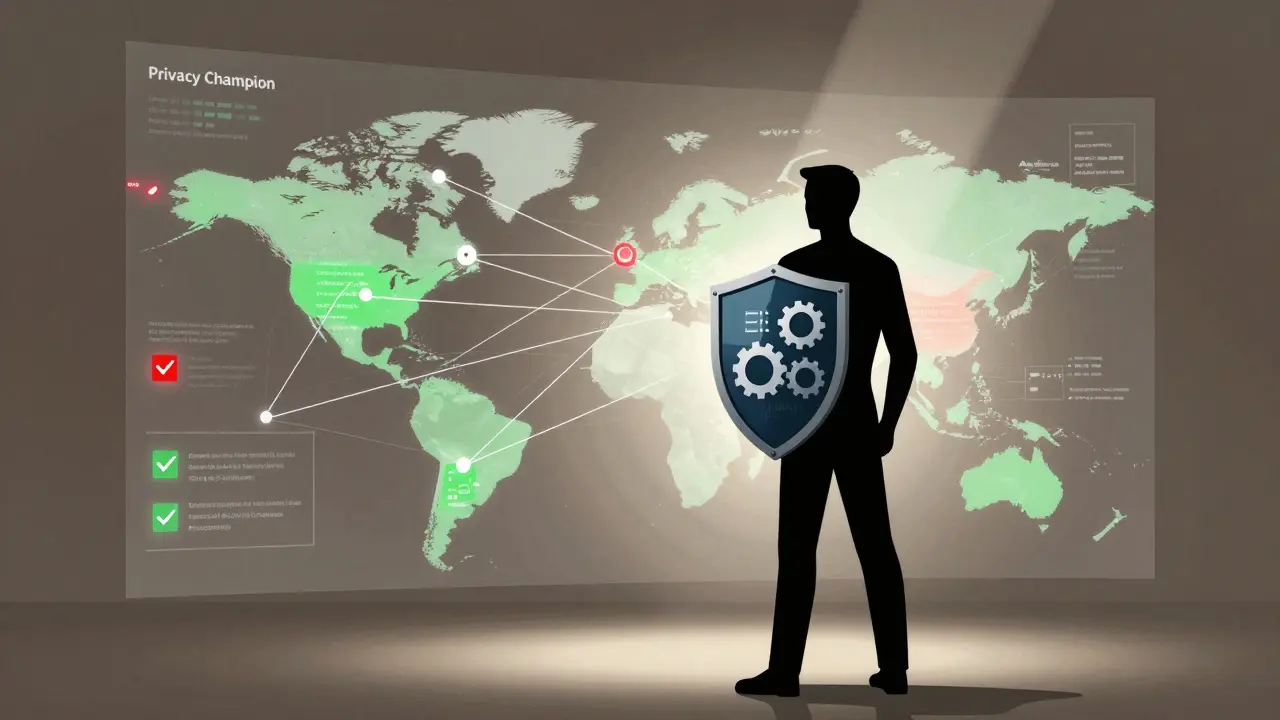
Establish a maintenance protocol. Assign a "Privacy Champion" in your team whose role is to review significant code changes generated by AI. This person doesn’t need to write code, but they must understand the data implications. When the AI refactors a user profile page, the champion verifies that no new data fields were introduced without proper consent gates.
Also, leverage version control for your data maps. Just as you track changes in Git, track changes in your RoPAs. If the AI modifies a data retention policy in the database configuration, the corresponding entry in your data map should be updated simultaneously. This linkage ensures that audits reveal a consistent story between what the code does and what the documentation says.
Finally, remember that regulators care about outcomes, not just tools. Whether you use Copilot, Cursor, or another AI assistant, the responsibility for compliance remains with your organization. As the European Data Protection Board stated in December 2025, organizations must document AI/ML data flows separately, including training data sources and model outputs. If your vibe-coded system uses AI features that process user input to generate responses, those inputs are personal data. Map them, protect them, and respect the user’s choice.
What is the first step in data mapping for an AI-generated application?
The first step is identifying all data collection points. Since AI may introduce hidden trackers or API calls, start by scanning the generated code for external endpoints, cookies, and local storage usage. Engage all departments to ensure no shadow IT or undocumented integrations exist.
How does vibe coding affect GDPR consent requirements?
Vibe coding can lead to unintentional data collection because AI models often prioritize functionality over privacy. This risks violating GDPR’s principle of data minimization. You must explicitly prompt the AI to exclude unnecessary data and implement robust consent gates before any non-essential processing occurs.
Do I need different data maps for GDPR and CCPA?
You can use a unified data map that captures the stricter requirements of both regulations. GDPR requires detailed legal bases and processing activities, while CCPA focuses on data categories and sharing practices. A comprehensive map that includes legal bases, data types, and third-party disclosures will satisfy both.
Can automated tools replace manual data mapping?
No. Automated tools are excellent for discovery but lack contextual understanding. They can identify data fields but cannot always determine the legal basis for processing or the business purpose. Human oversight is essential to validate findings and ensure compliance with nuanced regulations like GDPR and CCPA.
How often should I update my data map in an AI-driven workflow?
In a vibe-coded environment, data maps should be updated continuously or after every significant code change. Implement automated scans that trigger map updates when new data flows are detected. Regular audits, perhaps weekly or bi-weekly, help catch discrepancies between the code and the documentation.








They want you to believe it's just code. It is not just code. The AI is watching. Every prompt is a fingerprint. They are building a cage of data and calling it convenience. You think you are the user? No. You are the product being mined by algorithms that do not sleep. Wake up.
Oh, please. Another fear-mongering article about 'vibe coding' as if developers haven't been sloppy for decades. GDPR is not a magic shield against incompetence. If your AI generates bad code, that is on YOU, not the regulation. Stop whining about compliance and start learning how to read a stack trace. Seriously. It is embarrassing how many people treat privacy laws like a suggestion box rather than a legal requirement. And don't get me started on these 'consent flows'. Users click 'agree' without reading anything anyway. So why are we pretending this solves anything? It is theater. Pure theater.
I appreciate the detailed breakdown here. It is crucial to remember that while AI speeds up development, it does not absolve us of responsibility. I have seen teams struggle with this exact issue. The key is to integrate privacy checks early in the pipeline. Do not wait until deployment. Use automated scanning tools as suggested, but always pair them with human review. This hybrid approach ensures both speed and compliance. Keep up the good work sharing these insights.
This is absolutely brilliant! I love how you break down the invisible complexities of vibe coding. It is like shining a light into a dark corner. We need more energy like this in tech discussions! Let us embrace the challenge and turn our AI assistants into privacy champions. Imagine a world where every line of code respects user rights. That is the future we can build together. Go team!
Great point about the difference between GDPR and CCPA requirements! I often see people confuse the two. The table really helps clarify the distinctions. Has anyone tried using Mineos.ai for this? I am curious about its effectiveness in real-world scenarios.
its very important to respect boundaries even in code. i try to keep my prompts simple and clear. no hidden trackers. just honest code. hope everyone stays safe out there.
You are right! The speed of AI is amazing but we must stay vigilant. Short bursts of focused auditing can make a huge difference. Keep pushing forward!
Love this perspective! 🌟 Privacy is a right, not a luxury. Let us keep advocating for ethical AI use. 💖
Just read through. Seems like a lot of work for something that should be automatic. But yeah, better safe than sorry.
I understand the frustration. It feels overwhelming at first. But taking small steps helps. Start with one module. Then another. You got this.