How to Keep LLMs Safe During Fine-Tuning: A Practical Guide
There is a nasty habit in the world of artificial intelligence. You take a large language model that behaves perfectly well, you teach it your specific task, and suddenly it starts spitting out nonsense or worse. It’s like training a polite dog to fetch newspapers, only for it to start biting the mailman when you aren’t looking. This isn’t just a glitch; it is a fundamental mathematical conflict between learning new skills and keeping old manners.
If you are fine-tuning an LLM is a machine learning model designed to process and generate human-like text based on vast amounts of data, you need to know that standard methods often break its safety guardrails. Research shows that after benign fine-tuning, some models see their attack success rates jump from roughly 11% to over 40%. That is a massive drop in security for a modest gain in performance. The good news? We have figured out how to stop this from happening without sacrificing the quality of your results.
Why Fine-Tuning Breaks Safety
To fix the problem, we first need to understand why it happens. Most modern LLMs go through a rigorous safety training process before they ever reach your hands. This involves Supervised Fine-Tuning (SFT) with curated safe responses, Reinforcement Learning from Human Feedback (RLHF), and Constitutional AI training. These steps teach the model to refuse harmful requests while staying helpful.
The issue arises because these safety features are not deeply etched into every single parameter of the model. They are often superficial or concentrated in specific areas. When you apply standard gradient-based optimization to adapt the model for a new task, you update millions of parameters. If the gradients (the directions in which the model learns) for your new task point in a different direction than the safety constraints, the model drifts away from its "safe basin." It essentially forgets what it was told not to do because the math prioritizes getting the new task right over remembering the old rules.
Think of it like renovating a house. You want to add a kitchen extension (your task). But if you pull down the wrong wall (update the wrong parameters), you might accidentally compromise the structural integrity (safety) of the entire building. Standard fine-tuning pulls down walls indiscriminately.
Surgical Approaches: Gradient Surgery
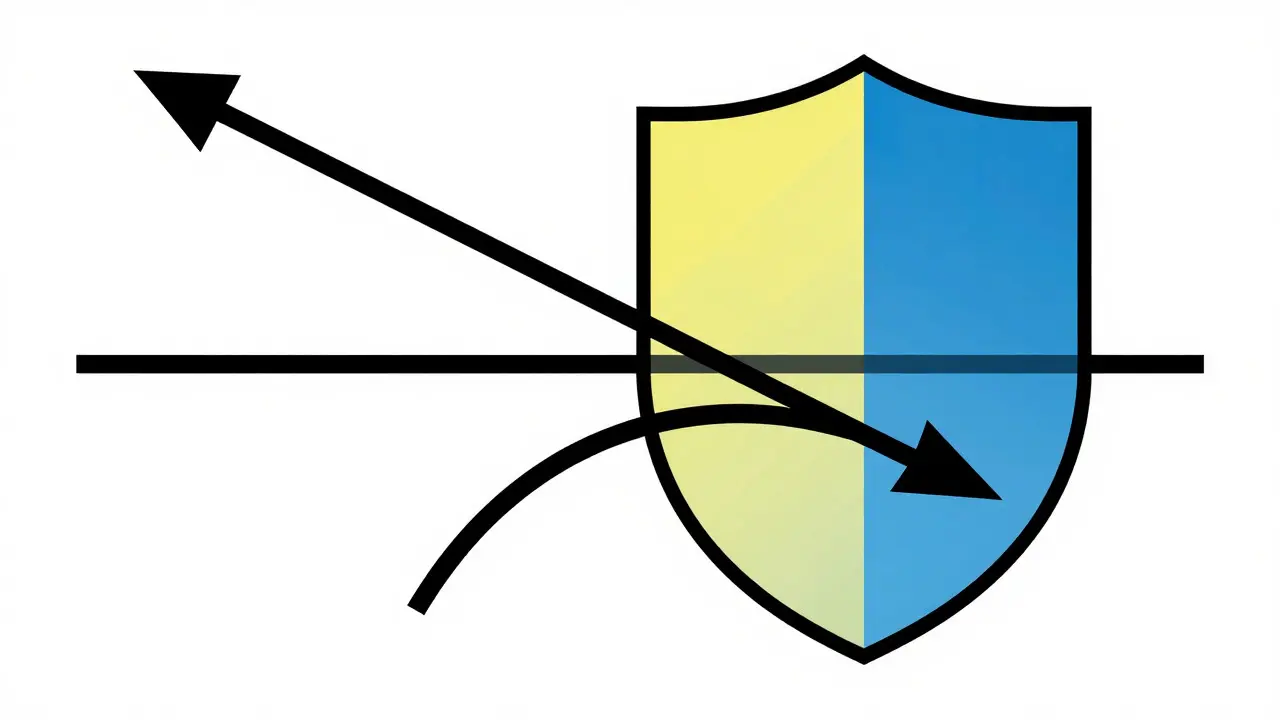
One of the most effective ways to prevent this drift is to be surgical about how you update the model. Instead of letting the model learn freely, you can manually remove the parts of the learning signal that hurt safety. This technique is known as SafeGrad is a gradient surgery method that projects task gradients orthogonal to safety gradients to preserve alignment.
Here is how it works in plain English. When the model calculates how to improve for your task, it also calculates how that improvement affects its safety. If the two goals conflict-meaning learning the task makes the model less safe-the algorithm subtracts the conflicting part. Mathematically, it looks at the dot product of the task gradient and the safety gradient. If they point in opposite directions, SafeGrad nullifies the harmful component.
The result is impressive. Studies show that SafeGrad can achieve 85-90% of the task performance you would get from standard fine-tuning while maintaining 92-95% of the original safety alignment. It allows the model to learn your specific job without forgetting its manners. For high-stakes applications like healthcare or finance, this is often the baseline requirement.
Freezing the Right Layers
Another powerful strategy relies on a surprising discovery about where safety lives inside a neural network. It turns out that safety information isn't spread evenly. In many models, the critical safety mechanisms are concentrated in the middle layers.
For example, in a 40-layer model, layers 15 through 25 often hold the keys to ethical reasoning and refusal behaviors. The early layers handle basic input processing, and the late layers focus on generating the final text output. By identifying these critical safety layers through ablation studies, you can simply freeze them during fine-tuning.
This means those layers don't change at all. You only train the remaining layers. To make sure the frozen layers still communicate effectively with the trained ones, you can add small trainable adapter modules. This approach yields significant performance-safety trade-offs. You lose a tiny bit of flexibility in learning the new task, but you gain a massive boost in stability. It is like reinforcing the foundation of a building so you can safely remodel the upstairs.
| Technique | Mechanism | Safety Retention | Task Performance Impact | Best Use Case |
|---|---|---|---|---|
| Standard Fine-Tuning | Update all parameters | Low (often <50%) | High (Baseline) | Low-risk experiments |
| SafeGrad | Gradient projection | High (92-95%) | Medium-High (85-90%) | Healthcare, Finance |
| Layer Freezing | Freeze middle layers | Very High | Medium | Customer Service, Education |
| Safety-Aware Probing | Monitor gradient flow | High | Medium-High | General purpose adaptation |
Monitoring and Dynamic Shaping
Even with the best techniques, safety can degrade subtly over time. This is why continuous monitoring is non-negotiable. You should evaluate safety at regular intervals during training-say, every N steps. Use a benchmark suite of safety tests to check if the model is slipping. If safety drops below 95% of the baseline, you have two options: roll back to the previous checkpoint or reduce the learning rate immediately.
A newer framework called Dynamic Safety Shaping (DSS) takes this a step further. Instead of just checking the final answer, DSS uses guardrail models to evaluate partial responses as they are being generated. It tracks how safety risk evolves segment by segment. If a response starts going off the rails, the system reinforces the safe parts and suppresses the unsafe content in real-time. This provides a much finer-grained control over the model's behavior.

Choosing Your Strategy Based on Risk
Not every project needs the same level of protection. Your choice of technique should depend on the risk level of your application.
- High-Risk Applications: Think healthcare diagnostics, legal advice, or financial trading. Here, a mistake is costly. You should combine multiple techniques: use SafeGrad for gradient management, freeze critical layers, and implement continuous monitoring. Do not cut corners here.
- Moderate-Risk Applications: Customer service bots or educational tools benefit from Safety-Aware Probing plus regularization. You want the model to be helpful but not wildly incorrect or offensive.
- Research and Experimentation: If you are just testing ideas, start with layer freezing. It is computationally cheaper and easier to implement. Add gradient surgery only if you notice significant safety degradation.
For API-deployed LLMs or telecom-specific use cases, integrating safety instruction examples (SafeInstruct) or post-hoc subspace projection (SafeLoRA) can restore alignment regardless of the training data composition. These methods ensure that even if your dataset has some noise, the core safety vectors remain intact.
Practical Implementation Tips
When you start implementing these strategies, keep a few practical tips in mind. First, always maintain a reference model. This is your "super-aligned" version of the LLM before any fine-tuning. You will use this reference to calculate safety gradients and measure drift. Without a clear baseline, you won't know if you are succeeding or failing.
Second, pay attention to your prompt templates. System prompts play a crucial role in protecting models. The templates you use during fine-tuning should match those used during inference. Specific template choices significantly influence downstream safety behavior. Consistency here acts as an additional layer of defense.
Finally, remember that there is no free lunch. There is always a trade-off between safety and capability. Imposing strict alignment penalties guarantees bounded safety gaps, but your achievable downstream performance depends on how similar your new data is to the original training set. Tune your penalty coefficients carefully. Monitor both empirical safety and utility gaps. Aim for the Pareto-optimal front where you get the best possible task performance without unacceptable safety risks.
Fine-tuning doesn't have to mean breaking your model. By treating safety as a first-class citizen in your training pipeline rather than an afterthought, you can build specialized AI systems that are both highly capable and reliably safe. The tools exist; you just need to choose the right ones for your context.
What is the biggest risk of standard LLM fine-tuning?
The biggest risk is the dramatic loss of safety alignment. Standard fine-tuning can cause attack success rates to quadruple, making the model vulnerable to jailbreaks and harmful outputs because the new task gradients overwrite the subtle safety constraints learned during pre-training.
How does SafeGrad work?
SafeGrad uses gradient surgery to identify and remove components of the learning signal that conflict with safety. It projects the task gradients orthogonally to the safety gradients, ensuring that the model learns the new task without moving away from its safe parameter space.
Which layers of an LLM contain safety information?
Research indicates that safety alignment often concentrates in the middle layers of the model. For a typical 40-layer model, layers 15 through 25 are critical for safety. Freezing these layers during fine-tuning helps preserve alignment while allowing other layers to adapt to new tasks.
Is continuous monitoring necessary during fine-tuning?
Yes. Safety can degrade subtly over training steps. Monitoring at regular intervals allows you to detect drift early. If safety falls below a threshold (e.g., 95% of baseline), you can trigger a rollback or reduce the learning rate to prevent catastrophic failure.
What is the best approach for high-risk applications like healthcare?
For high-risk applications, a combination approach is recommended. Use SafeGrad for gradient management, freeze critical middle layers, and implement continuous safety monitoring. This multi-layered defense ensures maximum robustness against safety failures.