Marketing Content at Scale with Generative AI: Product Descriptions, Emails, and Social Posts
Imagine launching 200 new products next month. Each one needs a unique description, a personalized email sequence, and three social media posts. If you’re doing this by hand, you’re looking at weeks of work-maybe months. Now imagine doing it in a single day. That’s not science fiction. It’s what companies are doing right now with generative AI.
How Generative AI Actually Works for Marketing
Generative AI doesn’t just copy-paste old content. It learns patterns. Give it 500 of your best product descriptions, 1,000 high-performing emails, and 2,000 top-rated social posts, and it starts to understand your voice, your tone, even your quirks. It doesn’t memorize-it predicts. Like how your brain finishes someone’s sentence, these models predict the next word, the next image, the next emoji based on what they’ve seen before.Tools like Jasper, Copy.ai, and Writer.com use large language models trained on billions of text samples. They’re not magic. They’re math. But the math works. A team at a mid-sized outdoor gear brand used AI to generate 1,200 product descriptions in 18 hours. Previously, that took their copywriters six weeks. The catch? They spent the next week editing. Not because the AI was bad-but because brand voice is subtle. One word can make it feel robotic or real.
Product Descriptions That Don’t Sound Like Robots
Product descriptions are the easiest place to start with AI. Why? They’re structured. You need features, benefits, materials, sizing, use cases. That’s easy for AI to mimic.But here’s where most teams fail: they let the AI run wild. You end up with descriptions like: “This ergonomic backpack is perfect for your daily commute.” Sounds like every other brand on the planet. What makes your backpack different? Is it the waterproof zipper? The hidden pocket for your earbuds? The fact it’s made from recycled ocean plastic?
Successful teams feed the AI their best-performing descriptions and add a style guide. Not just “be casual.” But “use contractions, mention real-life situations (like ‘forgetting your coffee at home’), and never say ‘premium’-say ‘built to last.’” Burberry did this with their signature check pattern. They trained the AI on decades of their marketing materials. Result? Seasonal product launches cut from 10 weeks to five. And customers didn’t notice a difference-because it still sounded like Burberry.
Emails That Feel Human, Not Automated
Emails are trickier. People open them because they trust you. If your subject line says “Your exclusive offer inside!” and the body reads like a textbook, you’re dead in the water.Top performers use AI to draft, not write. They start with a template: “Hi [Name], we noticed you left [Product] in your cart. Here’s why people like you loved it.” Then they tweak. They add a line about the customer’s last purchase. They mention a local event. They throw in a joke only their audience would get.
Spotify does this at scale. Their AI doesn’t just recommend songs. It analyzes what you skip, how long you listen, and even the time of day. Then it writes emails like: “You listened to ‘Midnight Drive’ 17 times last week. Here’s a playlist for when you’re stuck in traffic tomorrow.” That’s not generic. That’s personal. And it increased engagement by 40%.
For smaller brands, start simple. Use AI to rewrite your top 10 email templates. Then compare open rates. If one AI version performs 15% better, keep it. If it feels flat, rewrite it yourself. AI is your assistant, not your replacement.
Social Posts That Spark Real Conversations
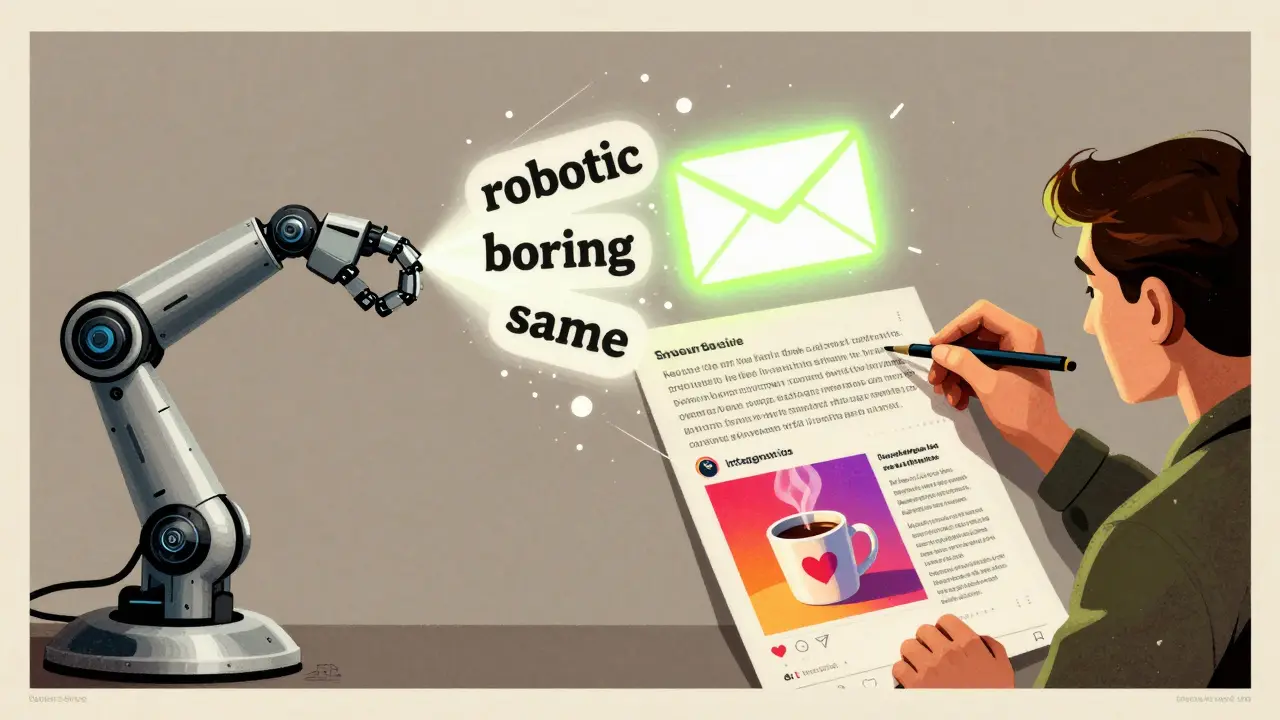
Social media is noise. If your AI-generated post says “Love our new line? Tap to shop!”-it’s going to get ignored. But if it says “We asked 50 customers to wear these boots in the rain. Here’s what happened…”-that’s curiosity. That’s storytelling.AI can help you brainstorm angles. Ask it: “Give me 10 post ideas for our new coffee mug that feel like a friend talking.” Then pick the ones that sound like you. Use AI to write captions, but always add a human twist. A photo of the mug with steam rising? Add a caption like: “This mug survived my 7 a.m. panic attack. You’re welcome.”
One skincare brand used AI to generate 50 Instagram captions for their new serum. They tested them. The top performer? “My skin doesn’t need a vacation. But it deserves this.” It got 3x more comments than their average post. Why? It felt like a confession, not an ad.
The Tools That Actually Work in 2025
Not all AI tools are built the same. Here’s who’s winning right now:- Jasper: Best for long-form content. Used by 100,000+ brands. Strong for product pages and email sequences. But 32% of users say it struggles with brand voice consistency.
- Copy.ai: Super easy for beginners. 4.6/5 rating. Great for quick social posts and headlines. But 27% of negative reviews say outputs feel generic.
- Writer.com: Adopted by 30% of Fortune 500 companies. Built for brand control. You upload your tone guide, and it sticks to it. Costs 20% more, but worth it if you’re scaling.
- HubSpot AI: If you already use HubSpot, this is your best bet. Integrates with your CRM. Generates emails based on lead behavior. But the learning curve is steep if you’re new to their platform.
- Contents: The quiet giant. $9M ARR in 2024. Specializes in brand consistency. Trains models on your exact content. Used by companies who can’t afford to sound like everyone else.
Most teams use two: one for drafting (like Copy.ai) and one for brand control (like Writer.com). It’s not about picking the best tool. It’s about picking the right combo.
Why 65% of AI Marketing Projects Fail
You’ve probably heard the hype. “AI will save you 80% of your time!” But McKinsey’s 2025 survey found 65% of companies struggle with content quality control. Why?Because they skip the setup. They plug in the tool. Hit generate. And post. No training. No editing. No rules.
Here’s what actually works:
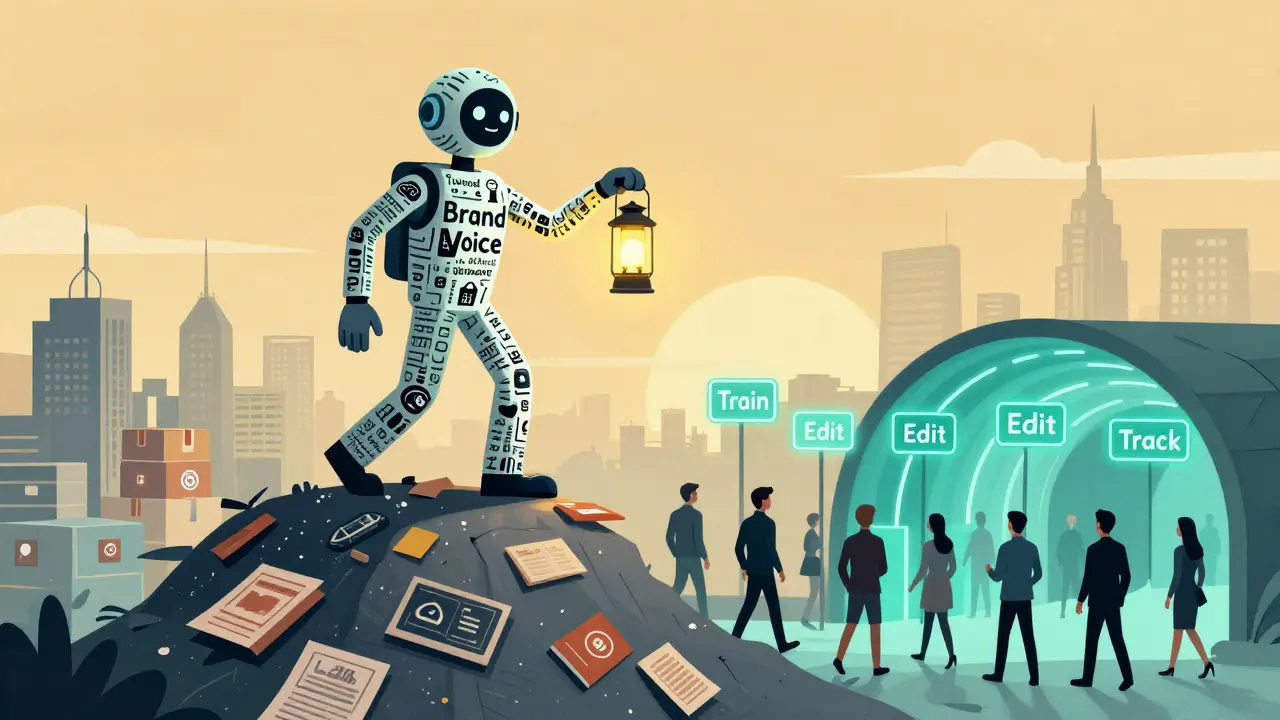
- Train the AI: Feed it 100 of your best pieces. Not just any content-your highest converting stuff.
- Build a style guide: Not “be friendly.” But “use ‘you’ not ‘customers,’ avoid corporate jargon, never use exclamation points in emails.”
- Set up a review loop: Assign one person to edit every AI output. Don’t skip this. Even the best tools make up facts. 15-20% of AI outputs contain hallucinations.
- Track performance: Compare AI-generated content vs. human-written. Which gets more clicks? More shares? More sales?
One retail brand skipped all of this. They used AI to write 5,000 product descriptions. Within a month, customer complaints spiked. Turns out, the AI said their hiking boots were “waterproof up to 10 feet.” They weren’t. Sales dropped 30%. They had to pull everything.
What’s Next? AI Agents and Multi-Modal Workflows
The next leap isn’t just writing better text. It’s building AI teams.By 2026, marketers won’t just use AI to write. They’ll use AI to manage the whole process. Think of it like a virtual assistant that can:
- Write a product description
- Generate a matching Instagram image
- Send an email to customers who viewed the product
- Track engagement and adjust the next post
Tools like n8n, GPT AgentKit, and Google’s Opal are making this real. One beauty brand now runs their entire launch cycle with AI agents. No human touches the copy until it’s ready to go live. Result? 50% faster launches, 22% higher conversion.
But here’s the catch: you still need humans to set the rules. AI doesn’t know what your brand stands for. Only you do.
Regulations Are Coming
The EU AI Act went live in March 2025. It requires companies to label AI-generated content in ads, emails, and social posts. Same rules are coming to the U.S. This isn’t about transparency-it’s about trust.Brands that hide AI use will lose credibility. Brands that say, “We use AI to help us create better content, but every piece is reviewed by our team,” will build stronger relationships.
Don’t fight the regulation. Use it as a selling point. Transparency is the new authenticity.
Where to Start Today
You don’t need a big budget. You don’t need a tech team. Here’s your 3-step plan:- Pick one channel: Start with product descriptions. They’re low-risk and high-reward.
- Feed it your best work: Take 20 of your top-performing descriptions and upload them to Copy.ai or Jasper.
- Set a review rule: Every AI output gets one human edit before going live.
Do that for 30 days. Track your time saved. Track your sales. If you’re saving 10 hours a week and your conversion rate stays the same-you’ve won.
Generative AI isn’t replacing marketers. It’s replacing busywork. The best marketers aren’t the ones who write the most. They’re the ones who think the most. And now, AI gives them the time to do exactly that.


bro i tried using copy.ai for our product descriptions and it sounded like a robot wrote them after a caffeine overdose. then we fed it 20 of our best ones with a dumb little style guide like 'say 'you' not 'customers' and never use 'premium' - say 'built to last' - and holy shit it got way better. now it sounds like us. not some corporate ghost.
the real win here isn't speed - it's consistency. i work at a midsize skincare brand and we used to have 5 different 'voices' across 300 SKUs. AI doesn't care about who wrote what last week. if you train it right, it learns the cadence, the quirks, the damn em dashes you love. now our emails feel like they came from the same person - even though 7 people touch them. also, jasper is garbage for tone. writer.com is the only one that actually remembers your style guide. don't waste your time.
oh wow. so we're just gonna ignore that 15% of AI outputs hallucinate facts? like that hiking boot company that said 'waterproof up to 10 feet'? because that's not a typo - that's a lawsuit waiting to happen. also, 'contents' is spelled wrong in the article. it's 'Contentful' or 'Rasa' or something. and why is there no mention of Anyword? they're doing way better on brand consistency. also - 'you're welcome' as a caption? that's not a twist. that's cringe. and you call that storytelling? please. this whole thing reads like a sponsored post for Jasper.
you people are delusional. AI isn't saving time - it's replacing souls. you think customers don't notice when a brand stops sounding human? they feel it. they smell it. i used to love this one coffee brand - their emails were like letters from your weird, brilliant uncle. now? every one of their 'personalized' emails starts with 'Hey [Name], we noticed you left [Product] in your cart.' NO. YOU DIDN'T NOTICE. YOU SCRAPED A DATASET. YOU LOST THE HEART. and now I'm unsubscribing. not because it's bad - because it's empty. and that's worse than failure.
i read this whole thing carefully and i think the most important part is not the tools or the speed or even the editing - it's the mindset shift. before, we thought marketing was about writing more. now we realize it's about thinking deeper. ai takes the grind away - the 12-hour days rewriting the same damn product description 20 times - and gives us space to ask better questions. why does our customer feel lonely when they buy this? what hidden fear does this product solve? what story do they tell themselves when they use it? those are the things ai can't generate. only humans can. and if we stop doing that work - if we let the machine write the soul - then we're not marketers anymore. we're just data janitors. and i don't want to be that. so i train the ai, i edit it, i add the human whisper - and then i let it go. it's not magic. it's responsibility.