Multi-Agent Systems with LLMs: Collaboration and Role Specialization Guide
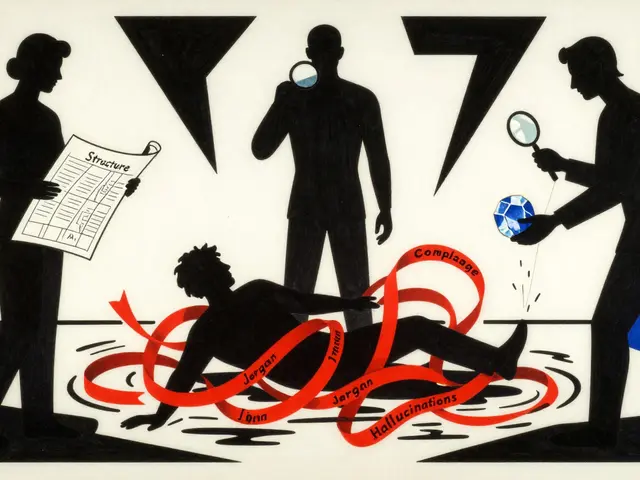
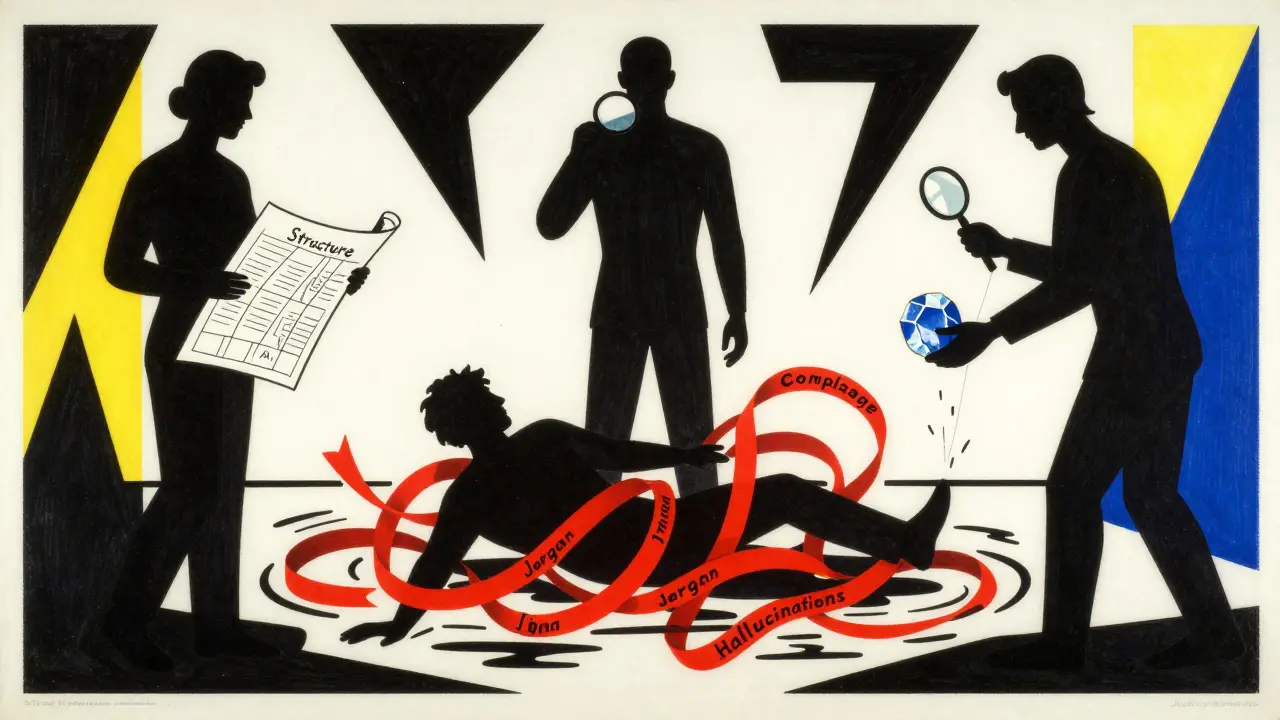
Imagine trying to write a complex legal contract alone. You’d likely miss key clauses, get bogged down in jargon, or simply run out of steam. Now imagine handing that task to a team: one expert drafts the structure, another checks for regulatory compliance, and a third polishes the language. This is exactly what Multi-Agent Systems (MAS) are doing for Large Language Models (LLMs). Instead of relying on a single, monolithic AI model to handle everything, developers are now orchestrating teams of specialized agents that collaborate to solve problems no single model could tackle effectively.
The shift from isolated models to collaborative frameworks represents a fundamental change in how we build AI applications. In 2023 and 2024, researchers realized that while individual LLMs were powerful, they struggled with multi-faceted problems requiring diverse reasoning steps. The solution? Collective intelligence. By mimicking human teamwork, these systems allow multiple LLM instances to share information, debate solutions, and specialize in specific roles. The result is often higher accuracy, better creativity, and more robust decision-making than any single agent could achieve on its own.
Why Single Agents Fall Short
To understand why multi-agent systems are gaining traction, you first need to see where single LLMs hit a wall. A standard LLM processes input sequentially. When faced with a task that requires coding, data analysis, and creative writing simultaneously, it has to context-switch internally. This often leads to diluted focus or hallucinations-where the model confabulates facts because it’s trying to do too much at once.
Consider a scenario where you ask an LLM to analyze a 100-page financial report and then write a summary for investors. A single model might lose track of earlier details as it reaches the end of the document (the "lost in the middle" phenomenon). It might also struggle to balance technical accuracy with persuasive tone. With a multi-agent approach, you can assign one agent to extract key metrics, another to verify those numbers against external sources, and a third to craft the narrative. Each agent operates within its zone of expertise, reducing cognitive load and error rates.
This isn't just about splitting tasks; it's about leveraging social dynamics. Research published in the ACL Anthology shows that LLM agents exhibit human-like behaviors such as conformity and consensus-building. When agents interact, they can correct each other’s biases. For instance, if one agent hallucinates a fact, a second agent acting as a verifier can catch it before the final output is generated. This collaborative verification loop is a core advantage of MAS over standalone models.
Key Frameworks Defining the Landscape
As of late 2025, several frameworks have emerged to make building these systems easier. They differ significantly in architecture, efficiency, and use cases. Understanding these differences is crucial for choosing the right tool for your project.
| Framework | Core Mechanism | Best Use Case | Efficiency Gain | Complexity Level |
|---|---|---|---|---|
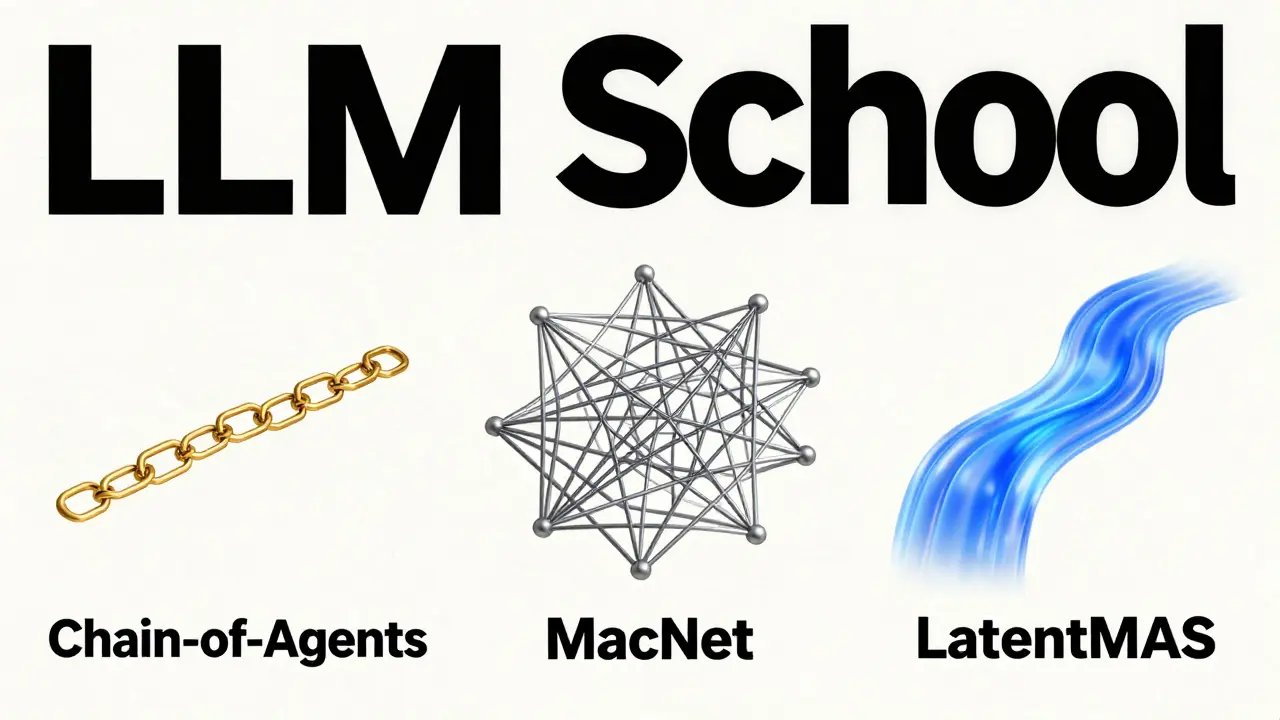
| Chain-of-Agents (CoA) | Sequential collaboration | Long-context tasks (QA, summarization) | Up to 10% improvement over RAG | Low (Training-free) |
| MacNet | Directed Acyclic Graphs (DAGs) | Creative tasks, large-scale coordination | 7.3% better than regular topologies | High (Topology config required) |
| LatentMAS | Latent space collaboration | Cost-sensitive, high-speed inference | 70-83% less token usage | Medium (Requires latent model access) |
Chain-of-Agents (CoA), introduced by Google researchers in early 2025, takes a sequential approach. It passes context from one agent to the next like a relay race. This is particularly effective for long-context tasks where information needs to be refined step-by-step. Because it’s training-free, you can implement it quickly without fine-tuning models. However, it can incur higher API costs due to repeated text-based communication between agents.
MacNet, developed by OpenBMB, uses a network topology based on directed acyclic graphs. This allows hundreds or even thousands of agents to collaborate in irregular structures. It excels in creative domains where diverse perspectives are needed. For example, in code generation tasks, MacNet showed a 15.2% improvement over single agents. The trade-off is complexity; configuring the graph topology has a steep learning curve, and response times can slow down significantly with large agent counts (up to 2.3x slower with 100 agents).
LatentMAS, released in November 2025, offers a breakthrough in efficiency. Instead of agents communicating via text (which consumes tokens and time), they exchange information in continuous latent space-the internal mathematical representation of the model’s understanding. This reduces output token usage by up to 83.7% and speeds up inference by four times. If cost and speed are your primary constraints, LatentMAS is currently the most compelling option.
Designing Effective Role Specialization
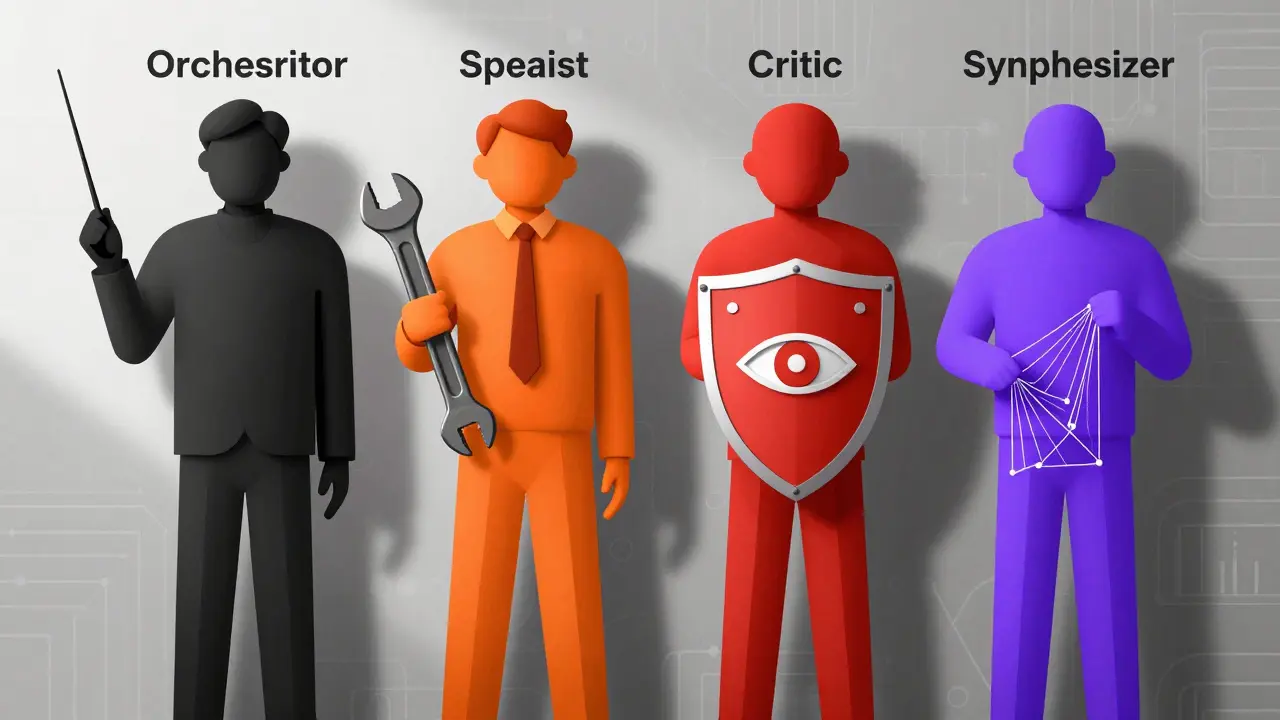
The magic of multi-agent systems lies in role specialization. You don’t just create generic assistants; you define precise personas with constrained action spaces. Here’s how to structure roles for maximum effectiveness:
- The Orchestrator: This agent breaks down the user’s high-level request into subtasks. It doesn’t do the heavy lifting but manages the workflow. Think of it as a project manager.
- The Specialist: These agents handle specific domains. For a travel planning app, you might have a "Flight Finder," a "Hotel Booker," and a "Local Guide." Each specialist has access to relevant tools (e.g., APIs) and knowledge bases.
- The Critic/Verifier: Crucial for quality control. This agent reviews outputs from specialists for factual accuracy, tone consistency, and safety. It can reject work and send it back for revision.
- The Synthesizer: Finally, this agent combines the verified outputs into a cohesive final product. It ensures smooth transitions between sections and maintains a unified voice.
When defining these roles, clarity is key. Vague prompts lead to vague results. Instead of saying "be helpful," specify "act as a senior Python developer who prioritizes PEP 8 compliance and security best practices." Constrained action spaces prevent agents from drifting off-topic or hallucinating unrelated content.
Implementation Challenges and Pitfalls
Building a multi-agent system is not plug-and-play. Developers report 40-60% longer development times compared to single-agent implementations. Why? Because you’re now managing distributed logic, communication protocols, and potential conflicts.
Debugging Complexity: When an error occurs, it’s hard to trace which agent caused it. Did the Orchestrator misassign the task? Did the Specialist hallucinate data? Or did the Synthesizer garble the final output? Tools like LangSmith or custom logging pipelines are essential. You need to log every inter-agent message to reconstruct the conversation history.
Error Propagation: If Agent A makes a mistake, Agent B might build on that mistake, compounding the error. This is known as cascading failure. To mitigate this, implement strict validation steps. For example, require the Critic agent to cross-reference all facts before passing them to the Synthesizer.
Coordination Overhead: Communication costs add up. In text-based systems like CoA, every message exchanged consumes tokens. If you have 10 agents talking back and forth five times, you’re making 50 API calls. LatentMAS solves this partially, but for traditional setups, you must optimize the number of interaction rounds. Limit debates to two rounds unless necessary.
Bias Amplification: A cautionary note from Dr. Emily Bender at the 2025 ACM Conference: multi-agent systems can amplify biases through collaborative reinforcement. If multiple agents share a similar underlying bias, their consensus might strengthen that bias rather than correct it. Always include diverse perspectives in your agent design and test for fairness explicitly.
Practical Steps to Get Started
If you’re ready to build your first multi-agent system, follow this streamlined workflow:
- Define the Problem: Start with a task that is too complex for a single prompt. Examples include multi-step research, code refactoring across multiple files, or generating comprehensive business reports.
- Choose Your Framework: For quick prototypes, try Chain-of-Agents. For cost-efficiency, explore LatentMAS. For complex creative workflows, look at MacNet.
- Design Roles: Map out the agents needed. Write detailed system prompts for each, including their goals, constraints, and communication style.
- Set Up Communication Protocols: Decide how agents will talk. Will they pass full context summaries? Only key findings? Define the format (JSON, structured text) to ensure parsing reliability.
- Implement Memory: Use a shared context store (like Redis or a vector database) so agents can access intermediate results without re-sending entire conversations.
- Test and Iterate: Run small tests. Monitor token usage and latency. Adjust role definitions if agents are underperforming or conflicting.
Expect a learning curve. Most developers spend 2-3 weeks mastering basic orchestration patterns. Don’t try to build a 50-agent system on day one. Start with three agents: Planner, Worker, and Reviewer. Once that works smoothly, scale up.
Future Trends and Market Outlook
The market for multi-agent LLM technologies is exploding. IDC estimates the sector reached $2.8 billion in Q4 2025, projected to grow to $14.7 billion by 2028. Gartner predicts that by 2027, 65% of enterprise LLM deployments will use multi-agent architectures, up from just 12% in 2025.
We’re seeing rapid adoption in industries like finance (for risk analysis), healthcare (for diagnostic support), and software development (for automated code review). Cloud providers like AWS Bedrock and Google Vertex AI are integrating native multi-agent support, lowering the barrier to entry.
Looking ahead, expect greater standardization. The IEEE formed a working group in September 2025 to establish standards for multi-agent collaboration protocols. This will help interoperability between different frameworks. Additionally, research into "self-organizing agent collectives" suggests future systems might automatically determine the optimal number and type of agents for a given task, removing the need for manual role definition.
What is the main difference between Multi-Agent Systems and single LLMs?
Single LLMs process tasks sequentially within one model instance, which can lead to context loss and hallucinations on complex tasks. Multi-Agent Systems use multiple specialized LLM instances that collaborate, share information, and verify each other's work, leading to higher accuracy and better handling of multi-faceted problems.
Which framework is best for cost-effective multi-agent deployment?
LatentMAS is currently the most cost-effective option. By enabling collaboration in latent space rather than through text, it reduces token usage by 70-83% and speeds up inference significantly, making it ideal for budget-conscious projects.
How do I prevent errors from propagating between agents?
Implement a dedicated Critic or Verifier agent in your workflow. This agent should check outputs for factual accuracy and logical consistency before they are passed to the next stage. Additionally, limit the number of interaction rounds and use structured data formats for communication to reduce ambiguity.
Is multi-agent technology ready for production environments?
Yes, but with caveats. While frameworks like Chain-of-Agents and AWS Bedrock’s multi-agent features are production-ready, they require careful orchestration and monitoring. Debugging is more complex than single-agent systems, so robust logging and testing strategies are essential before full deployment.
What skills do I need to build a multi-agent system?
You need advanced LLM prompting techniques, system architecture design skills, and familiarity with distributed systems concepts. Proficiency in Python is essential, along with experience using orchestration libraries like LangChain or AutoGen. Understanding graph theory helps when working with frameworks like MacNet.