Next-Generation Generative AI Hardware: Accelerators, Memory, and Networking in 2026
By early 2026, the race for AI dominance isn’t just about better models anymore-it’s about the silicon underneath them. If you thought last year’s AI breakthroughs were impressive, wait until you see what’s powering the next wave. The real revolution isn’t happening in code. It’s happening in chips, memory, and the networks that connect them. Companies aren’t just upgrading hardware-they’re rebuilding the entire foundation of how AI runs. And if you’re not paying attention to accelerators, memory bandwidth, or networking design, you’re missing the biggest shift in computing since GPUs took over deep learning.
Accelerators: Beyond GPUs and Into Specialized Silicon
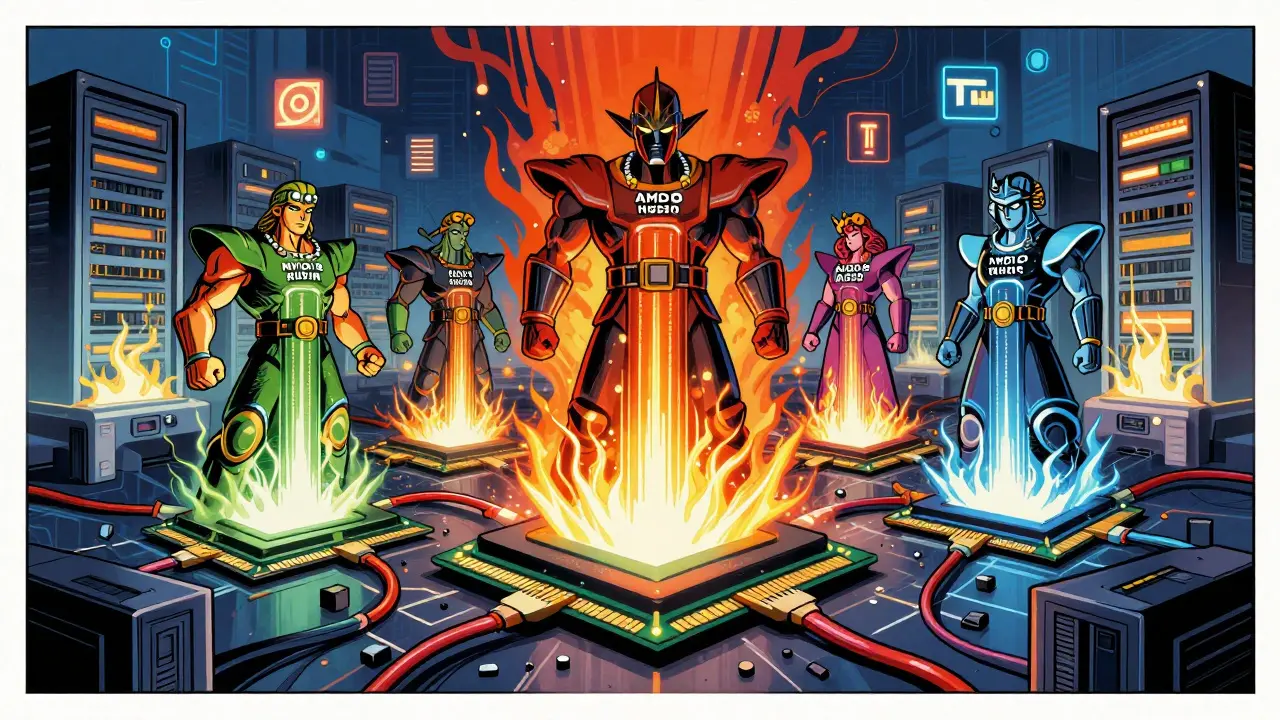
For years, NVIDIA’s GPUs were the only game in town for training massive AI models. But 2026 is the year that changed. NVIDIA’s Rubin platform is now shipping, built on HBM4 memory and a new architecture designed to handle trillion-parameter models with ease. But NVIDIA isn’t alone anymore.
AMD’s MI400/MI450 "Helios" systems are hitting datacenters with 35x faster inference than the MI300. These chips use CDNA 4 architecture and HBM4 memory running at 19.6 TB/s-enough bandwidth to keep even the hungriest LLMs fed. AMD’s strategy? Offer performance close to NVIDIA’s, but at a lower price point. Enterprises that got burned by NVIDIA’s premium pricing are switching in droves.
Then there’s Microsoft’s Maia 200. This isn’t just another chip-it’s a rethinking of inference. Built on TSMC’s 3nm process, Maia 200 has 216GB of HBM3e memory and 272MB of on-chip SRAM. Its secret sauce? Native FP8 and FP4 tensor cores. That means it can generate text tokens faster and cheaper than any GPU on the market. Microsoft claims it delivers three times the FP4 performance of Amazon’s Trainium3. And it’s not just about raw speed-it’s about cost per token. For companies running chatbots at scale, that’s the difference between profit and loss.
Google’s TPUs are evolving too. While details are scarce, the fact that Maia 200 outperforms Google’s TPU v7 means the TPU team had to step up. The new TPU v8 is rumored to feature a redesigned matrix multiplier and tighter integration with Google’s JAX framework, making it ideal for research-heavy workloads.
And then there are the outsiders. Qualcomm’s AI200 and AI250 aren’t for datacenters-they’re for edge devices. These accelerators pack massive AI performance into a power budget that fits a laptop or smartphone. By 2026, your next laptop won’t just have an AI chip-it’ll have a full-fledged inference engine that runs LLMs locally, without ever sending data to the cloud.
Intel’s Xeon 6 processors are making a comeback. Instead of trying to match GPUs, Intel built AI acceleration into every core. With up to 50% higher AI performance than AMD’s offerings and one-third fewer cores, Xeon 6 is the go-to for companies running smaller generative models on-premises. It’s not flashy, but it’s reliable-and it doesn’t require a new datacenter.
Memory: The New Bottleneck Is No Longer What You Think
Remember when we thought CPUs were slow? Now, the bottleneck isn’t the processor-it’s the memory. Modern AI models need to move data faster than ever. A single LLM can require over 200GB of memory just to load. And if the memory can’t keep up, the chip sits idle, waiting. That’s why HBM4 is the big story of 2026.
HBM4, or High-Bandwidth Memory generation 4, is the new gold standard. It delivers up to 1.5x the bandwidth of HBM3e, with lower power consumption and higher density. NVIDIA’s Rubin platform, AMD’s Helios, and even Intel’s upcoming AI accelerators all rely on HBM4. But here’s the catch: SK Hynix controls over 80% of HBM production. And they’re sold out through 2026. Companies that didn’t lock in supply early are scrambling.
Microsoft’s Maia 200 uses HBM3e-not because it’s better, but because HBM4 wasn’t available in volume. That’s a smart workaround. By using HBM3e with 216GB of memory and 7 TB/s bandwidth, Microsoft got a high-performance chip out the door on schedule. They’re betting that by 2027, HBM4 will be abundant enough to upgrade.
Qualcomm’s AI250, launching in 2027, takes memory innovation further. It uses near-memory computing-placing processing units directly next to memory stacks. This cuts latency by over 60% and boosts bandwidth by 10x compared to traditional designs. It’s a radical shift: instead of moving data to the processor, you bring the processor to the data.
And then there’s IBM’s Spyre Accelerator, which supports up to 1TB of memory across eight cards. That’s not just for training-it’s for running massive, multi-modal models that combine text, images, and video in real time. For industries like healthcare and autonomous systems, that kind of memory capacity isn’t a luxury-it’s a requirement.

Networking: How AI Chips Talk to Each Other
One chip can’t do it all. Training a model like GPT-5 requires thousands of accelerators working together. And that’s where networking becomes everything. The old days of proprietary InfiniBand fabrics are fading. In 2026, Ethernet is winning.
Microsoft’s Maia 200 introduced a two-tier scale-up network using standard Ethernet. Instead of relying on expensive, closed systems, Maia connects up to 6,144 chips with 2.8 TB/s of bidirectional bandwidth. It’s cheaper, easier to maintain, and just as fast. Companies like Dell and HPE are already building servers around this design.
NVIDIA’s MGX program still dominates the market, but now it’s being used by AMD and Intel too. That’s a sign of how fragmented the market has become. You can now build a mixed-architecture cluster with NVIDIA, AMD, and Intel chips-all connected through the same network. It’s messy, but it works.
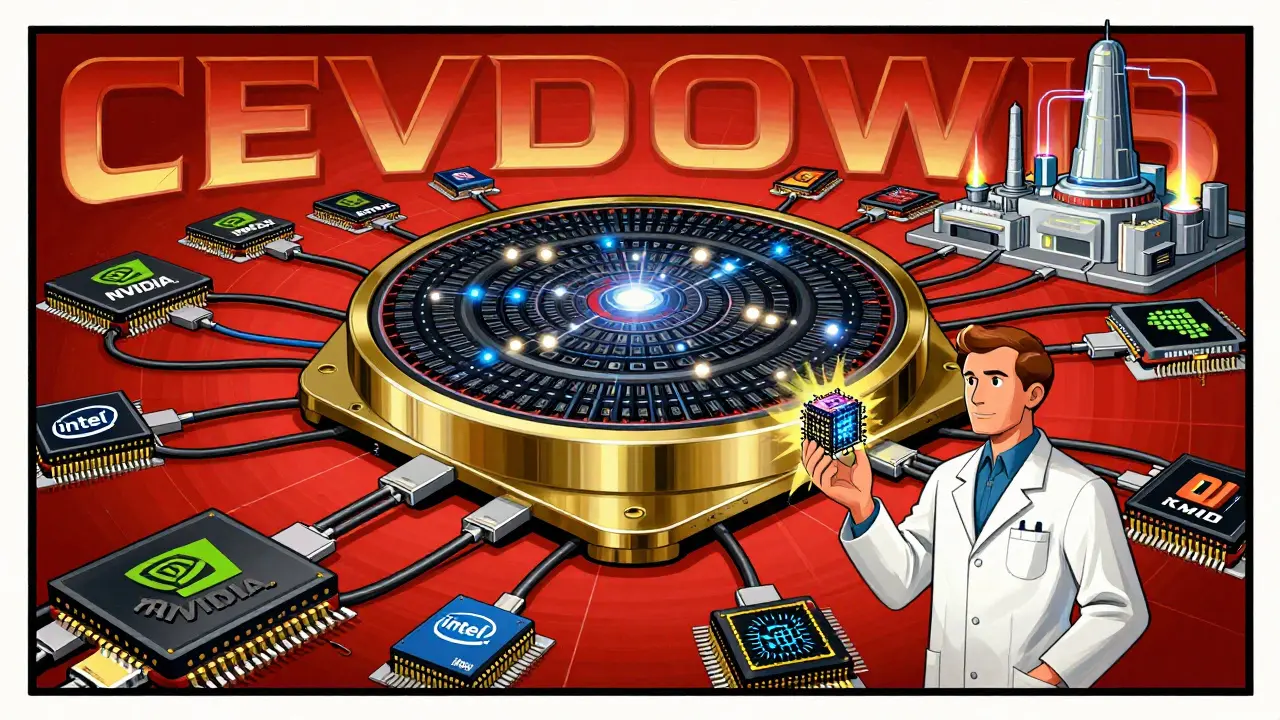
Cerebras Systems took a different route. Their Wafer-Scale Engine (WSE) doesn’t need networking at all. One chip, 850,000 cores, all on a single silicon wafer. No interconnects. No latency. No bottlenecks. It’s not for everyone-it’s huge, expensive, and power-hungry-but for organizations running massive simulations or training ultra-large models, it’s unmatched.
Even TSMC is playing a role. Their A16 process (1.6nm-class) doesn’t just shrink transistors-it improves signal integrity across chips. That means higher clock speeds and more reliable connections between accelerators. The chip isn’t just faster-it talks better.
Who’s Winning in 2026?
There’s no single winner anymore. NVIDIA still leads in training, thanks to CUDA’s ecosystem and its deep partnerships with OpenAI and Meta. But for inference? Microsoft’s Maia 200 is the new benchmark. For cost-sensitive enterprises? AMD’s Helios. For edge AI? Qualcomm’s AI200. For on-premises workloads? Intel’s Xeon 6.
The market has fractured. Companies aren’t choosing one vendor-they’re mixing and matching. A single AI cluster might use NVIDIA chips for training, AMD for batch inference, and Microsoft’s Maia for real-time chat. It’s not ideal, but it’s practical.
And then there’s the elephant in the room: manufacturing. TSMC produces nearly every AI chip in the world. Their A16 process is the backbone of Rubin, Helios, Maia 200, and Trainium3. If TSMC hits a snag, the whole AI industry slows down. That’s why every major tech company is investing in alternative foundries, backup supply chains, and even in-house chip design teams.
What Comes After 2026?
The next leap won’t be about more transistors. It’ll be about architecture. Near-memory computing. Optical interconnects. Quantum-inspired logic gates. We’re already seeing prototypes. In 2027, expect to see chips that don’t just process data-they adapt to it. Models that reconfigure their own hardware on the fly. Systems that learn how to run themselves.
For now, 2026 is the year the hardware caught up to the hype. The models are bigger. The data is denser. The demands are relentless. And for the first time, the chips are actually keeping pace.






The shift from GPU-centric to diversified accelerators is long overdue. HBM4 adoption is the real story here-not the chip names. Companies that didn’t lock in supply early are now playing catch-up with band-aid solutions. This isn’t innovation; it’s supply-chain triage.
Let’s be real-this isn’t just about hardware anymore. It’s about architectural philosophy. The move toward near-memory computing on Qualcomm’s AI250? That’s the future. We’re not optimizing for clock speed anymore-we’re optimizing for data proximity. Latency isn’t just a number; it’s the new currency of real-time AI. And when you combine that with FP4 tensor cores on Maia 200, you’re not just running inference-you’re redefining what ‘real-time’ even means. This is the infrastructure of tomorrow’s conversational agents, autonomous systems, and edge-native AI. We’re not upgrading-we’re evolving.
Oh wow, so now we’re supposed to be impressed because Microsoft used HBM3e instead of HBM4? How noble. Let’s all clap for the company that got its chip out on time because they couldn’t get the good stuff. Meanwhile, NVIDIA’s Rubin is out there with HBM4 and a full CUDA ecosystem, and everyone’s acting like AMD’s ‘lower price’ is some kind of moral victory. Please. It’s not about ethics-it’s about who has the most reliable, scalable, and supported stack. And right now? That’s still NVIDIA. The rest are just trying to look good in a press release.
I’ve been watching this space for years, and honestly? The fact that we’re even having this conversation-that companies like Intel and Qualcomm are building AI into mainstream silicon-is the real win. We’re not just talking about datacenters anymore. We’re talking about laptops that can run LLMs offline, phones that understand context without uploading your messages, and edge devices that don’t rely on cloud APIs. That’s not just progress-it’s liberation. The AI revolution isn’t about who has the biggest cluster. It’s about who puts power back into the hands of the user. And that’s what makes this moment historic.
TSMC’s A16 process is the unsung hero here. Everything else is just building on top of it. If TSMC slips, we all slip. And nobody’s talking about that. Also, mixed clusters are inevitable. You don’t need to pick a side. Just use what works. No drama needed.
I must point out, with meticulous attention to linguistic precision, that the phrase 'the chips are actually keeping pace' is grammatically correct but semantically imprecise. Chips do not 'keep pace'-they enable systems to do so. Furthermore, 'HBM4' should be consistently capitalized as 'HBM4' throughout, not occasionally rendered as 'hbm4'. Also, 'FP4' and 'FP8' are not acronyms-they are floating-point formats, and thus should not be preceded by 'the' as if they were proper nouns. Finally, the Oxford comma is non-negotiable.
You know what’s funny? All these tech giants talking about 'cost per token' like it's some deep insight. Meanwhile, in India, we’re still trying to get basic internet in rural areas. You’re all building trillion-parameter models while kids are using WhatsApp on 2G to study. I mean, really? This is progress? I’m not jealous-I’m just… disappointed. You’re solving problems no one asked for. And you call this innovation? Please.
The real story here is how quickly the ecosystem fragmented. Just a few years ago, it was NVIDIA or bust. Now? You’ve got Microsoft optimizing for inference efficiency, AMD undercutting on price, Intel quietly dominating on-prem, and Qualcomm making AI feel personal again. It’s messy, sure-but it’s also healthy. Competition isn’t just about specs anymore. It’s about philosophy: cloud-first, edge-first, open-standards-first. And that diversity? That’s what’ll make AI resilient. Not just faster. More adaptable.