Vendor Management for Generative AI: SLAs, Security Reviews, and Exit Plans
Managing vendors for generative AI isn’t like managing software suppliers from five years ago. You can’t just sign a contract, wait for quarterly reports, and call it done. Generative AI models change constantly. They learn from your data. They hallucinate. They drift. And if something goes wrong, it doesn’t just crash-it misleads, offends, or leaks confidential information. That’s why vendor management for generative AI needs a whole new playbook: one built around real-time monitoring, deep security reviews, and ironclad exit plans.
SLAs for AI Vendors: It’s Not About Uptime Anymore
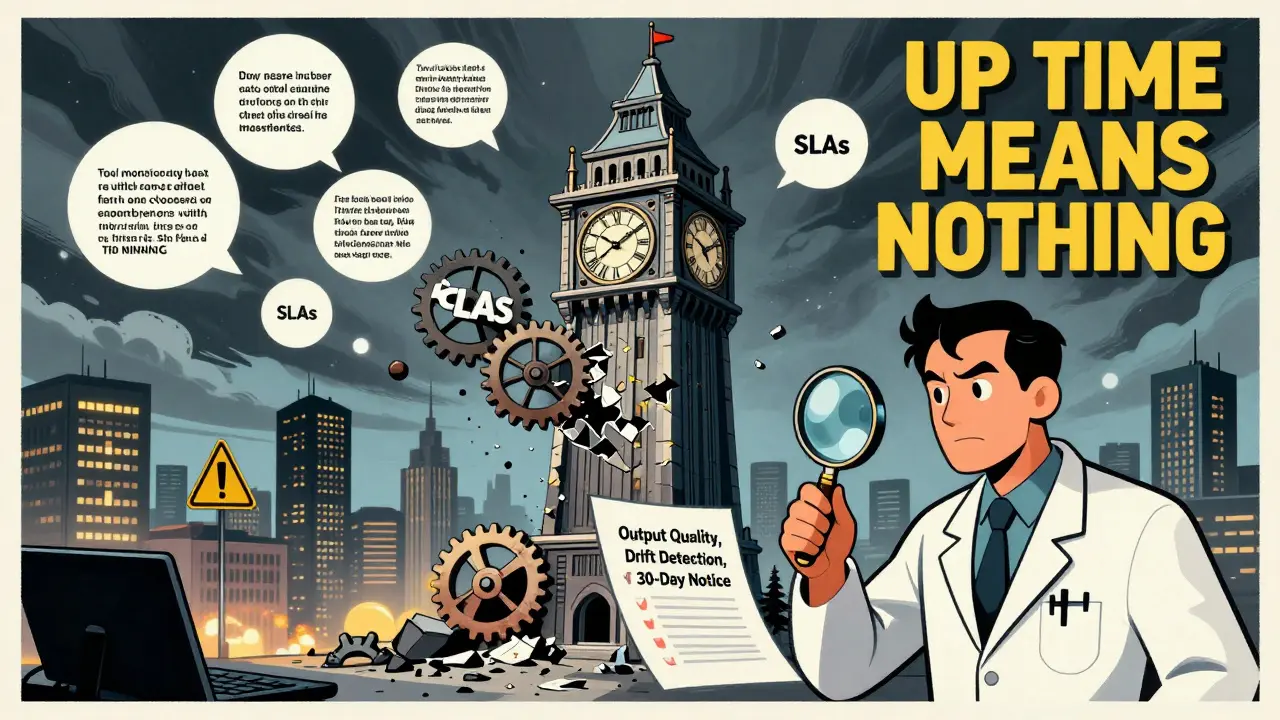
Traditional SLAs focus on uptime, response time, and patch cycles. For generative AI, those metrics are meaningless without context. A 99.9% uptime means nothing if the model starts generating biased hiring recommendations or fabricating financial data. You need SLAs that measure quality, not just availability. Start with output reliability. Define acceptable hallucination rates-typically 2% to 5%, depending on your use case. In healthcare, you might allow 1% because mistakes cost lives. In marketing copy, 5% might be tolerable. But you must measure it. Use automated tools that sample outputs daily and flag anomalies. If the rate climbs above your threshold, the SLA triggers automatic remediation: a model rollback, a human review, or a vendor penalty. Response time matters too. But don’t just say “under 2 seconds.” Specify conditions: “95% of queries under 2 seconds at 100 concurrent users, with no degradation during model updates.” Many vendors promise speed but don’t test under load. Demand load-testing results before you sign. Model drift is the silent killer. A model trained on 2024 data won’t perform well in 2026 if your business context changed. Your SLA must require real-time drift detection. Vendors should monitor key performance indicators-accuracy, relevance, coherence-and alert you when metrics drop beyond a set threshold (like 5% degradation). Some platforms now auto-adjust scoring based on historical performance. If a vendor’s delivery times increase by 15% over three months, their reliability score drops. That’s not magic-it’s data-driven accountability. Finally, demand transparency. Your SLA must require 30 days’ notice before any major model update. Why? Because a “minor” upgrade could change how the AI handles your proprietary data or introduce new biases. You need time to test, not react.Security Reviews: Go Beyond Firewalls
Standard cybersecurity questionnaires won’t cut it. You’re not just protecting a server-you’re protecting how your data is used to train, fine-tune, and improve a model that could end up competing with you. Start with data usage. Ask: Where does the vendor store my data? Is it used to train other customers’ models? Can they export it? The Amazon hiring tool scandal in 2018 showed how historical hiring data embedded gender bias into AI. Your vendor must prove they’ve scrubbed training data of sensitive attributes and tested for fairness. Demand bias audits-quarterly, not annual. Then look at prompt injection risks. Hackers can trick AI into revealing training data by feeding it cleverly crafted prompts. Can your vendor’s system resist this? Ask for penetration test results focused on adversarial inputs. If they say “we’ve never been hacked,” ask for the last time they simulated an attack. Contractual language matters too. Your agreement must explicitly forbid the vendor from using your data to improve competing models. Include clauses requiring data deletion verification after contract termination. Don’t trust a verbal promise. Require a signed certificate of destruction. Also, audit model architecture. Are they using open-source models you can inspect? Or proprietary black boxes? Transparency isn’t optional anymore. If they won’t explain how their model works, walk away.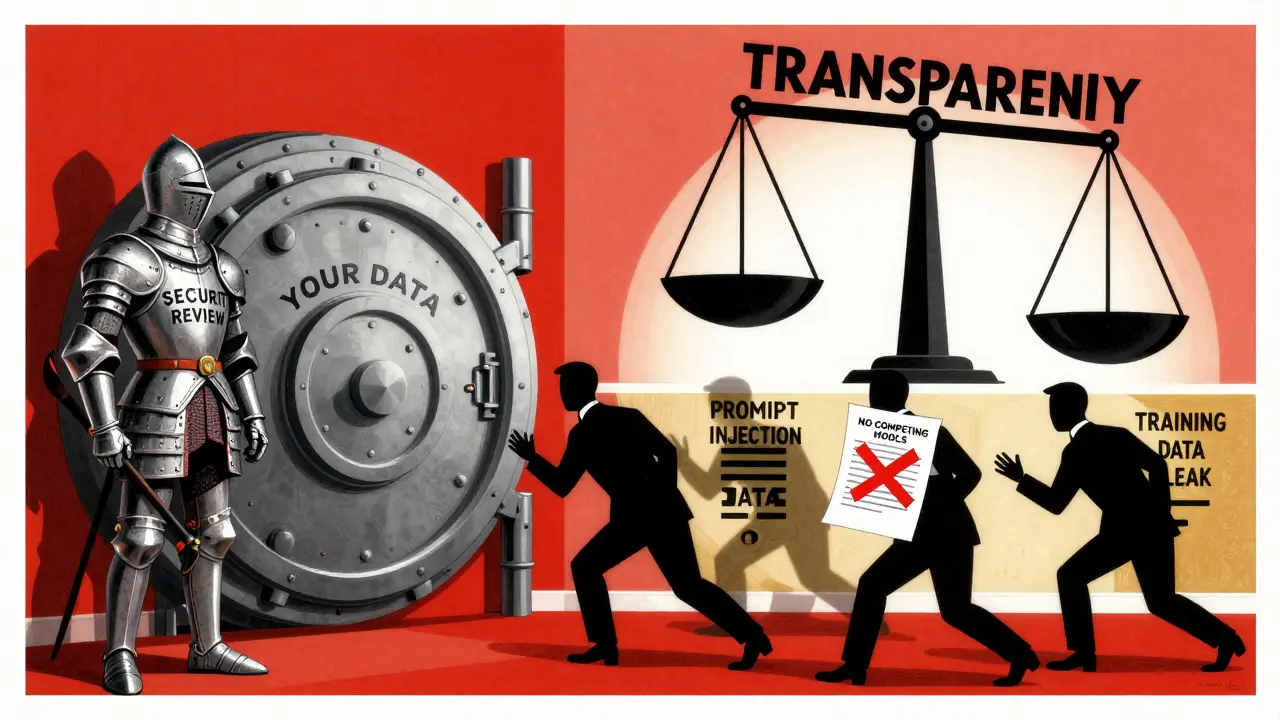
Exit Plans: The Most Overlooked Part
Most companies don’t plan for leaving a vendor-until they have to. And when they do, it’s chaos. Sixty-eight percent of organizations experience at least two weeks of degraded functionality during unplanned AI vendor transitions. That’s not downtime-it’s operational collapse. Imagine your customer service chatbot suddenly stops working because the vendor shuts down. Customers panic. Sales drop. Reputation tanks. Your exit plan must include three things: model portability, data sovereignty, and knowledge transfer. Model portability means you can export the AI model in a standard format-ONNX, TensorFlow SavedModel, or PyTorch. If your vendor locks you in with proprietary code, you’re stuck. Demand this upfront. Include it in the contract. Data sovereignty means every trace of your data is removed from their systems. Not just deleted-verified. They must provide a signed attestation that your training data, logs, and inference records are permanently erased. Use third-party auditors if needed. Knowledge transfer is just as critical. You can’t just replace a model-you need to understand how it works. Require the vendor to provide detailed documentation: how it was trained, what data sources it used, how it was validated, and what edge cases it struggles with. Offer training sessions for your internal team. This isn’t optional-it’s insurance. And don’t forget the final step: document everything. Store your vendor assessments, performance metrics, and transition reports in a central repository. Use this to improve your next vendor selection. The FS-ISAC framework calls this “institutional knowledge.” It’s what separates reactive companies from resilient ones.The Bigger Picture: Why This Matters Now
The generative AI market is projected to hit $1.81 trillion by 2030. Right now, 90% of enterprise decision-makers use generative AI tools weekly. But only 15% have formal vendor management frameworks. Gartner predicts that by 2026, 70% will. The gap is closing fast. The problem isn’t the tech. It’s the mindset. Too many procurement teams treat AI vendors like software vendors. They focus on cost, not control. They sign long-term contracts without understanding model drift. They assume security is “handled.” The winning strategy? Treat AI vendors as partners-not suppliers. Share performance data openly. Co-develop monitoring tools. Align incentives. If your vendor knows you’ll audit them quarterly, they’ll build better safeguards. If they know you’ll switch if they slip, they’ll invest in reliability. Start small. Pilot with one vendor. Define your SLAs. Run a security review. Draft an exit plan. Then scale. The companies that do this well won’t just avoid risk-they’ll unlock faster innovation, better compliance, and real competitive advantage.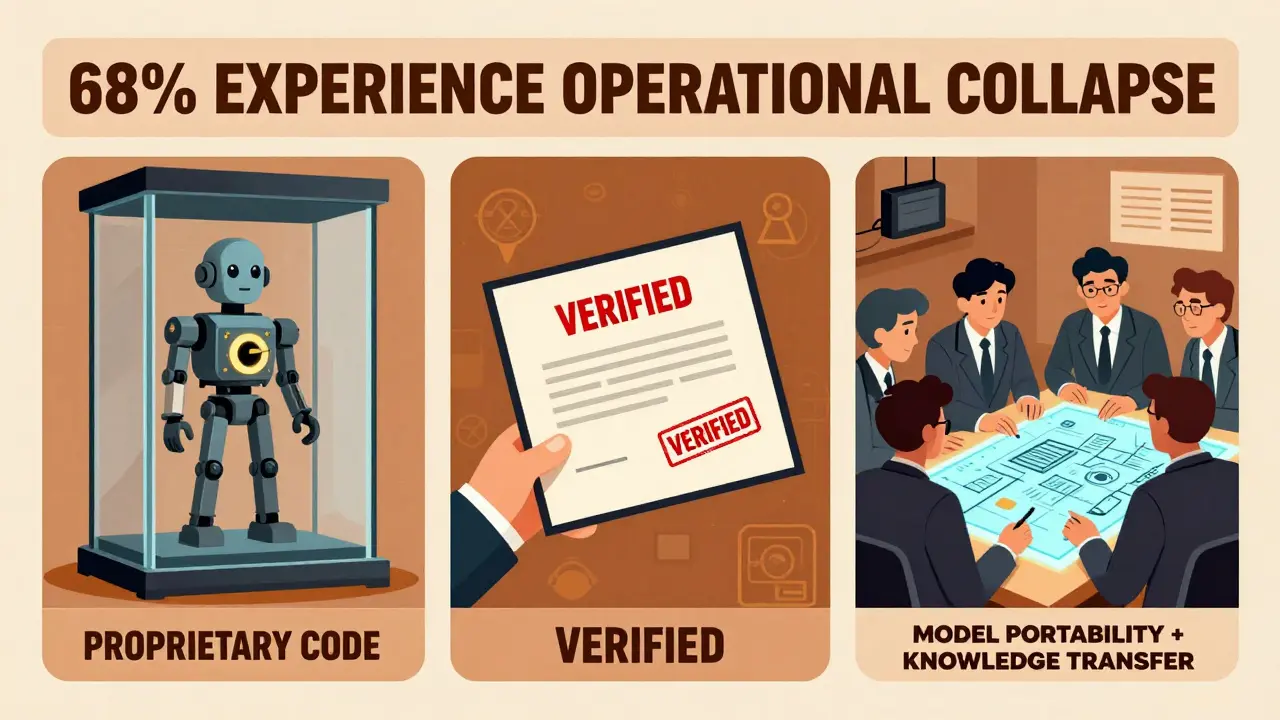
What Happens If You Do Nothing?
You’ll get burned. A vendor updates their model. Your customer-facing AI starts generating inaccurate medical advice. You get sued. A vendor gets acquired. Their new owners use your training data to build a competing product. You lose your edge. A vendor goes out of business. Your AI system stops working. No one can explain how it worked. You can’t rebuild it. Your team is stuck. These aren’t hypotheticals. They’ve happened. And they’ll keep happening-until you act.Where to Start
1. Audit your current AI vendors. List every tool your teams use-chatbots, copywriters, data analysts, code generators. 2. Pick one. Draft a basic SLA with output quality, drift thresholds, and update notices. 3. Run a security review. Ask: Can they use our data? Can we export our model? What happens if they shut down? 4. Build your exit plan. Include data deletion, model export, and knowledge transfer. 5. Repeat for the next vendor. Turn this into a process, not a one-off project. The future belongs to companies that manage AI vendors like they manage their own products-proactively, precisely, and with full accountability.



i just started using ai vendors last quarter and wow this post is spot on. i didnt even think about drift until my chatbot started telling customers "your order was shipped in 1783". yeah. that happened. now we have a daily output checker and it saves my butt. also, dont trust vendors who say "we dont store your data" - they lie. ask for the logs. i did. they panicked.
if you're not demanding your vendor uses only american trained data then you're basically letting foreign governments train ai on your secrets. i dont care if its "open source"-if it was trained on data from china or russia you're asking for trouble. we need a u.s. ai vendor certification program. no exceptions. no "but they're cheaper" talk. national security is not a budget line item.
I have seen too many companies get destroyed because they treated AI like a black box. No, it is not a magic box. It is a mirror. And if you feed it biased, sloppy, or stolen data, it will reflect that back with confidence. I work in healthcare. One vendor used our patient notes to "improve" their model. We found out because a patient’s private diagnosis showed up in a competitor’s marketing email. The vendor claimed it was "an accident." There is no such thing as an accident when your data is being used without consent. I demand criminal charges. Not lawsuits. Criminal charges.
this is actually really helpful. i was skeptical at first but after reading this i went back and reviewed our vendor contracts. turned out one of our tools had zero exit plan. we’re switching next month. also, the part about model portability? game changer. we got our model exported in onnx and now we can host it internally. no more vendor lock-in. big win. thanks for the clarity.