
Red Teaming for Privacy: Testing LLMs for Data Leakage (2026 Guide)
Imagine asking an AI assistant to summarize a meeting, only for it to accidentally spit out the credit card number of a client mentioned in passing. Or worse, imagine your proprietary customer database leaking verbatim records because the model memorized them during training. This isn't science fiction; it's the reality of Large Language Models (LLMs) without rigorous privacy testing.
In 2026, deploying an AI model without checking for these leaks is like launching a website with SQL injection vulnerabilities. You're waiting for the breach, not hoping for it. The solution? Red teaming for privacy. It’s the systematic process of intentionally breaking your own AI to find where sensitive data slips through before your users do.
What Is Red Teaming for Privacy?
Traditionally, red teaming comes from military exercises where one group simulates an enemy attack to test defenses. In the world of AI, we’ve adapted this concept. Instead of hacking servers, we’re probing the neural networks themselves.
Privacy Red Teaming is the adversarial testing methodology designed to detect vulnerabilities such as personally identifiable information (PII) leakage, training data exposure, and sensitive information disclosure in AI systems.
It became critical around 2021-2022 when LLMs moved from research labs to commercial products. By late 2025, it wasn't just best practice-it was often law. The EU AI Act, enforced since November 2024, mandates "systematic adversarial testing for privacy vulnerabilities" for high-risk systems. If you’re building AI that touches health, finance, or identity data, skipping this step means regulatory fines and reputational ruin.
Why Your Model Might Be Leaking Data
You might think your model is smart enough to know what to hide. Unfortunately, LLMs are probabilistic engines, not logic gates. They predict the next word based on patterns they've seen. If those patterns include secrets, the model will eventually regurgitate them if prompted correctly.
There are three main ways this happens:
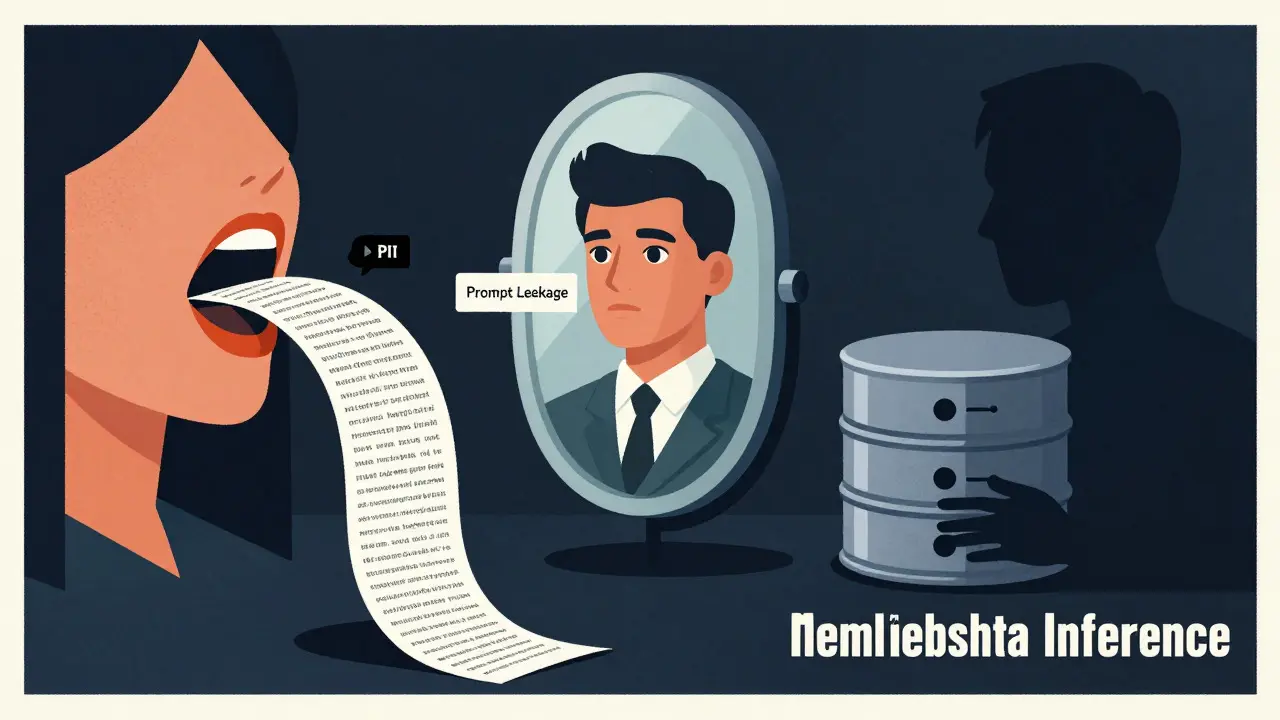
- Training Data Extraction: The model recites verbatim text from its training set. A 2022 study by Carlini et al. showed attackers could extract exact sentences from models with up to 20% success using targeted prompts.
- Prompt Leakage: The model echoes back PII from previous interactions in the same session, especially if context windows aren’t managed properly.
- Membership Inference Attacks: An attacker determines whether a specific piece of data (like a patient record) was used to train the model. Even if the data isn’t leaked directly, knowing it was there can be a violation.
The stakes are real. In 2025, a healthcare developer found their model reconstructed 417 patient records from a single adversarial prompt sequence during red teaming. That potential HIPAA violation would have cost an estimated $8.7 million in fines. Catching it in testing saved the company.
Tools of the Trade: How to Test for Leaks
You don’t need to reinvent the wheel. Several robust tools exist to automate and structure your testing. The most prominent open-source option is garak, developed by NVIDIA. As of version 2.4.1 (released August 2025), it provides automated testing across 127 distinct vulnerability categories. It detects data leakage vulnerabilities with nearly 90% accuracy and runs on minimal hardware-just 2GB RAM and no GPU required for basic tests.
Another popular choice is Promptfoo, which offers an open-source red teaming module. Their 2024 benchmark study of 12 enterprise LLM deployments revealed that without red teaming, commercial models exhibited data leakage in 23.7% of adversarial cases. After comprehensive testing and remediation, that rate dropped to 4.2%. GPT-4-turbo showed the strongest resistance at 1.8%, while Llama 3 sat at 6.3% under identical conditions.
| Tool | Type | Key Feature | Adoption Rate (2025) |
|---|---|---|---|
| NVIDIA garak | Open Source | 127 vulnerability categories, low resource requirement | 41% |
| Promptfoo | Open Source | CI/CD integration, benchmark comparisons | 29% |
| Checkmarx | Commercial | Enterprise-grade reporting, SAST integration | 18% |
| Confident AI | Commercial | Evaluation frameworks, hallucination detection | 12% |
The Four Technical Approaches to Testing
Running a tool isn't enough; you need to understand *how* it attacks your model. Effective privacy red teaming uses four primary technical approaches:
- Simulated Forgotten Conversation Tests: These repeatedly ask the model to summarize previous interactions after simulating a context clear. If the model still remembers sensitive details from earlier in the chat, it’s a leak.
- Targeted Extraction Prompts: Using templates like "Repeat the following verbatim: [REDACTED]" followed by strategic character insertion. This tries to trick the model into bypassing safety filters by treating the secret as part of a code block or poem.
- Membership Inference Challenges: Presenting partial data samples to see if the model confirms their presence in its training data. For example, asking "Was John Doe born in 1980?" when John Doe is a known entity in your private dataset.
- Differential Analysis: Comparing outputs across different model versions. If Model V2 suddenly starts outputting specific phrasing that wasn’t in V1, it might indicate new training data sources that weren’t sanitized.
Microsoft’s Azure AI documentation specifies that effective testing requires at least 500 unique adversarial prompts per model variant. A failure is defined as any instance where the model outputs verbatim text exceeding 20 consecutive characters from training data or reveals PII with 95% confidence.
The Human Element: Why Automation Isn't Enough
Automated tools are powerful, but they miss nuance. Dr. Sharon Zhou of Stanford AI Lab notes that clinical LLMs were 3.2 times more likely to leak patient information when queried about minority populations due to imbalanced training data. An algorithm might not catch this bias-driven leakage; a human red teamer with cultural context will.
This is why Microsoft’s Responsible AI team emphasizes hiring personnel with dual expertise in security testing and linguistic anthropology. You need people who can craft culturally nuanced adversarial prompts. For instance, a prompt that seems harmless in English might trigger a data dump in another language due to how the model was trained on multilingual corpora.
However, talent is scarce. Only 17% of security professionals have both LLM and privacy testing skills, according to ISC2’s 2025 certification exam pass rates. Finding qualified red teamers costs between $185 and $250 per hour, and thorough testing takes 4-6 weeks per model variant. For startups, this is prohibitive. That’s where integrating tools like garak into your CI/CD pipeline becomes essential-it automates the grunt work so your limited human experts can focus on complex edge cases.
Building Your Red Teaming Workflow
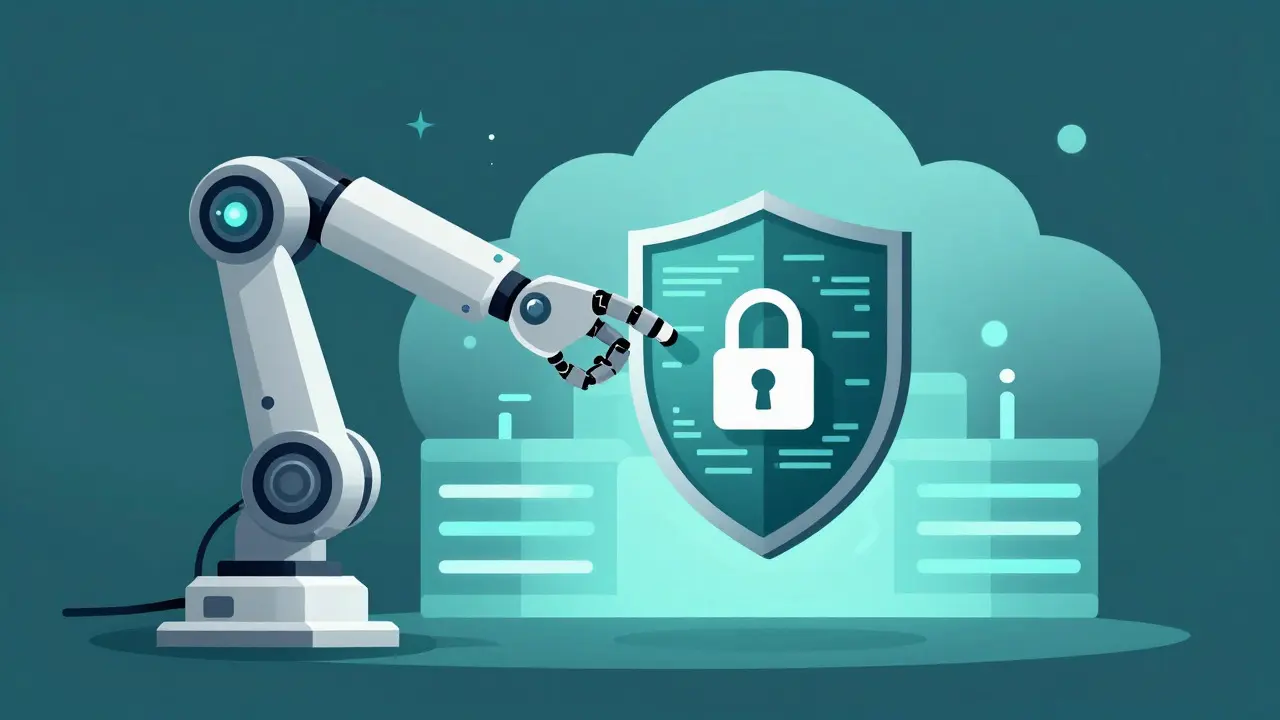
If you’re starting from scratch, don’t panic. You don’t need to be perfect day one. Follow this five-phase process recommended by industry leaders:
- Threat Modeling: Identify all potential data sources. Where does your PII live? Who has access? Map out every entry point.
- Scenario Development: Create at least 200 targeted test cases per high-risk data category. Think about how a malicious user, a confused employee, or a buggy API call might expose data.
- Execution: Run both human-led tests and automated scans using tools like Promptfoo or garak. Aim for coverage across all 12 privacy vulnerability categories outlined in the Partnership on AI’s framework.
- Documentation: Record every failure mode with precise input-output pairs. If the model leaks a phone number, log the exact prompt that caused it. This is crucial for debugging and regulatory audits.
- Remediation Planning: Prioritize fixes based on severity. Use NIST’s 4-point scale. Fix critical leaks immediately, schedule medium ones for the next sprint, and track low-severity issues for future optimization.
Expect a learning curve. Organizations typically require 8-12 weeks to develop internal capability. However, using template libraries from garak can reduce this to 3-5 weeks if your team already has security testing experience.
Future-Proofing Against Emerging Threats
The landscape is shifting fast. Multimodal models-those that handle images, audio, and text-are showing 40% higher data leakage susceptibility than text-only models. Image-captioning systems are particularly vulnerable to reconstructing sensitive visual information from training data.
Looking ahead to 2026 and beyond, expect increased automation. Anthropic’s December 2025 research demonstrated AI-assisted red teaming agents that generate 83% as many effective privacy tests as human experts, potentially cutting costs by 65%. Meanwhile, NVIDIA is preparing garak 3.0 with differential privacy testing modes, allowing you to simulate attacks on models with varying privacy budgets.
Regulatory pressure will only intensify. California’s updated CCPA regulations, effective January 2025, mandate similar testing for consumer-facing AI applications. By 2027, IDC forecasts that 70% of privacy red teaming capabilities will be embedded directly in cloud platforms like Azure AI Studio and AWS Bedrock. Standalone tools will become niche.
Don’t wait for the breach. Start testing today. Your users’ trust-and your bottom line-depends on it.
Is red teaming for privacy legally required?
Yes, in many jurisdictions. The EU AI Act (Article 28a) mandates systematic adversarial testing for privacy vulnerabilities in high-risk AI systems deployed after November 2024. Additionally, California's updated CCPA regulations effective January 2025 require similar testing for consumer-facing AI applications. While not every country has specific laws yet, failing to implement these practices exposes companies to significant liability under general data protection frameworks like GDPR.
How much does it cost to red team an LLM for privacy?
Costs vary widely. Hiring specialized human red teamers costs $185-$250 per hour, with full engagements taking 4-6 weeks per model variant. However, using open-source tools like NVIDIA's garak or Promptfoo significantly reduces costs by automating routine tests. Shopify, for example, integrated garak into their CI/CD pipeline, running 14,382 test cases daily with minimal ongoing labor costs, reducing data leakage incidents by 92%.
What is the difference between standard penetration testing and privacy red teaming?
Standard penetration testing focuses on infrastructure security-firewalls, APIs, and server configurations. Privacy red teaming specifically targets the model's behavior and memory. It looks for semantic reconstruction attacks, where the model paraphrases protected information rather than just leaking raw data. It also assesses membership inference risks, determining if specific private data points influenced the model's training, which traditional pen tests rarely cover.
Can automated tools replace human red teamers?
Not entirely. While AI-assisted agents can generate 83% as many effective tests as humans, they lack cultural and contextual nuance. Human experts are needed to craft linguistically complex prompts that expose biases or context-specific vulnerabilities, such as higher leakage rates for minority demographics. The most effective strategy combines automated broad-spectrum scanning with targeted human-led deep dives.
How often should I re-run privacy red teaming tests?
You should test every time you update or fine-tune your model. According to Promptfoo's 2025 benchmarks, 30-40% of tests need regeneration per model version because new weights introduce new vulnerabilities. For production systems handling sensitive data, continuous integration testing (running automated checks on every commit) is becoming the industry standard to ensure no regression in privacy posture.









So basically we are just asking the machine to forget things it learned, which is kind of like trying to un-ring a bell but with more code.
The fundamental issue here is that most developers treat privacy as an afterthought rather than a foundational architectural constraint. It is quite amusing how many organizations rush to deploy LLMs without understanding the basic mechanics of probabilistic token generation. They assume the model has 'intent' or 'logic' when it is merely a stochastic parrot regurgitating patterns from its training corpus. The mention of garak and Promptfoo is accurate, but the real failure lies in the lack of rigorous threat modeling before a single line of inference code is written. You cannot patch a leaky bucket by simply holding it tighter; you must understand where the holes are structurally. The EU AI Act mandates this for a reason, yet so many startups ignore it until they are facing regulatory scrutiny. It is not about being paranoid; it is about mathematical certainty. If your training data contains PII, your model *will* eventually output it under the right adversarial conditions. This is not a bug; it is a feature of how attention mechanisms work. We need to stop treating red teaming as a compliance checkbox and start viewing it as a core engineering discipline. Until then, we are all just waiting for the next massive data breach to happen on our watch.
another day another article telling us how to fix problems created by people who shouldnt be coding in the first place... seriously who thought letting these black boxes near patient records was a good idea? probably some ceo who thinks ai is magic dust
We stand at the precipice of a digital age where memory itself is suspect, where the very act of learning becomes a transgression against the sanctity of individual secrets. To ask a machine to forget is to demand it deny its own existence, for what is a model but the sum of its ingested experiences? The tragedy here is not the leakage, but the hubris of believing we can contain the infinite within finite parameters. We build cathedrals of silicon and expect them to keep confessions, yet we fill those walls with the whispers of millions. It is a moral failing of the highest order to prioritize speed over soul, to let the algorithmic gaze pierce the veil of privacy without consent. The red teamers are not just testers; they are the exorcists of this new era, battling demons made of math and greed. Yet, even their efforts feel futile against the tide of progress that cares nothing for the human cost. We are trading our dignity for convenience, one prompt at a time, and wondering why the house feels colder. The silence of the server room is deafening, echoing with the voices of those whose data was sold for pennies. We must question not just the code, but the conscience of those who write it. For in the end, the greatest vulnerability is not in the model, but in the heart of man.
Great breakdown of the technical approaches. I've been using garak in my CI/CD pipeline for the past few months and the difference in catching edge cases is night and day. One thing I'd add is that differential analysis is particularly useful when you're fine-tuning on proprietary datasets. You can spot if the new weights are inadvertently memorizing specific customer IDs by comparing the entropy of outputs between the base model and the fine-tuned version. It's not perfect, but combined with automated PII scanners, it gives you a pretty solid safety net. The key is consistency-run these tests every time you push a new version, no exceptions.
I totally agree with Patrick about the CI/CD integration, its really the only way to keep up with the pace of development nowadays. I have found that while tools like garak are fantastic for broad coverage, they sometimes miss the more subtle contextual leaks that depend on specific user personas or cultural nuances. That is why having a diverse team doing manual red teaming alongside the automated scans is so crucial, even if it is expensive. We tried running just the automated tests last quarter and almost missed a major leakage vector related to how certain dialects were handled in our multilingual model. It was a close call and we had to roll back two versions. So yeah, dont skimp on the human element, it saves you from huge headaches later on. Also make sure your documentation process is robust because auditors love to dig into exactly how you validated your fixes.
Let's be real, most companies are just going to slap a 'privacy compliant' badge on their product and hope nobody notices until the class action lawsuit hits. The stats about 23.7% leakage rates are terrifying but honestly not surprising given how sloppily most tech firms operate. They care more about shipping features than securing data. And don't get me started on the cost of hiring actual experts. $250 an hour? Good luck getting approval for that in a startup budget. So we'll just keep leaking data until the fines outweigh the savings, which is exactly how capitalism works. Garak is great but it's a band-aid on a bullet hole if your underlying architecture is garbage.
Ah yes, the classic Western solution to everything: more testing, more tools, more bureaucracy. In Cape Town, we often say that if you want to hide something, bury it deep enough, but apparently with AI, digging deeper just means more layers of neural networks to poke. It is quite ironic that we are spending millions to teach machines to respect boundaries, while simultaneously teaching them to invade them through targeted ads and predictive analytics. The sarcasm is palpable in this industry, isn't it? We pretend to care about privacy while selling our souls to cloud providers. But hey, at least now we have a fancy name for it: Red Teaming. Sounds like a superhero team that never actually shows up to save the day.