Regulatory Frameworks for Generative AI: Global Laws, Standards, and Compliance
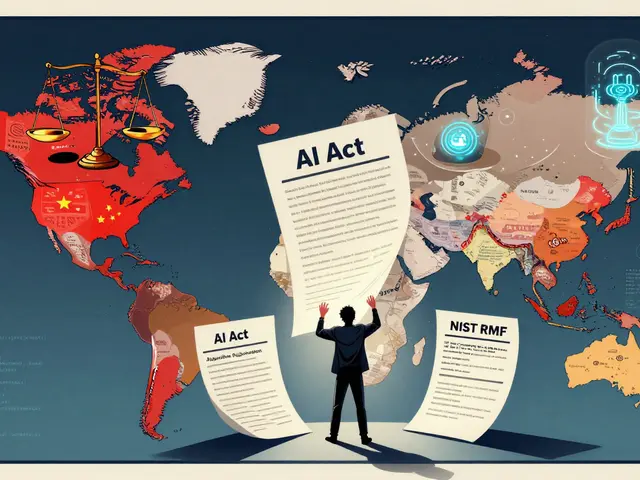
By December 2025, if you're building or using generative AI tools, you're not just coding-you're navigating a minefield of laws that vary by country, industry, and even state. There’s no single global rulebook. Instead, there are dozens of overlapping, sometimes conflicting, regulations that demand real action-not just awareness. The EU’s AI Act is enforceable. China’s algorithm registration system is live. California’s SB 1047 is in effect. And if you’re ignoring these, you’re risking fines, lawsuits, or worse-your product being pulled from the market.
How the EU AI Act Changed Everything
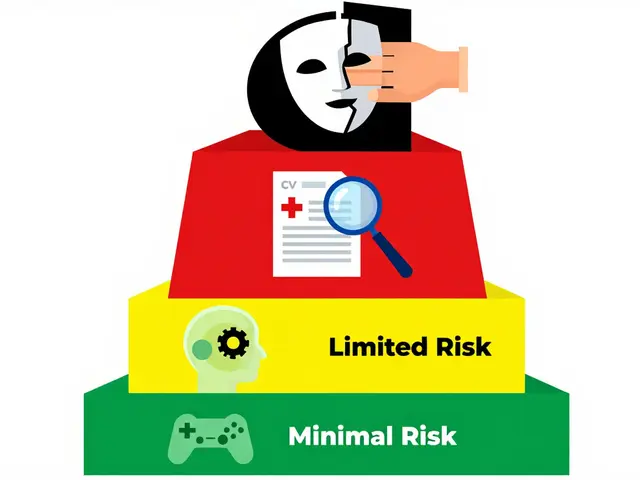
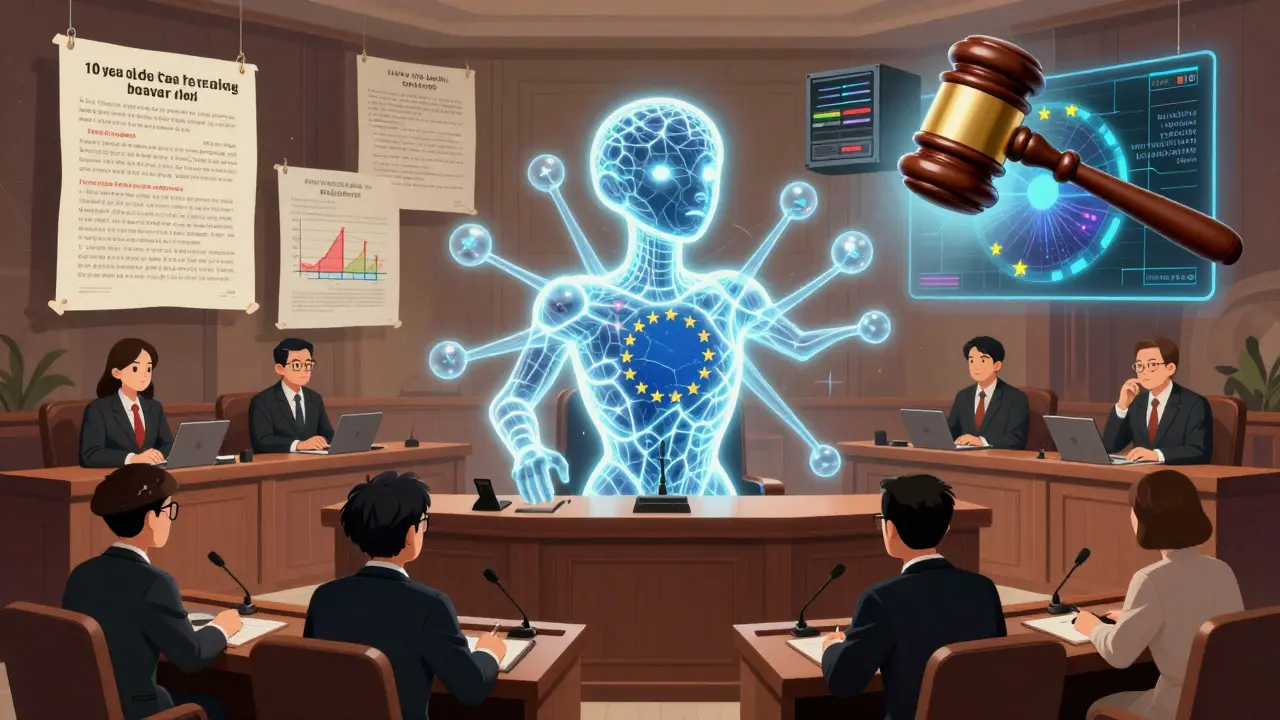
The European Union’s AI Act, which became fully enforceable on August 1, 2024, is the most detailed and far-reaching AI law ever passed. It doesn’t just say “be careful.” It defines exactly what counts as high-risk, what documentation you need, and how long you must keep logs. For generative AI, the biggest shift came on August 2, 2025, when the rules for General-Purpose AI (GPAI) kicked in. These apply to foundation models like GPT, Claude, and anything else trained on massive datasets to generate text, images, or audio.
Under the EU AI Act, GPAI providers must now meet strict technical standards:
- Ensure factual accuracy of outputs hits at least 85% on standardized benchmark tests
- Limit bias across gender, race, and age groups to under 15% disparity
- Prove resistance to adversarial attacks-meaning someone can’t trick your AI into generating harmful content
- Keep detailed logs of all inputs and outputs for 10 years
- Disclose training data sources unless it’s a trade secret (and even then, you need to justify why)
And it’s not theoretical. On November 18, 2025, France’s data authority fined a major AI company €17 million for failing to disclose where its model’s training data came from. That’s not a warning. That’s a wake-up call.
China’s Approach: Control Through Transparency
If the EU focuses on risk, China focuses on control. Its Interim Measures for the Management of Generative AI Services, effective since August 2023, require companies to register their algorithms with the government before launch. This isn’t just paperwork-it’s a gatekeeping system. The government can block releases if content doesn’t align with “socialist core values.”
But here’s what’s surprising: many Chinese AI startups say this has actually improved their models. One founder on Hacker News shared that regulators flagged three hidden biases in their image generator during the registration review-biases the company had missed internally. After fixing them, user complaints dropped by 40%.
China also requires all AI-generated content to carry a cryptographic watermark. This isn’t a visible logo. It’s invisible metadata embedded in the file that can be verified by authorities or platforms. If you’re distributing AI images or audio outside China, you still need to comply if your model was trained or hosted there.
The U.S. Patchwork: No Federal Law, But States Are Acting
The U.S. has no national AI law. Instead, you’ve got a patchwork. California’s SB 1047, effective January 1, 2025, is the most aggressive state law. It targets large foundation models-those with over 10 billion parameters-and requires:
- Red teaming by at least three independent testing groups
- Reporting of serious incidents within 72 hours
- Proof that safety testing was done before public release
Other states are watching. The federal government’s AI Accountability Policy Framework, released in October 2025, isn’t binding-but 41 states have pledged to adopt its guidelines by mid-2026. That means even if you’re based in Texas or Florida, you might still need to follow California-style rules if you sell to customers there.
And here’s the catch: the U.S. doesn’t even have a federal definition of “high-risk AI.” That creates confusion. A model considered low-risk in Washington D.C. might be high-risk in New York. Companies are spending more time figuring out which rules apply than building features.
Global Standards: What’s Actually Working Across Borders
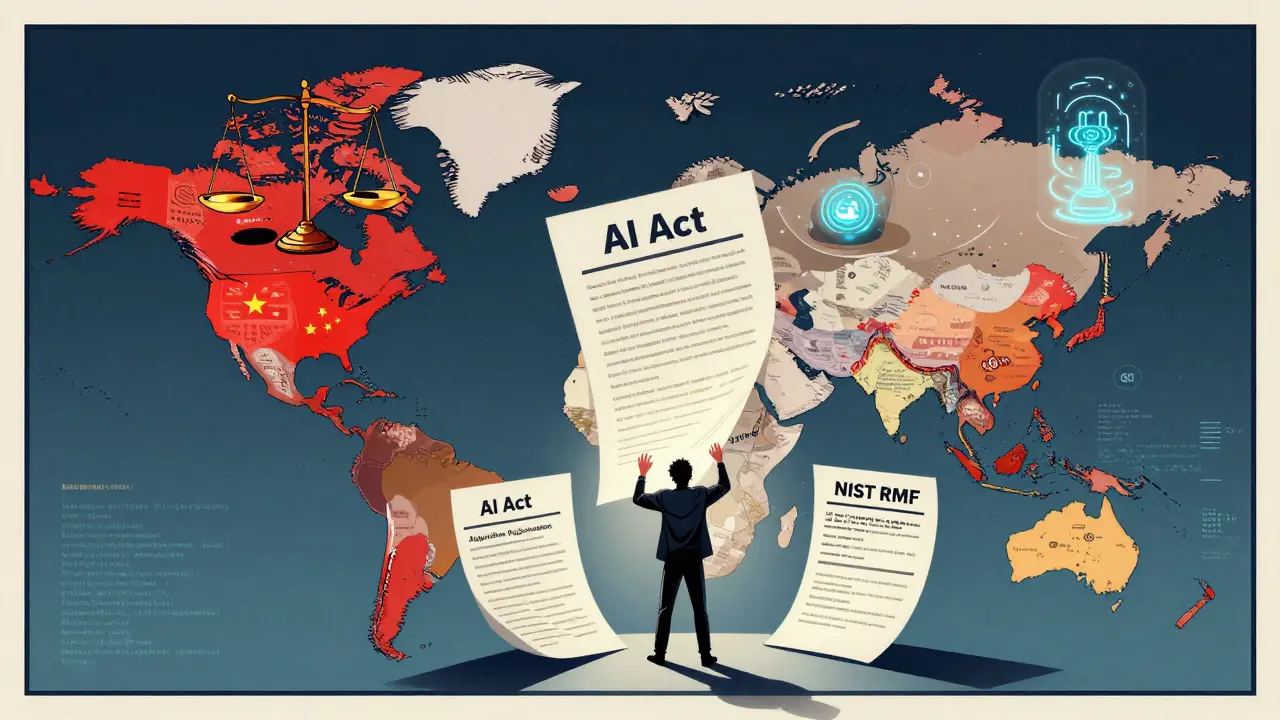
With 47 different regulatory initiatives worldwide, businesses can’t afford to comply country-by-country. That’s why two frameworks are becoming the de facto global baseline:
- NIST AI Risk Management Framework (AI RMF): Used by Colorado and referenced by the U.S. federal government, it gives you 47 specific practices across four areas: govern, map, measure, manage. It’s not law-but if you follow it, you’re 70% of the way to EU and UK compliance.
- ISO/IEC 42001:2023: The first international standard for AI management systems. It’s like an audit checklist for AI ethics and safety. Companies that get certified report a 35% drop in compliance costs over time.
The Global Partnership on AI (GPAI) also released a voluntary Code of Practice in 2025, backed by the EU AI Office. It’s not mandatory-but 63% of multinational AI firms now use it as their primary compliance guide. Why? Because it’s the only document that aligns EU, U.S., and Asian expectations.
What Compliance Actually Costs (And Who Pays the Most)
Compliance isn’t free. And it’s not just about hiring lawyers.
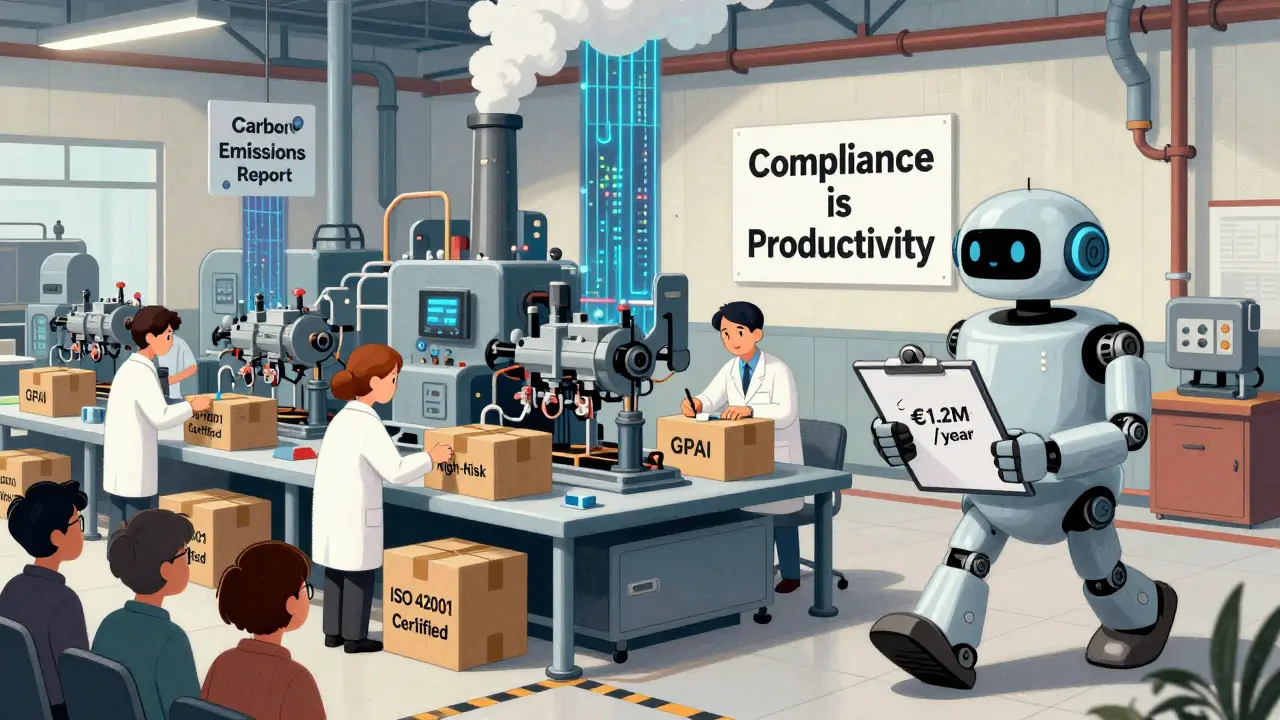
According to EU impact assessments, a small AI startup developing a high-risk system (like one used in hiring or healthcare) spends an average of €1.2 million per year just on compliance. That includes:
- 3-5 full-time compliance specialists
- Third-party audits (€200K-€450K per year)
- Documentation systems and log storage for 10 years
- Staff training (Salesforce spent $8.2 million training 70,000 employees in 2025)
Small companies (<50 employees) are hit hardest. 82% of them spend over 20% of their engineering time on compliance. For enterprises (>1,000 employees), it’s only 37%. That’s why 68% of AI developers say time-to-market has slowed by over 5 months.
And the cost is rising. The global AI governance market hit $14.7 billion in Q3 2025-up 63% from last year. Most of that growth is from companies buying tools to automate compliance, like Trustible AI, which is rated 4.6/5 by enterprise users but requires 3-4 weeks of training just to use properly.
Who’s Ahead-and Who’s Falling Behind
Not all industries are moving at the same speed.
- Financial services: 94% have AI governance frameworks. They’ve had to comply with financial regulations for decades-AI is just the next layer.
- Healthcare: 87% compliance. HIPAA and patient safety rules forced them to act fast.
- Creative industries: Only 42%. Many artists and designers still think AI tools are “just software.” They’re wrong. If you’re using AI to generate logos, music, or scripts for clients, you’re legally responsible for copyright and attribution.
And here’s something no one talks about: environmental impact. By 2027, 34 countries will require AI developers to report carbon emissions from training large models. The EU already does. If you’re training a model on AWS or Azure, you’re indirectly responsible for its energy use. That’s a new compliance line item.
What You Need to Do Right Now
If you’re building or using generative AI in 2025, here’s your action plan:
- Map your AI use cases. Are you using it for hiring? Customer service? Content creation? Each has different risk levels.
- Check where your users are. If even 10% of your users are in the EU, you need to comply with the AI Act. Geography matters more than where you’re headquartered.
- Adopt NIST AI RMF. It’s the easiest starting point. It covers 80% of what the EU, UK, and U.S. states expect.
- Start documenting everything. Logs, training data sources, bias tests, red teaming reports. If you don’t have it written down, it didn’t happen.
- Train your team. Engineers need to understand compliance. Lawyers need to understand AI. Everyone needs to speak the same language.
There’s no magic bullet. But if you treat compliance like product development-not a legal afterthought-you’ll avoid fines, keep your product on the market, and even build trust with users.
What’s Coming in 2026
The European Commission’s “AI Pact,” launched in November 2025, has already gotten commitments from 1,842 organizations to follow the AI Act ahead of schedule. Early adopters are seeing 22% higher consumer trust, according to Ipsos polling.
South Korea’s new AI Act will fully roll out in early 2026, creating a dual-track system for public and private sector AI. Switzerland is finalizing its law. Canada and Japan are launching new AI oversight centers.
The trend is clear: regulation isn’t slowing AI. It’s forcing it to grow up. The companies that thrive won’t be the ones with the biggest models-they’ll be the ones with the cleanest compliance records.
Do I need to comply with the EU AI Act if I’m not based in Europe?
Yes. The EU AI Act applies to any company that offers AI services to users in the European Union-even if you’re based in the U.S., India, or Brazil. If your AI tool is accessible to EU residents, you’re subject to its rules. This is similar to how GDPR works for data privacy.
What happens if I ignore AI regulations?
Fines can reach up to 7% of your global annual revenue under the EU AI Act. In China, non-compliant AI services can be blocked from the market. In California, you could face lawsuits from users or regulators. Beyond legal penalties, your brand reputation can collapse overnight-especially if your AI generates harmful content and regulators prove you ignored known risks.
Is there a global AI compliance certificate I can get?
The only internationally recognized standard is ISO/IEC 42001:2023. It’s not mandatory, but it’s the closest thing to a global compliance badge. Many companies use it to prove they meet EU, U.S., and Asian requirements without having to redo audits for each region. Other certifications exist, but none have the same cross-border credibility.
Can I use AI-generated content without legal risk?
It depends. In the EU and U.S., you must disclose when content is AI-generated. In China, you must watermark it. Copyright law is still evolving, but courts are increasingly ruling that using AI to replicate someone’s creative style without permission can be infringement. Always disclose, document your training data sources, and avoid copying protected works directly.
How do I know if my AI model is “high-risk”?
The EU defines 27 specific high-risk use cases, including hiring, education, law enforcement, and healthcare. If your AI influences decisions that affect someone’s rights, safety, or livelihood, it’s likely high-risk. The NIST AI RMF helps you assess this yourself. If you’re unsure, assume it’s high-risk until proven otherwise-it’s safer than guessing wrong.
What’s the easiest way to start complying?
Start with the NIST AI Risk Management Framework. It’s free, publicly available, and covers the core requirements of most major regulations. Use it to map your AI use cases, identify risks, and document your safeguards. Once you’ve done that, you’ll know exactly where you stand-and what gaps you need to fill.