
Continuous Security Testing for LLM Platforms: A 2026 Guide to Stopping Prompt Injections
Learn how continuous security testing protects LLM platforms from prompt injections and data leaks in 2026. Compare top tools, implementation steps, and regulatory requirements.

Building Content Moderation Pipelines for LLMs: A Practical Guide to Security and Safety
Learn how to build secure content moderation pipelines for LLMs using hybrid architectures, policy-as-prompt strategies, and human-in-the-loop validation to prevent security risks.

Building Content Moderation Pipelines for LLMs: A 2026 Security Guide
Learn how to build secure content moderation pipelines for LLMs using hybrid architectures, policy-as-prompt strategies, and human-in-the-loop validation to prevent security risks and ensure compliance.

Stop Vibe Coding: How to Avoid Anti-Pattern Prompts for Secure AI Code
Learn why "vibe coding" leads to insecure software and how to replace dangerous anti-pattern prompts with secure, structured frameworks to stop AI-generated vulnerabilities.

Threat Modeling for Large Language Model Integrations in Enterprise Apps
Threat modeling for LLM integrations in enterprise apps is no longer optional. Learn the top five real-world risks-prompt injection, data poisoning, model theft, supply chain flaws, and insecure outputs-and how tools like AWS Threat Designer are making security practical for development teams.
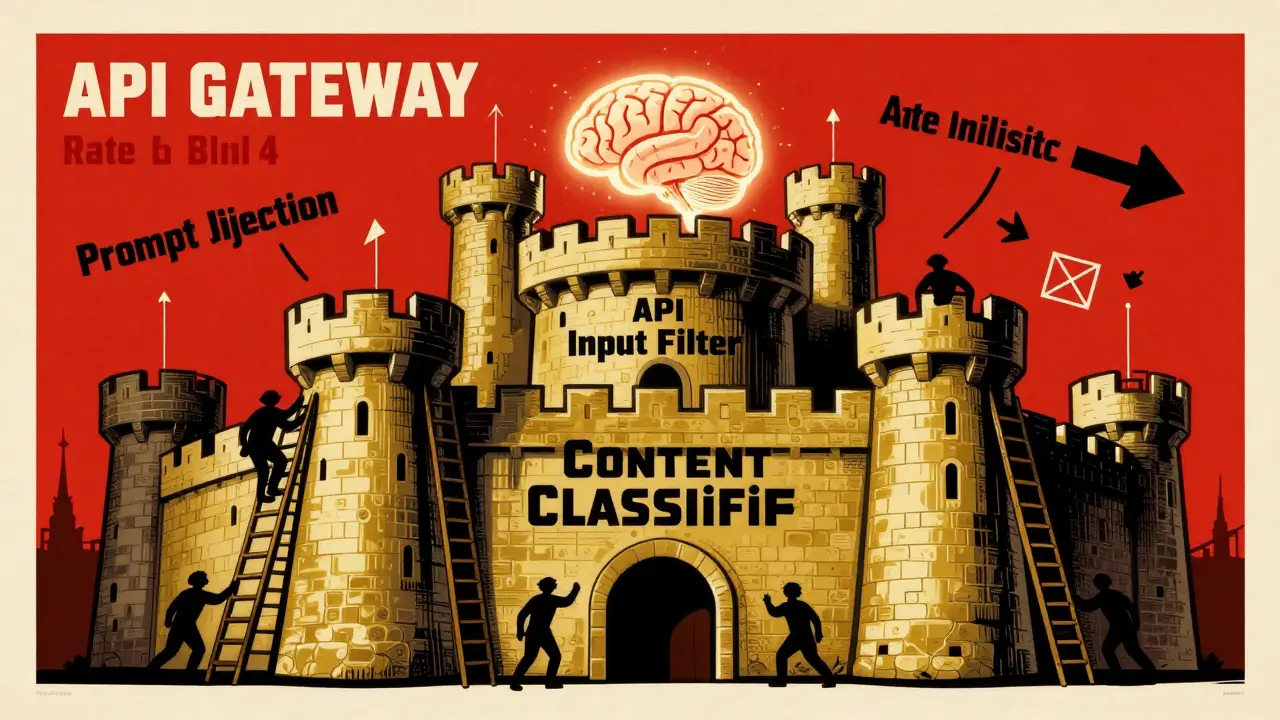
Safety Layers in Generative AI: Content Filters, Classifiers, and Guardrails Explained
Safety layers in generative AI-like content filters, classifiers, and guardrails-are essential for preventing harmful outputs, blocking attacks, and protecting data. Without them, AI systems become unpredictable and dangerous.

Security and Compliance Considerations for Self-Hosting Large Language Models
Self-hosting large language models gives organizations full control over data and compliance, but requires robust security, continuous monitoring, and deep expertise. Learn what it takes to do it right.

Training Data Poisoning Risks for Large Language Models and How to Mitigate Them
Training data poisoning lets attackers corrupt AI models with tiny amounts of malicious data, causing hidden backdoors and dangerous outputs. Learn how it works, real-world examples, and proven ways to defend your models.

Prompt Injection Risks in Large Language Models: How Attacks Work and How to Stop Them
Prompt injection attacks trick AI models into ignoring their rules, exposing sensitive data and enabling code execution. Learn how these attacks work, which systems are at risk, and what defenses actually work in 2025.