Third-Party Risk Management for Vendors Handling LLM Data: A 2026 Guide
Imagine handing over the keys to your company’s most valuable asset-its proprietary data-to a third-party vendor. Now imagine that vendor is using that data to train or fine-tune a Large Language Model (LLM). The stakes have never been higher. In 2026, as AI integration becomes standard across industries, the traditional playbook for Third-Party Risk Management is the systematic process of identifying, assessing, and mitigating risks associated with external vendors and suppliers is no longer enough. You aren’t just protecting static databases anymore; you are guarding dynamic, generative systems that can leak, hallucinate, or be poisoned.
If you are responsible for vendor security, you know that a breach isn’t always about hackers breaking down your firewall. Often, it’s about a contractor accessing more than they should, a vendor storing training data insecurely, or an API endpoint leaking sensitive context. This article cuts through the noise to give you a concrete framework for managing these specific risks when vendors handle your LLM data.
Why Traditional TPRM Fails for LLMs
Most organizations still rely on annual questionnaires and static audits to vet vendors. This approach works for accounting software but fails miserably for AI providers. Why? Because LLMs introduce unique threat vectors that traditional frameworks like NIST CSF or ISO 27001 don’t fully address out of the box.
Consider the difference between a SQL database and a vector database used for Retrieval-Augmented Generation (RAG). In a SQL database, access controls are binary: you either have permission to read row X, or you don’t. In an LLM context, a vendor might not "steal" your data in a single file dump. Instead, they might inadvertently include your confidential contract terms in their public model weights, where a competitor could extract them through prompt engineering techniques. Or worse, a malicious insider at the vendor could inject biased or harmful content into the model, leading to model poisoning is a cyberattack where an adversary corrupts the training data to manipulate the AI model's behavior or outputs.
You need to shift from checking boxes to monitoring behaviors. Your risk management strategy must account for the lifecycle of the data: ingestion, processing, inference, and output generation. If your vendor doesn’t have visibility into how your data flows through these stages, you are flying blind.
Identifying the Core Risks in Vendor-Led AI Projects
Before you can mitigate risks, you must name them. When engaging vendors for LLM services, four primary risk categories emerge:
- Data Exfiltration via Outputs: The model generates text that includes snippets of your private training data. This is common if the vendor uses shared infrastructure without proper isolation.
- Prompt Injection Vulnerabilities: End-users of the vendor’s application might trick the model into revealing system instructions or internal data. If the vendor hasn’t implemented robust input filtering, your data is exposed.
- Intellectual Property Leakage: Your proprietary algorithms or business logic embedded in the prompts or fine-tuning datasets become part of the vendor’s general knowledge base, potentially accessible to other clients.
- Supply Chain Compromise: The vendor uses open-source libraries or pre-trained models that contain hidden backdoors or vulnerabilities. Since you rely on their stack, their weakness becomes your liability.
To manage these, you cannot treat all vendors equally. A vendor providing simple chatbot UI components poses less risk than one handling your core customer support data for fine-tuning. You need a tiered approach based on data sensitivity and access level.
Building a Robust Assessment Framework
Your first line of defense is the due diligence process. But forget the generic PDF questionnaire. For LLM vendors, you need technical depth. Here is what you must ask and verify:
- Data Isolation Guarantees: Does the vendor use multi-tenancy architectures? If so, how do they ensure logical separation? Ask for evidence of encryption keys managed by you (BYOK - Bring Your Own Key) rather than the vendor.
- Training Data Provenance: Where does the base model come from? Has it been audited for bias and safety? More importantly, will your data be used to improve their foundational models? The answer must be a hard "no" unless explicitly negotiated otherwise.
- Output Filtering Mechanisms: What tools does the vendor use to detect PII (Personally Identifiable Information) or sensitive data in model outputs before they reach the end-user?
- Incident Response for AI: Do they have a specific protocol for AI-related incidents? Standard breach notifications don’t cover "model drift" or "prompt leakage." Their response plan must include steps to freeze model updates and audit recent interactions.
Don’t take their word for it. Require proof. This might mean reviewing architecture diagrams, seeing logs of data deletion processes, or even conducting a penetration test focused on prompt injection attacks.
| Assessment Area | Traditional TPRM Approach | LLM-Focused TPRM Approach |
|---|---|---|
| Data Access | Role-based access control (RBAC) checks | Verification of data isolation in vector stores and model weights |
| Security Certifications | SOC 2 Type II, ISO 27001 | SOC 2 + AI-specific audits (e.g., MLCS - Machine Learning Cybersecurity) |
| Breach Notification | Notify within 72 hours of data loss | Immediate notification of potential model contamination or output leakage |
| Data Retention | Delete files upon contract end | Verify unlearning capabilities to remove data influence from trained models |

Contractual Safeguards for AI Vendors
Contracts are your legal safety net. Standard Master Service Agreements (MSAs) are insufficient for LLM engagements. You need specific clauses that address the nuances of AI data handling.
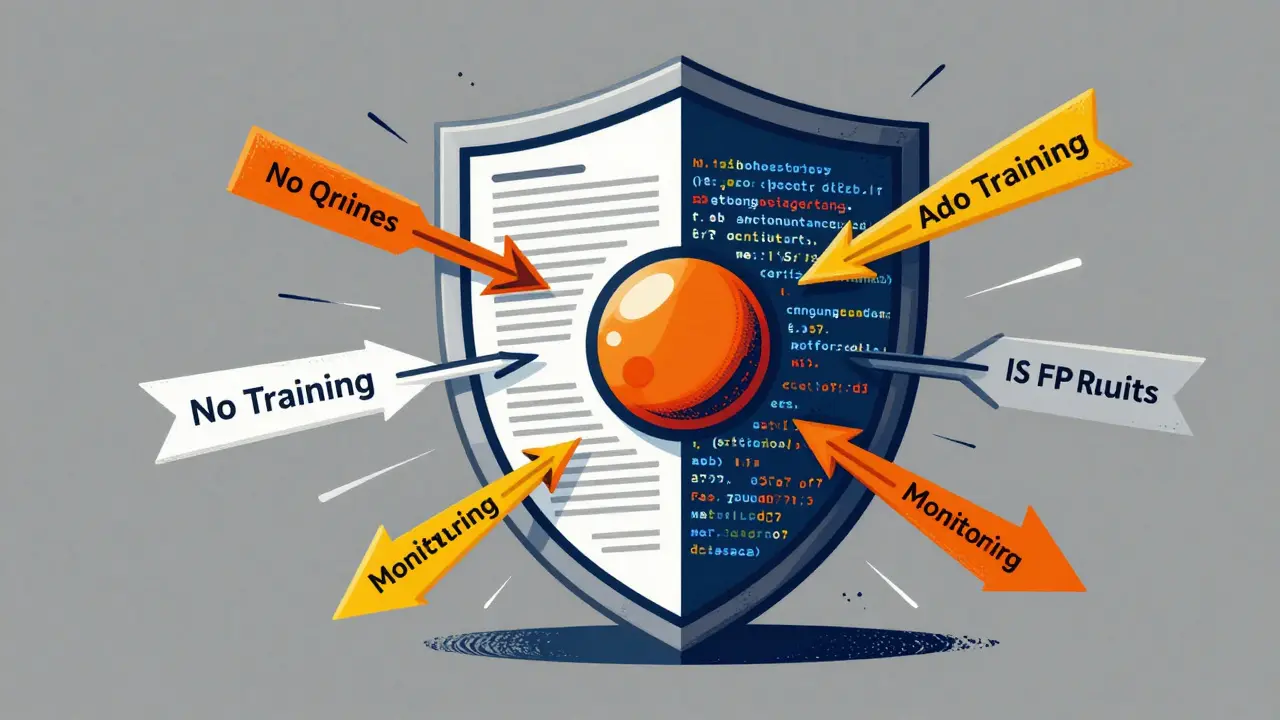
First, define "Data Ownership" clearly. State that all inputs, outputs, and derivatives remain your property. Crucially, include a clause prohibiting the vendor from using your data to train, fine-tune, or improve their own models without explicit written consent. This is often called a "No Training" clause.
Second, address "Model Unlearning." If you terminate the contract, the vendor must not only delete your raw data but also demonstrate that your data has been removed from any ongoing training pipelines. While true "unlearning" from a neural network is technically challenging, requiring them to retrain the model without your data or switch to a fresh instance is a reasonable expectation for high-security contracts.
Third, include "Audit Rights" specifically for AI systems. You should have the right to request logs showing who accessed your data, what prompts were sent, and whether any automated systems flagged anomalies. Without this transparency, compliance is impossible.
Continuous Monitoring Beyond Onboarding
Risk doesn’t stop after the contract is signed. In fact, that’s when the real work begins. Continuous monitoring is essential because the AI landscape changes daily. New vulnerabilities are discovered, regulations evolve, and vendor practices shift.
Implement automated monitoring tools that scan for anomalous behavior. For example, if a vendor’s API suddenly starts returning unusually long responses or includes unexpected metadata, that could indicate a prompt injection attack or a configuration error. Tools like Vanta is an automation platform for compliance and security reviews that offers continuous monitoring and AI-powered assessments or Mitratech is a unified third-party risk management platform featuring AI-powered risk assessments and continuous monitoring can help automate parts of this process, but you need custom alerts tailored to your AI usage patterns.
Regularly review the vendor’s security posture. Are they still compliant with the standards they promised? Have there been any recent breaches in their ecosystem? Subscribe to security bulletins from major cloud providers (AWS, Azure, GCP) since most LLM vendors run on their infrastructure. A outage or vulnerability in AWS Bedrock, for instance, directly impacts your vendor’s reliability and security.
Navigating Regulatory Compliance in 2026
The regulatory landscape for AI is maturing rapidly. By 2026, organizations must comply with multiple overlapping frameworks. The EU AI Act, for example, imposes strict requirements on high-risk AI systems, including transparency and human oversight. The US Executive Order on Safe, Secure, and Trustworthy AI mandates rigorous testing and reporting for advanced models.
When selecting vendors, ensure they can help you meet these obligations. They should provide documentation on model lineage, bias testing results, and safety evaluations. If your industry is regulated-such as healthcare (HIPAA) or finance (GLBA)-your vendor must adhere to those specific data protection rules. Never assume an AI vendor understands HIPAA; make them prove it with a Business Associate Agreement (BAA) that covers AI processing.
Keep an eye on emerging standards like NIST’s AI Risk Management Framework (AI RMF). Aligning your vendor assessments with this framework ensures you are covering all bases: mapping, measuring, managing, and governing AI risks.
Practical Steps to Get Started Today
Feeling overwhelmed? Start small. Here is a checklist to begin securing your LLM vendor relationships immediately:
- Inventorize Your AI Stack: List every vendor that touches your data, even indirectly. Include cloud providers, API wrappers, and analytics tools.
- Classify Data Sensitivity: Tag data as Public, Internal, Confidential, or Restricted. Only share Restricted data with vendors that have passed enhanced due diligence.
- Update Contracts: Add "No Training" and "Data Isolation" clauses to all new AI vendor agreements.
- Conduct a Prompt Audit: Review how your team interacts with vendor LLMs. Are employees pasting sensitive code or customer details into public chatbots? Implement user training and technical blocks.
- Test for Leaks: Use dummy data with watermarks to see if it appears in vendor outputs or public forums. This helps detect exfiltration early.
Remember, trust but verify. In the world of AI, verification requires technical sophistication and relentless attention to detail. Your vendors are partners, but they are also potential points of failure. Manage them accordingly.
The Human Element: Training and Awareness
Technology alone won’t save you. Your employees are the front line. If a marketing executive copies a confidential product roadmap into a vendor’s AI tool to generate a press release, no amount of backend security will prevent that exposure if the tool allows it.
Implement mandatory training on AI hygiene. Teach staff what constitutes sensitive data, how to recognize prompt injection attempts, and the importance of using approved, secured AI channels. Create clear guidelines: "If it’s confidential, it stays in our secure environment."
Encourage a culture of reporting. If someone notices weird behavior from an AI vendor, they should feel safe reporting it without fear of blame. Early detection of issues like hallucinated secrets or biased outputs depends on human vigilance.
Looking Ahead: The Future of AI Vendor Risk
As AI models become more autonomous and integrated into critical decision-making processes, the definition of "vendor risk" will expand. We may soon see scenarios where vendors’ AI agents negotiate contracts or execute trades on your behalf. The risk shifts from data privacy to operational integrity and financial liability.
Prepare for this by building flexibility into your risk management framework. Stay engaged with industry groups, follow thought leaders in AI security, and continuously update your assessment criteria. The goal is not to avoid AI vendors, but to engage with them safely and strategically.
Your data is the fuel for the AI revolution. Protect it fiercely. By implementing robust Third-Party Risk Management practices tailored for LLMs, you safeguard not just your information, but your reputation, your customers’ trust, and your competitive edge.
What is the biggest risk when sharing data with LLM vendors?
The biggest risk is unintentional data leakage through model outputs or training. Unlike traditional databases, LLMs can memorize and regurgitate sensitive information if not properly isolated. Additionally, there is the risk of the vendor using your proprietary data to improve their own models, which could expose your IP to competitors.
How do I ensure my data isn't used to train the vendor's model?
You must include a strict "No Training" clause in your contract. This legally binds the vendor to exclude your data from their training sets. Technically, look for vendors that offer dedicated instances or zero-retention policies, where data is processed in memory and deleted immediately after inference.
Are SOC 2 and ISO 27001 certifications enough for AI vendors?
They are a good start, but not sufficient on their own. These certifications cover general information security but do not address AI-specific risks like prompt injection, model poisoning, or output leakage. Look for additional AI-specific audits or adherence to frameworks like NIST AI RMF.
What is "model unlearning" and why does it matter?
Model unlearning is the process of removing the influence of specific data points from a trained machine learning model. It matters because simply deleting raw data doesn't erase what the model has already learned from it. If you leave a vendor, you want assurance that your data no longer shapes their model's behavior.
How can I monitor for prompt injection attacks from vendors?
Implement input and output filtering tools that scan for suspicious patterns. Monitor for anomalies in response length, structure, or content. Regularly conduct red-team exercises where ethical hackers attempt to inject prompts to test your vendor’s defenses. Automated monitoring platforms can alert you to unusual API activity in real-time.
Which regulations apply to LLM data handling in 2026?
Key regulations include the EU AI Act, which categorizes AI systems by risk level, and various US state laws like CCPA/CPRA that govern consumer data privacy. Industry-specific rules like HIPAA for healthcare and GLBA for finance also apply. Always ensure your vendor complies with the relevant laws for your sector and location.