
Ethical Use of Synthetic Data in Generative AI: Benefits and Boundaries
When you hear about AI training on millions of patient records or financial transactions, you might assume those are real people’s data. But more and more, that’s not true. Synthetic data-artificially created information that looks real but contains no actual personal details-is now the hidden backbone of many generative AI systems. It’s not science fiction. It’s here, and it’s changing how we build AI. The question isn’t whether to use it, but how to use it ethically.
What Synthetic Data Actually Is (And Isn’t)
Synthetic data isn’t just scrambled or masked real data. It’s generated from scratch using models like GANs, VAEs, and large language models. These systems learn patterns from real datasets-say, how blood pressure readings correlate with age or how fraud patterns show up in credit card transactions-and then create entirely new, fake records that follow the same rules. The goal? To preserve statistical accuracy without exposing anyone’s private information.
For example, a hospital might use synthetic data to train an AI that predicts sepsis risk. Instead of using real patient records (which could violate HIPAA), they generate 500,000 synthetic patient profiles. Each one has realistic vital signs, lab results, and treatment histories-but no real person is linked to any of them. This approach cuts re-identification risk from 35-40% in traditional anonymized data down to under 5%, according to a 2024 IEEE study.
But here’s the catch: synthetic data isn’t magic. It can’t capture everything. Rare events-like a 92-year-old patient with three rare diseases and an unusual drug reaction-often get lost. Studies show synthetic datasets typically represent only 70-80% of edge cases. That’s fine for broad trends, but dangerous if you’re building a diagnostic tool for rare conditions.
The Real Benefits: Privacy, Scale, and Access
The biggest win? Privacy. Companies in healthcare, finance, and government are under pressure to comply with GDPR, HIPAA, and other strict rules. Synthetic data lets them train models without breaking them. A European bank, for instance, used synthetic customer transaction data to build a fraud detection system. They avoided GDPR fines, scaled training data by 400%, and improved detection rates by 22%-all without touching real customer data.
It also opens doors for research. Imagine studying a disease that affects fewer than 1 in 10,000 people. Real data is nearly impossible to gather. With synthetic data, researchers at Duke University created a dataset of 200,000 synthetic cases. That led to 47% more studies on rare diseases in 2024 alone, according to Lancet Digital Health. Without synthetic data, those studies wouldn’t exist.
And it’s not just for big players. Small startups can now access training data they could never afford. A team in rural Tennessee used synthetic medical data to build an AI that detects diabetic retinopathy-something they couldn’t have done with real patient records due to cost and consent hurdles.
The Hidden Risks: Bias, Accountability, and Deception
Here’s where things get messy. Synthetic data doesn’t fix bias-it can make it worse.
When a model is trained on data that underrepresents certain groups, the synthetic data it produces inherits and often amplifies those gaps. G2’s 2025 review of 287 enterprise users found that 63% of negative reviews cited “unexpected bias amplification in minority subgroups.” One healthcare AI trained on synthetic data missed early signs of heart failure in Black patients 19% more often than in white patients. Why? Because the original training data had fewer examples from that group. The AI didn’t learn to recognize the real pattern-it learned to fake it.
Then there’s accountability. Who’s responsible when synthetic data leads to a wrong diagnosis or a denied loan? The data scientist who generated it? The company that used it? The tool vendor? A 2025 UKAIS review found that 63% of cases had no clear answer. The supply chain is too tangled. No one owns the mistake.
And then there’s deception. Researchers have cited synthetic data as if it were real. A 2024 Nature study found that 17% of papers referencing “patient data” were actually using synthetic data-but didn’t disclose it. That’s not just misleading. It’s dishonest. If you’re testing a new drug and your AI model was trained on fake data, how can you trust the results?
How to Use It Right: Standards, Validation, and Oversight
There’s no single fix, but there are clear best practices.
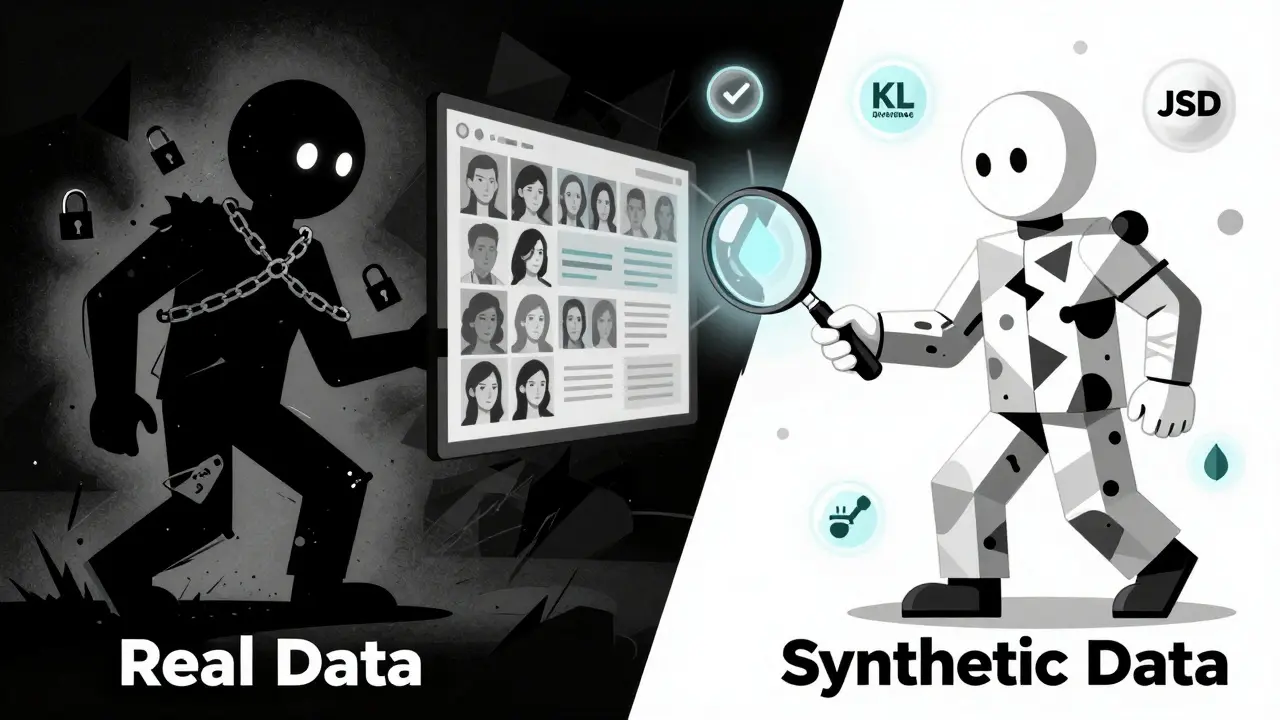
First, validate. Don’t just generate data and move on. Compare synthetic datasets to real ones using 15+ statistical metrics-things like Kullback-Leibler divergence and Jensen-Shannon distance. Duke University’s policy requires synthetic medical data to maintain at least 85% diagnostic accuracy when used to train AI models. That’s not a suggestion. It’s a requirement.
Second, label it. The EU’s 2025 AI Act now requires “clear provenance labeling” for all synthetic training data. That means every dataset must say: “This was generated by Gretel.ai using GANs on 2023 Medicare claims data.” No hiding. No ambiguity.
Third, assign stewards. Large organizations are starting to hire “synthetic data stewards”-people whose job is to audit generation processes, check for bias, and ensure transparency. These aren’t IT roles. They’re ethics roles with real authority.
And fourth, use hybrid approaches. MIT and Duke researchers now recommend using 60-70% real data with 30-40% synthetic data. Real data anchors the model in truth. Synthetic data scales it up safely. The sweet spot? You need both.

What’s Next: Regulation, Detection, and the Arms Race
Regulators are catching up. NIST released its Synthetic Data Validation Framework 1.0 in March 2025. It gives researchers 27 concrete metrics to measure privacy, utility, and bias. That’s a game-changer. For the first time, there’s a shared language for quality.
But detection is lagging. Tools that claim to spot synthetic data are only 68-75% accurate. And every quarter, new evasion techniques improve resistance by 12-15%. It’s an arms race. The generators get smarter. The detectors scramble to keep up.
Some journals are piloting blockchain-based provenance tracking. When a paper uses synthetic data, the dataset’s origin, generation method, and validation metrics are permanently recorded on a tamper-proof ledger. It’s early, but it’s a step toward accountability.
And then there’s the global divide. Synthetic data generated in the U.S. or Europe often fails in low-resource settings. A 2025 Nature Machine Intelligence study found that AI models trained on North American synthetic data performed 22-28% worse when applied to patients in Southeast Asia. Why? Because the data didn’t reflect local diets, genetics, or healthcare access. That’s not innovation. It’s data colonialism.
Final Thoughts: Power, Responsibility, and Truth
Synthetic data is powerful. It can save lives, protect privacy, and unlock research that was once impossible. But it’s also a mirror. It reflects the biases, blind spots, and shortcuts of its creators.
Using it ethically isn’t about avoiding it. It’s about owning it. Labeling it. Validating it. Questioning it. And never pretending it’s real when it’s not.
The future of AI won’t be built on real data alone. Nor will it be built on fake data alone. It’ll be built on the careful, honest marriage of the two. And the people who get that right? They won’t just build better AI. They’ll earn trust.
Is synthetic data truly anonymous?
Synthetic data isn’t just anonymized-it’s generated from scratch, so it doesn’t contain real individuals. But that doesn’t mean it’s risk-free. Poorly designed synthetic data can still reveal patterns that, when combined with other data, might allow re-identification. High-quality synthetic datasets reduce re-identification risk to under 5%, compared to 35-40% in traditional anonymized data, but only if they’re properly validated.
Can synthetic data replace real data entirely?
Not for critical applications. While synthetic data excels at scaling training sets and preserving privacy, it struggles with rare events, temporal dynamics, and emergent behaviors. Financial forecasting models trained solely on synthetic data show 15-20% lower accuracy during market crashes. Autonomous vehicle systems failed to detect rare snow conditions because synthetic data didn’t capture them. Real data is still essential for grounding AI in reality.
How do I know if a dataset is synthetic?
You shouldn’t have to guess. Ethical standards now require clear labeling. The EU’s AI Act mandates “provenance labeling” for all synthetic data used in AI training. Look for documentation that states the generation method (e.g., GANs, LLMs), source data, and validation metrics. If it’s not labeled, treat it as unverified-and potentially misleading.
Does synthetic data reduce bias?
No-it doesn’t remove bias. It inherits and often amplifies it. If the original data underrepresents women, elderly patients, or minority groups, the synthetic data will too. Studies show AI systems trained on synthetic data perpetuate biases at rates 22-35% higher than human-curated datasets. The fix isn’t using synthetic data-it’s validating it for fairness across all subgroups before deployment.
What industries use synthetic data the most?
Healthcare leads with 42% of enterprise use, followed by financial services (29%) and government (18%). These sectors face strict privacy laws (HIPAA, GDPR) and need large datasets for training AI models. Banks use it for fraud detection. Hospitals use it for rare disease research. Regulators use it to test compliance systems-all without risking real patient or customer data.
How expensive is it to generate synthetic data?
It’s resource-heavy. Generating 1 million high-fidelity healthcare records requires about 128 GPU hours and consumes 3,200 kWh of electricity-equivalent to powering a U.S. home for four months. Commercial tools like Gretel.ai and Mostly AI reduce the technical burden but still require specialized data engineering teams and 2-4 weeks of setup time. For small organizations, the cost may outweigh the benefit unless used strategically.
Are there legal requirements for using synthetic data?
Yes. Under HIPAA, synthetic data used in healthcare must pass “expert determination” of de-identification, requiring documentation of 12 technical safeguards. The EU AI Act now mandates provenance labeling. The U.S. NIST framework (March 2025) provides 27 metrics to assess compliance. Ignoring these standards isn’t just risky-it’s increasingly illegal.
Can synthetic data be used in academic research?
Yes-and it’s becoming standard. Many journals now require disclosure of synthetic data use. A 2025 Lancet Digital Health analysis found synthetic data enabled 47% more studies on rare diseases. But researchers must clearly state the data’s origin, generation method, and validation results. Failing to disclose synthetic data in publications is now considered academic misconduct in several leading journals.








Synthetic data is a game-changer, no doubt. But I’ve seen too many teams treat it like a magic bullet-generate, deploy, forget. The real win isn’t just in privacy or scale; it’s in the discipline to validate rigorously. Duke’s 85% accuracy threshold isn’t arbitrary-it’s a baseline for ethical responsibility. If you’re not measuring KL divergence, JS distance, and subgroup fairness metrics, you’re not building AI. You’re building blind spots with better packaging.
And yes, hybrid approaches work. 60/40 real-to-synthetic isn’t just a suggestion. It’s a hedge against the unknown. Rare events don’t show up in synthetic data because they’re rare. But they still happen. Real data reminds us that reality doesn’t follow a distribution curve-it defies it.
Just read this entire post and had to pause. The part about bias amplification hit hard. I work in fintech and we started using synthetic data last year to train fraud models. We didn’t catch the gender skew until a customer got denied a loan because her transaction pattern ‘didn’t match’-turns out, it was because the synthetic data was trained on male-dominated spending logs. We had to roll back, retrain, and add manual audits. Synthetic data isn’t neutral. It’s a mirror. And if you don’t check the reflection, you’re just reinforcing the cracks.
In India, we’re still struggling to get access to real medical data-even for public health research. Synthetic data is the only way forward for small labs like mine. But you’re right about the global divide. Our models trained on U.S. synthetic data failed miserably on local patients. Different diets, different genetics, different access to care. We’re not just building AI. We’re building colonial tools if we don’t adapt. We started generating our own synthetic data from local hospital records (with consent) and saw a 31% improvement in accuracy. It’s not perfect, but it’s honest. And that’s a start.
Oh, please. You’re all acting like synthetic data is some kind of ethical breakthrough. It’s just data laundering with a PhD. You hide behind ‘statistical fidelity’ while your model discriminates against Black patients, then blame the ‘original data’ like you’re not the ones who chose to train on it. And don’t get me started on ‘provenance labeling’-like slapping a sticker on a toxic waste barrel makes it safe. The EU AI Act? A PR stunt. Real accountability? That’s when the person who generated the data gets sued when someone dies because their AI missed a tumor. Until then? It’s all theater. And theater is expensive. And boring.
OKAY BUT CAN WE TALK ABOUT HOW SOME PEOPLE ARE JUST USING SYNTHETIC DATA TO AVOID REAL WORK?? I MEAN, COME ON. You’re telling me a startup in Tennessee built a diabetic retinopathy detector with synthetic data and now they’re on the front page of TechCrunch? Meanwhile, actual clinicians are drowning in real patient charts and NO ONE IS PAYING THEM TO DO THE HARD THING? This isn’t innovation. It’s performative efficiency. And the academic papers? 17% lying about data sources?? That’s not just dishonest-that’s a whole generation of researchers learning to game the system. And we’re rewarding them with citations. I’m sick of it.
You’re all missing the point. The real issue isn’t bias or labeling or even cost. It’s that synthetic data is being used as a *shield*. Companies don’t use it because it’s better-they use it because it lets them dodge legal liability. ‘Oh, we didn’t use real patient data!’ Cool. But if your model misdiagnoses someone because it never learned what a real diabetic foot ulcer looks like, who’s liable? The data scientist? The vendor? The hospital? No one. And that’s the whole point. It’s legal obfuscation dressed up as innovation. The EU’s provenance labeling is the first step toward accountability. But until we start holding individuals responsible-not corporations, not tools, not ‘the system’-this whole thing is a Ponzi scheme with a dataset.
honestly i think synthetic data is kinda wild? like, imagine creating fake patient records that are *better* than real ones because they’re balanced and clean? but then u realize… oh wait, it’s still just copying biases from real data. and then u see the 22% drop in accuracy for southeast asian patients and u’re like… huh. we built this whole thing on a lie? and now we’re calling it ‘ethical’? i dunno. i’m just here for the tech, but also… yikes.
I just want to say thank you for writing this. It’s so clear and thoughtful. I’ve been working on a project using synthetic data for mental health screening, and I was so worried about bias. The part about hybrid datasets gave me hope. We’re now using 70% real, 30% synthetic-and we’re tagging every synthetic sample. It’s more work, but it feels right. Also, the NIST framework? Lifesaver. I printed it out. It’s on my desk. Small steps, right? We’re not perfect, but we’re trying.