Verification for Generative AI Agents: Guarantees, Constraints, and Audits
Imagine asking your company’s new generative AI agent to draft a legal contract or analyze patient records. It spits out a polished response in seconds. But how do you know it didn’t just make up the facts? This is the core problem facing businesses today. We are moving past the era of 'prompt and pray.' In 2026, the conversation has shifted from what AI can generate to whether we can trust what it generates. The answer lies in **verification for generative AI agents**. It is no longer optional; it is the bridge between experimental tech and mission-critical deployment.
We used to think of AI outputs as probabilistic guesses. Now, industries like finance and healthcare demand mathematical guarantees. This article breaks down how we move from vague confidence to concrete proof using constraints, audits, and formal verification methods.
Key Takeaways
- Formal Verification uses mathematical logic to prove AI outputs meet specific business rules, offering stronger guarantees than traditional testing.
- The VerifAI Framework introduces a three-step process (Indexer, Reranker, Verifier) to validate generated data against ground truth in data lakes.
- Blockchain Integration provides immutable audit trails, ensuring that verification records cannot be tampered with after the fact.
- Regulatory Pressure from the EU AI Act and NIST frameworks is driving adoption, especially in high-stakes sectors like finance and healthcare.
- Current Limitations include difficulty verifying subjective content and the steep learning curve for implementing formal methods.
Why Traditional Testing Fails Generative AI
You might wonder why we can’t just use standard software testing. The issue is that traditional testing checks for known bugs in code. Generative AI, however, creates novel outputs every time. A model might pass all unit tests but still hallucinate a fake court case or invent a medical dosage. Standard QA processes look for syntax errors, not semantic truths.
According to research published in the Communications of the ACM, verified AI aims to provide "strong, provable assurances of correctness." This means moving beyond checking if the code runs to proving that the output aligns with reality. For example, in financial services, an AI agent must not only calculate interest correctly but also adhere to complex regulatory constraints. If it violates a constraint, the system needs to flag it immediately, not just hope it doesn't happen often.
This shift is critical because the cost of error is rising. As noted by the VLDB Endowment, decisions based on AI outputs in government and healthcare have significant consequences. We need systems that can say, "I am 99.9% sure this is correct," backed by evidence, not just statistical likelihood.
The Three Pillars of Verification: Guarantees, Constraints, and Audits
To build trustworthy AI agents, we need a structured approach. Think of it as a safety net with three layers:
- Guarantees: Mathematical proofs that the AI’s reasoning follows logical rules.
- Constraints: Hard limits on what the AI can say or do, defined by business rules.
- Audits: Transparent logs that allow humans or regulators to review the decision-making process.
Let’s look at how these work in practice. A guarantee might involve using formal methods to ensure an AI agent never suggests a medication interaction that is known to be dangerous. A constraint could limit the AI to only citing sources from a approved library. An audit trail would record which sources were checked and why a specific answer was chosen.
How Formal Verification Works in Practice
Formal verification is the engine behind these guarantees. It involves translating business rules into mathematical logic. Companies like AWS have started integrating tools like Dafny and Kani into their AI workflows. These tools don’t just test the AI; they prove its correctness within a given logical framework.
Here is a simple breakdown of the process:
- Define Rules: Experts translate business policies into formal specifications. For instance, "Never disclose Social Security Numbers" becomes a verifiable constraint.
- Automated Reasoning: The system checks the AI’s output against these rules using automated reasoning engines.
- Proof Certificates: If the output passes, the system generates a certificate proving compliance. This certificate can be audited by third parties.
This approach offers "clear reasoning for why a response is valid or invalid," according to AWS technical teams. It turns black-box AI decisions into white-box processes where every step is justified.
The VerifAI Framework: A Data-Centric Approach
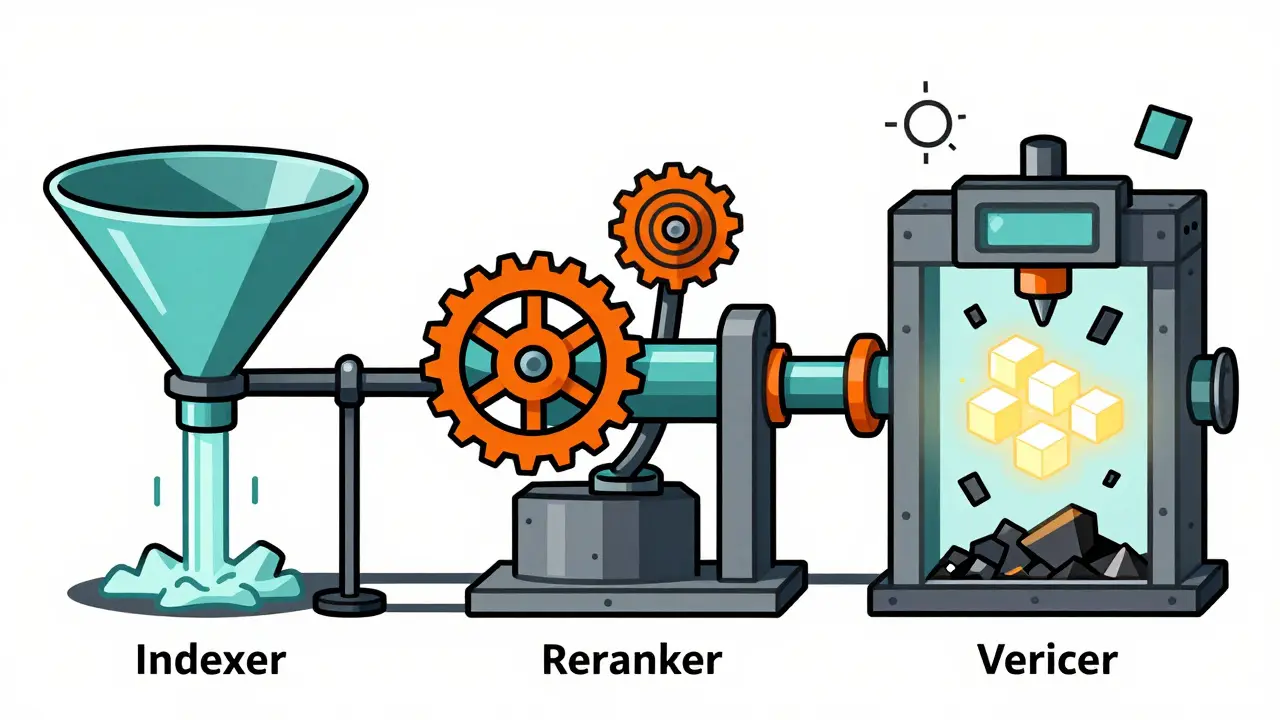
While formal methods handle logic, we also need to verify facts. This is where the VerifAI framework, developed by researchers at the VLDB Endowment, comes in. It takes a data management perspective, focusing on validating generated content against existing data lakes.
VerifAI operates through three core components:
| Component | Function | Key Benefit |
|---|---|---|
| Indexer | Identifies relevant supporting data from large data lakes. | Retrieves potential evidence quickly from vast datasets. |
| Reranker | Prioritizes the most likely verifying evidence. | Reduces computational load by focusing on high-probability matches. |
| Verifier | Determines if retrieved data validates or invalidates the AI output. | Provides a binary check: true or false based on ground truth. |
This system excels when there is clear "ground truth" data. For example, if an AI generates a table of quarterly sales figures, VerifAI can check those numbers against the company’s actual database. However, it struggles with subjective data, such as creative writing or opinion-based analysis, where no single ground truth exists.
Blockchain and Immutable Audits
What happens after the AI makes a decision? You need an audit trail that cannot be altered. This is where blockchain technology enters the picture. Protocols like Numbers Protocol offer decentralized verification by recording provenance data on immutable ledgers.
Unlike centralized databases, which can be edited by admins, blockchain records are cryptographically sealed. This provides "trustless verification," meaning you don’t need to trust the AI provider; you just need to trust the math. For industries facing strict regulatory scrutiny, this immutability is crucial. It ensures that if a regulator asks, "Why did the AI approve this loan?" you can show an unchangeable log of the data and rules used at that exact moment.
Challenges and Limitations
Despite the progress, verification is not a silver bullet. Several hurdles remain:
- Subjectivity Gap: Verifying factual claims is easier than verifying nuanced judgments. There is no mathematical proof for "good customer service tone."
- Implementation Cost: Setting up formal verification requires specialized skills. AWS notes that translating business rules into mathematical logic can take 2-3 weeks of dedicated effort by cross-functional teams.
- Physical Inspection Needs: Some experts argue that digital proofs aren't enough. The AI Alignment Forum highlights that proofs may need to be coupled with physical inspections of hardware and source code, which many AI labs are reluctant to provide.
- Real-Time Latency: Heavy verification processes can slow down AI responses. Balancing speed with rigorous checking is an ongoing engineering challenge.
Additionally, the talent pool is small. Proficiency in formal verification languages and probabilistic reasoning typically requires 6-12 months of dedicated study. This creates a barrier to entry for smaller organizations.
Market Trends and Regulatory Drivers
The push for verification is being driven by both market forces and regulations. The global AI verification market is projected to grow from $1.2 billion in 2023 to $8.7 billion by 2028, reflecting a compound annual growth rate of 48.3%. Financial services lead adoption at 32%, followed by healthcare at 24%.
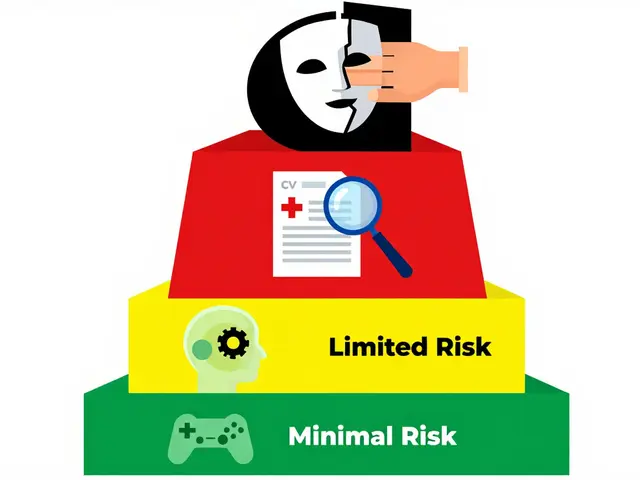
Regulations like the EU AI Act require high-risk AI systems to undergo conformity assessments. Similarly, the US NIST AI Risk Management Framework emphasizes trustworthiness characteristics like reliability and safety. These frameworks don't just suggest best practices; they mandate accountability. By 2026, analysts predict that 65% of enterprise generative AI deployments will incorporate some form of formal verification, up from just 17% in 2024.
Comparison: Traditional vs. Formal Verification
To understand the value proposition, let’s compare traditional testing with formal verification methods.
| Feature | Traditional Testing | Formal Verification |
|---|---|---|
| Basis | Probabilistic sampling | Mathematical logic |
| Guarantee Level | High confidence, but not absolute | Provable correctness within constraints |
| Scope | Known bugs and edge cases | All possible inputs within defined domain |
| Auditability | Test reports and logs | Cryptographic proof certificates |
| Complexity | Low to medium | High (requires specialized expertise) |
Traditional testing is faster and cheaper but leaves room for rare errors. Formal verification is more expensive and complex but provides the assurance needed for high-stakes decisions.
Future Roadmap: What Comes Next?
The field is evolving rapidly. Key developments to watch in 2026 and beyond include:
- Hybrid Models: Combining blockchain provenance with formal verification for end-to-end trust.
- Subjective Verification: Developing new metrics to assess quality in creative or opinion-based AI outputs.
- Industry-Specific Frameworks: Tailored verification standards for healthcare, legal, and financial domains.
- Real-Time Capabilities: Improving speed so verification doesn’t bottleneck user experience.
As Scott et al. and Ashok et al. demonstrated in earlier research, augmenting learning with verification modules is promising. The goal is to move from post-hoc auditing to real-time constraint satisfaction during generation.
What is the difference between validation and verification in AI?
Validation asks, "Are we building the right product?" (Does the AI solve the user's problem?). Verification asks, "Are we building the product right?" (Does the AI follow the specified rules and constraints without error?). In generative AI, verification focuses on ensuring outputs are factually accurate and compliant with safety guidelines.
Can blockchain verify the accuracy of AI-generated content?
Blockchain itself does not verify accuracy. It verifies provenance and immutability. It proves that a specific piece of data was generated at a certain time and has not been altered since. To verify accuracy, you still need external methods like formal verification or comparison against ground truth data, but blockchain ensures the audit trail of that process is trustworthy.
Is formal verification too expensive for small businesses?
Currently, yes. Implementing full formal verification requires specialized talent and significant setup time. However, cloud providers are beginning to offer managed verification services that lower the barrier to entry. Small businesses may start with simpler constraint-based filtering before moving to full mathematical proofs.
How does the EU AI Act impact AI verification?
The EU AI Act mandates that high-risk AI systems undergo conformity assessments. This includes verifying that the system meets safety, transparency, and non-discrimination requirements. Companies operating in Europe must implement robust verification and audit mechanisms to comply with these legal standards.
What is the role of ground truth in AI verification?
Ground truth refers to the definitive, correct data against which AI outputs are compared. Systems like VerifAI rely on ground truth to validate factual claims. Without reliable ground truth data, verifying objective accuracy becomes extremely difficult, limiting verification to subjective or logical consistency checks.