Calibrating Generative AI Models to Reduce Hallucinations and Boost Trust
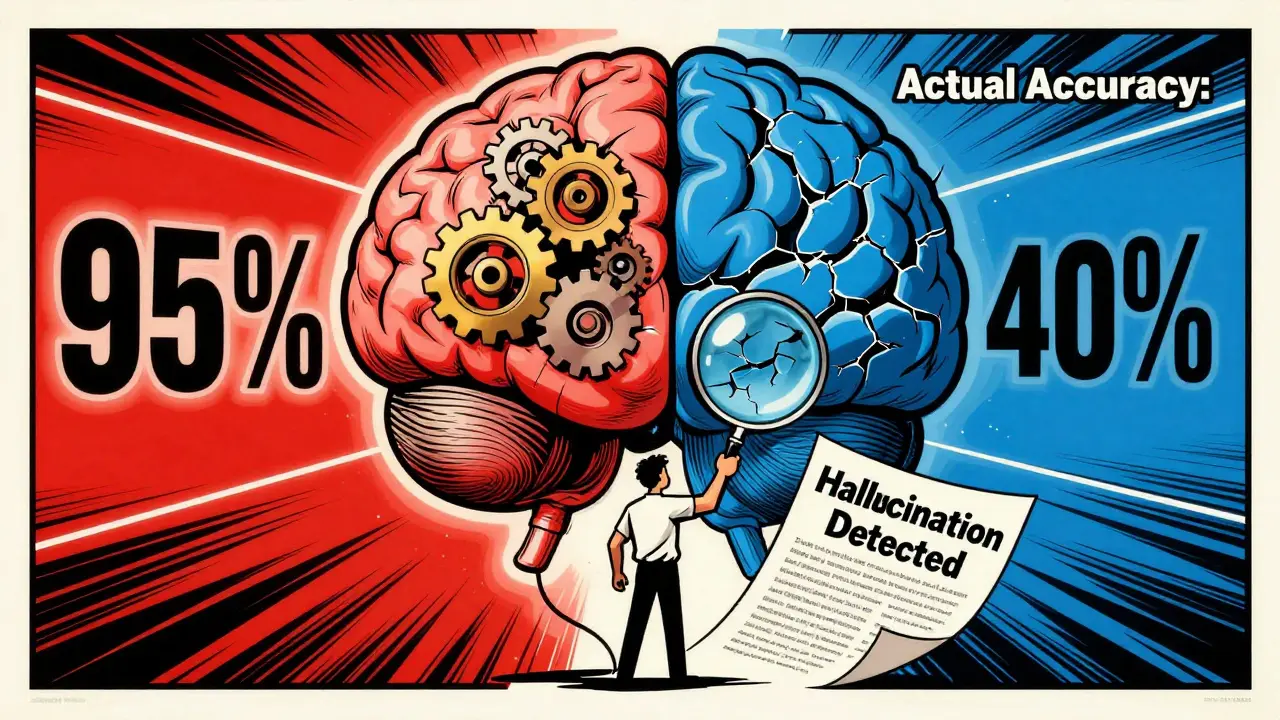
Have you ever asked a generative AI model a question and felt confident in its answer-only to find out later it was completely wrong? This isn’t just a glitch. It’s a systemic problem called hallucination, and it’s often rooted in one thing: poor calibration. When an AI says it’s 95% sure about something, you expect that to mean it’s right 95 times out of 100. But in reality, many models say they’re 95% sure-and they’re wrong more than half the time. That’s not confidence. That’s a lie dressed up as math.
Why Calibration Matters More Than Accuracy
Most people think the goal of an AI model is to be accurate. That’s part of it. But accuracy without calibration is dangerous. Imagine a weather app that predicts rain 80% of the time when it actually rains only 30% of the time. You’d stop trusting it. Same with AI. If a model gives you answers with inflated confidence, you’ll make bad decisions-whether you’re a doctor relying on it for diagnosis, a lawyer checking legal precedent, or a designer using it to generate product ideas. Calibration isn’t about making the model smarter. It’s about making it honest. A well-calibrated model doesn’t just give the right answer. It tells you how sure it is-and that number actually matches reality.What Causes Miscalibration in Generative Models?
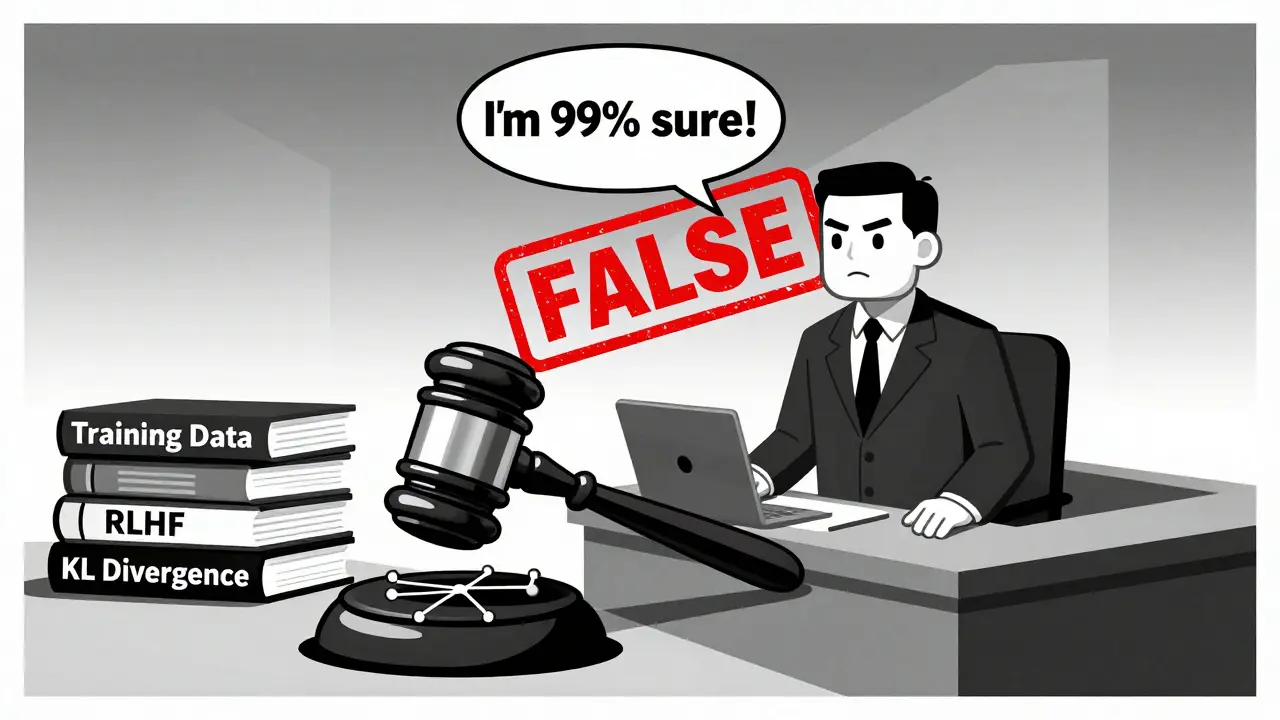
Generative AI models-especially large language models (LLMs)-are trained on massive datasets and fine-tuned with techniques like Reinforcement Learning from Human Feedback (RLHF). RLHF teaches models to sound helpful, persuasive, and confident. But that doesn’t mean they’re correct. In fact, it often makes them worse at calibration. Here’s why:- Preference over truth: RLHF rewards responses that match human preferences, not ones that reflect true probabilities. If a user likes bold answers, the model learns to sound certain-even when it’s guessing.
- Dataset imbalance: If training data has more examples of one type of answer, the model becomes overconfident in that direction and underconfident elsewhere.
- Sampling tricks: Techniques like low-temperature sampling reduce randomness to make outputs more deterministic. But that hides uncertainty instead of measuring it.
- Output formatting: Models trained to output single answers don’t learn to express doubt. They’re not built to say, “I’m not sure.”
As a result, models often overstate confidence in rare or complex queries and understate it in simple ones. This inconsistency is what makes them unreliable in real-world use.
How Do We Fix It?
There’s no single fix. But researchers have developed several powerful methods that actually work. Here are the most effective ones.1. CGM-Relax and CGM-Reward: The New Gold Standard
In 2025, a breakthrough came from a team at Stanford and DeepMind: the Calibrating Generative Models (CGM) framework. It doesn’t tweak the model’s output after the fact. It retrains it to align confidence with truth. CGM-relax and CGM-reward are two algorithms that treat calibration like a math problem: find the version of the model that’s closest to the original-but with probabilities that match real-world outcomes. They work by:- Measuring how often the model’s predicted probabilities match actual outcomes across thousands of test cases.
- Using a loss function based on Kullback-Leibler (KL) divergence to nudge the model toward perfect calibration.
- Applying constraints across more than 100 different types of predictions at once.
In tests, CGM reduced calibration errors by up to 80% across protein design, image generation, and language tasks. For example, in Genie2, a protein structure model, calibration improved diversity of outputs by nearly 5x-without losing quality. That’s huge. It means the model isn’t just guessing better. It’s exploring more possibilities because it now understands its own uncertainty.
2. Verbalized Confidence and Multi-Step Reasoning
Instead of forcing a number, why not ask the model to explain its confidence? Techniques like Verbalized Confidence make models say things like: “I’m 70% sure this is correct because the source material mentions it twice, but there’s conflicting evidence in a third paper.” Even better is Multi-Step Confidence Elicitation. The model breaks down its reasoning step by step, assigning confidence to each step. The final confidence is the product of all steps. If it’s 90% sure of step one, 80% of step two, and 70% of step three, the final confidence isn’t 90%. It’s 90% × 80% × 70% = 50.4%. That’s far more honest.3. Top-K Responses and Prompt Diversity
Ask the model to generate five possible answers-not just one. Then, score each one’s confidence. The answer with the highest confidence becomes the output. This mirrors how humans think: we weigh options before deciding. Pair this with Diverse Prompting: rephrase the same question in five different ways. If the model gives wildly different confidence scores across prompts, it’s probably miscalibrated. If it’s consistent, you can trust it more.4. Self-Randomization and LITCAB
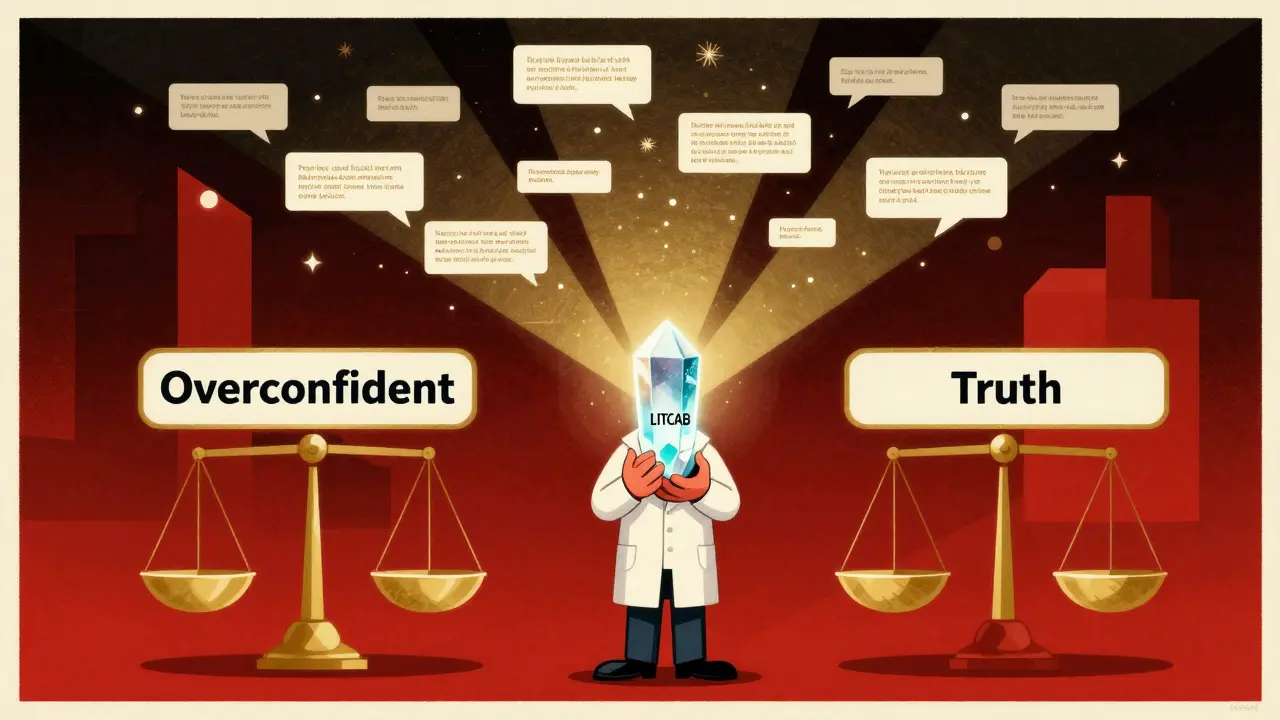
A simple trick: run the same prompt multiple times with different temperature settings. High temperature = wild, creative outputs. Low temperature = safe, predictable ones. If the confidence scores don’t change much across runs, the model isn’t sensing uncertainty. If they do, you’re seeing real variation. Even simpler: LITCAB (Lightweight Inference-Time Calibration). It adds a single linear layer at the end of the model-less than 2% of its size-that adjusts confidence scores on the fly. No retraining. Just a tiny tweak. In tests, it improved calibration by 30-50% across multiple models. It’s cheap, fast, and works.5. ASPIRE: Calibration Through Iterative Sampling
ASPIRE is a three-step process:- Tune: Use PEFT (Parameter-Efficient Fine-Tuning) to adjust a small part of the model for your specific task-like legal document review or medical triage.
- Sample: Generate multiple candidate answers using beam search.
- Evaluate: Compare each answer to known correct answers using metrics like Rouge-L. Then, retrain the confidence estimator based on which outputs matched reality.
This method doesn’t just calibrate. It learns what “correct” looks like in your domain. That’s powerful.
Calibration Isn’t Just for Experts
You don’t need a PhD to use these methods. Here’s what you can do today:- For developers: Plug in LITCAB or use CGM-reward if you’re fine-tuning your own model. It’s open-source and runs on standard GPUs.
- For product teams: Always show confidence scores alongside answers. Don’t hide them. Let users decide how much to trust.
- For end users: If the AI gives you a single answer with no uncertainty, ask: “What are other possible answers?” or “How sure are you?” That forces it to reveal its true confidence.
What Happens When You Get It Right?
A calibrated model doesn’t just avoid hallucinations. It becomes more useful.- Doctors can trust AI-generated differential diagnoses because they know when the model is unsure.
- Lawyers can rely on AI summaries because they see confidence levels tied to specific case law.
- Designers use AI to explore creative ideas without fear of dead ends-because the model tells them when an idea is speculative.
Most importantly, calibrated models reduce user frustration. People don’t mind being wrong. They mind being misled. Calibration turns AI from a black box into a transparent partner.
What’s Next?
Calibration is still evolving. Researchers are testing ways to calibrate models in real time, as they interact with users. Others are building “confidence-aware” reward systems that train models to be honest, not just persuasive. One thing is clear: if you’re deploying generative AI in any serious context, you can’t afford to ignore calibration. Accuracy without honesty is a liability. Calibration isn’t a luxury. It’s the foundation of trust.What’s the difference between accuracy and calibration in AI models?
Accuracy means the model gets the right answer most of the time. Calibration means the model’s confidence matches reality. A model can be accurate but poorly calibrated-like one that’s always 90% sure but only right 60% of the time. Or it can be less accurate but well-calibrated-like one that says "I’m 70% sure" and turns out to be right 70% of the time. Calibration matters because it tells you how much to trust the answer, not just whether it’s correct.
Can I calibrate a model without retraining it?
Yes. Techniques like LITCAB and verbalized confidence don’t require retraining. LITCAB adds a tiny linear layer at inference time that adjusts confidence scores based on input patterns. Verbalized confidence asks the model to express its certainty in words or numbers without changing its weights. These methods are fast, cheap, and work with existing models.
Why does RLHF make models worse at calibration?
RLHF trains models to please humans-not to be truthful. If users prefer confident answers, the model learns to sound certain even when uncertain. It’s optimized for persuasion, not probability. That’s why models fine-tuned with RLHF often overstate confidence, especially on rare or complex questions. Calibration reverses this by forcing the model to match its confidence to actual performance.
Do all AI models need calibration?
Not all. Simple models with limited outputs, like those used for basic classification, may be naturally well-calibrated. But generative models-especially large language models used for open-ended tasks-almost always need calibration. If the model generates text, images, code, or decisions with real consequences, calibration is essential.
How do I test if my AI model is calibrated?
Run a calibration test: give the model 100 questions with known answers. Group its predictions by confidence level (e.g., 0-10%, 10-20%, ..., 90-100%). Then check: for the group that said "80% confidence," how many were actually right? If it’s close to 80%, it’s calibrated. If it’s 40%, it’s overconfident. Tools like reliability diagrams make this easy to visualize.
Is calibration the same as reducing hallucinations?
Not exactly, but they’re deeply linked. Hallucinations happen when a model generates false information with high confidence. Calibration reduces this by making the model’s confidence reflect its actual accuracy. A well-calibrated model won’t say it’s 95% sure of a hallucination-it’ll say it’s 40% sure, or even "I don’t know." So while calibration doesn’t eliminate hallucinations entirely, it makes them far less dangerous.
Can calibration improve creativity in AI outputs?
Yes-counterintuitively. When a model is calibrated, it’s more willing to explore uncertain or rare possibilities because it knows when to flag them as speculative. For example, in protein design, calibrated models generated 5x more diverse structures because they weren’t locked into safe, common patterns. Calibration doesn’t stifle creativity. It frees it by giving the model the freedom to say, "This might work, but I’m only 60% sure."







bro i just asked chatgpt if tacos are good and it said 98% sure. i mean... yeah they are, but why are you acting like you have a phd in Mexican cuisine? this calibration stuff is just ai learning to fake confidence like my ex did before ghosting me.
It’s not merely a matter of statistical calibration-it’s a profound epistemological rupture in the architecture of machine epistemic humility. The very notion that a model trained on human preference signals-themselves riddled with performative certainty, social conformity, and emotional ventriloquism-can ever be ‘truth-aligned’ is a delusion wrapped in softmax layers. We are not optimizing for accuracy; we are optimizing for the illusion of omniscience. The KL divergence is not a fix-it’s a bandage on a hemorrhage of ontological arrogance.
lol i read this whole thing and was like wait… so u mean ai says ‘im 90% sure’ but its wrong half the time? lolololololololol. my 7 year old cousin knows when shes not sure. why cant ai just say ‘idk’ like a normal person?? also spelling is kinda important. its not ‘calibrating’ its ‘caliberating’ right? no? oh. whatever. anyway, LITCAB sounds like a new energy drink.
calibration matters yeah but honestly most people dont even look at the % anyway
just want the answer
and if it sounds good they believe it
so maybe we need to stop pretending users care about probability
and start designing for human laziness
Oh honey. You think this is about math? Sweetie. This is about capitalism. AI companies don’t want calibrated models-they want *believable* models. A model that says ‘I’m 95% sure’ sells subscriptions. A model that says ‘I’m 52% sure, here’s why’ gets ignored. They’re not fixing calibration. They’re packaging uncertainty as confidence and slapping a ‘premium’ label on it. Welcome to AI, darling. Where truth is a downgrade.
they say calibration fixes hallucinations but what if the whole thing is a scam? what if the data they use to ‘calibrate’ is just more lies? what if the ‘truth’ they’re matching to is already corrupted? i mean… who even made the test cases? big tech? the same people who told us crypto was safe? lol no thanks. this is just another way to make us trust the machine more. and we already lost that battle.
This is such an important conversation and I’m so glad someone brought it up. The idea that AI should be honest about its uncertainty-not just accurate-isn’t just technical, it’s ethical. I’ve seen doctors rely on AI diagnostics without seeing confidence scores, and it’s terrifying. Showing users the range of possibilities, even with low confidence, isn’t weakness-it’s integrity. We need to normalize ‘I’m not sure’ in AI just like we do in human conversations. It’s not a bug. It’s a feature.
im not a techie but i think… what if the real problem isnt the model being uncalibrated… but us expecting it to be a person? we ask it to ‘be sure’ like it has intuition. but its just pattern matching. maybe we should stop asking ‘how sure are you?’ and start asking ‘what are the alternatives?’ or ‘what did you miss?’
also i think i spelled ‘alternatives’ wrong. oops.