
Legal and Licensing Guide for Open-Source LLMs in 2026
You think you’re saving money by switching from a proprietary API to an open-source model? You might be buying a lawsuit instead.
It’s July 2026, and the hype around Open-Source Large Language Models has settled into hard reality. Companies are deploying these models at scale, but many are doing it blindly. They see "free" or "open source" and assume they can do whatever they want. That assumption is dangerous. The licensing landscape for AI isn’t just about code anymore; it’s about weights, training data, and complex commercial restrictions that change monthly.
I’ve seen startups nearly go bankrupt because their CTO assumed a "research-only" model could be used in production. I’ve seen enterprise legal teams spend months untangling nested licenses. If you are planning to deploy an LLM this year, you need to understand the rules of the road before you start driving.
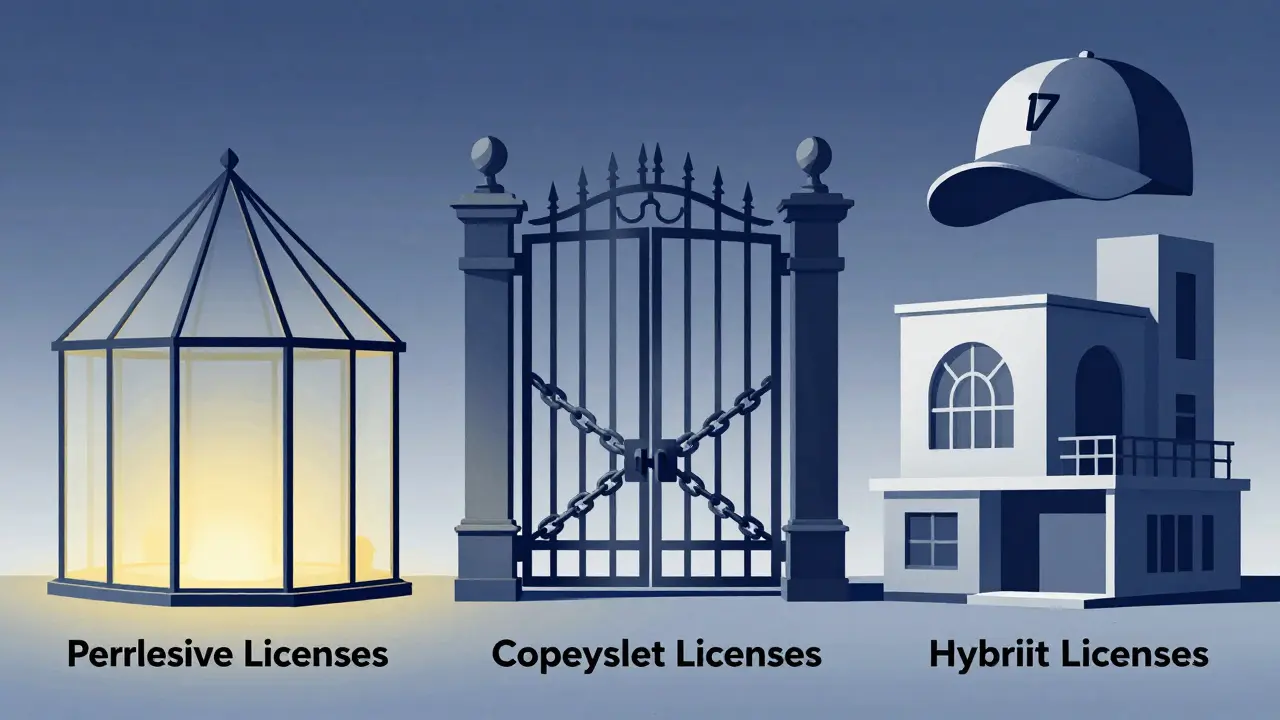
The Three License Families You Need to Know
Not all open-source licenses are created equal. In fact, the term "open source" is often misused in the AI world. According to Mend.io’s analysis from late 2025, the ecosystem splits into three distinct categories, each with very different implications for your business.
First, there are Permissive Licenses. These include the MIT License and Apache 2.0. As of Q3 2025, these make up about 62% of models on platforms like Hugging Face. They are the gold standard for commercial use. MIT requires you to keep the copyright notice. Apache 2.0 does that plus grants you explicit patent protection from contributors. If you want to build a product and sell it without worrying about opening your own source code, this is where you look.
Second, we have Copyleft Licenses, primarily the GNU General Public License (GPL) 3.0. This accounts for roughly 18% of LLM licenses. Here is the catch: if you modify the model and distribute it, you must release your modifications under the same GPL license. For most SaaS companies, this is a dealbreaker. You cannot keep your fine-tuned improvements proprietary. Only 8% of enterprises successfully deploy GPL-licensed models commercially, according to Latitude’s 2025 survey.
Third, there are Weak Copyleft and Hybrid Licenses. This includes the Mozilla Public License (MPL) 2.0 and custom licenses like Meta’s Llama Community License. These try to find a middle ground. MPL applies copyleft only to modified files, not the whole project. Custom licenses often impose user caps. For example, Meta updated its Llama license in June 2025 to allow commercial use up to 700 million monthly active users. If you exceed that cap, you need to negotiate a separate agreement. Ignoring this cap is a common way to trigger legal action.
| License Type | Commercial Use Allowed? | Must Open Source Derivatives? | Patent Protection? | Best For |
|---|---|---|---|---|
| MIT / Apache 2.0 | Yes | No | Yes (Apache) | SaaS products, internal tools |
| GPL 3.0 | Yes (with conditions) | Yes | No | Community projects, non-profits |
| MPL 2.0 | Yes | Only modified parts | No | Modular applications |
| Custom (e.g., Llama) | Conditional (User caps) | No | Varies | High-traffic consumer apps |
The Hidden Trap: Training Data and Weights
Here is where most developers get burned. A license file attached to a model repository usually covers the code to run the model. It does not always cover the weights (the trained parameters) or the training data.
Knobbe Martens, a leading IP law firm, highlighted in their April 2025 whitepaper that 68% of surveyed models had mismatched licenses across these components. You might download a model under an MIT license, but the weights were trained on data licensed under CC-BY-NC (Creative Commons Non-Commercial). Using that model commercially violates the data license, even if the code license says otherwise.
Dr. Sarah Jeong from Harvard Law School warned in October 2024 that training on copyrighted material creates "uncertain legal territory." While Professor Pamela Samuelson argues that current copyright frameworks might allow fair use for data mining, this is legally untested. Until courts rule definitively, relying on "fair use" is a gamble. Your safest bet is to verify the provenance of the training data. If the documentation doesn’t explicitly state the data sources and their licenses, treat the model as high-risk.
Compliance in Practice: What Actually Happens?
Let’s talk real-world scenarios. On Reddit’s r/MachineLearning, a developer shared how they spent three weeks resolving Apache 2.0 compliance issues for a commercial product. The issue wasn’t the attribution; it was the patent clause interacting with their existing IP portfolio. Another user on Hacker News reported accidentally distributing a fine-tuned Llama 2 model under MIT instead of the required custom license, triggering a cease-and-desist from Meta.
These aren’t edge cases. GitHub’s 2025 State of the Octoverse report found that 41% of LLM-related license violations stemmed from improper attribution in binary distributions. If you embed a model in a mobile app, you still need to provide access to the license text and copyright notices. Failing to do so is negligence.
On the flip side, proper compliance saves money. A Stack Overflow developer noted that using an Apache 2.0-licensed Mistral 7B model saved their company $1.2 million annually compared to GPT-4 API costs. The key difference? They did the legal homework first. They documented attributions, checked for patent grants, and ensured no GPL code leaked into their proprietary stack.
A 5-Step Compliance Checklist for 2026
You don’t need to be a lawyer to avoid basic mistakes. But you do need a process. Latitude’s 2025 compliance framework suggests these five steps:
- Identify All Components: Separate the inference code, the model weights, and the training dataset. Check the license for each independently.
- Determine Obligations: Is it permissive? Copyleft? Hybrid? Note any user caps or redistribution restrictions.
- Document Attributions: Create a "NOTICE" file in your project that lists every third-party component, its version, and its license. Include this in your builds.
- Automate Tracking: Use tools like FOSSA or Mend.io to scan your dependencies. Manual checks fail at scale. As of Q1 2025, 61% of Fortune 500 companies use automated license compliance tools.
- Audit Quarterly: Licenses change. Meta updated its terms in June 2025. Hugging Face introduced standardized metadata fields in September 2025. Review your stack regularly.
For permissive licenses, this process takes 15-25 hours initially. For copyleft or hybrid licenses, expect 80-120 hours of specialized legal assessment. Don’t skip this. The cost of a single infringement penalty can range from $500,000 to $5 million, according to Knobbe Martens.
Regulatory Headwinds: EU AI Act and Copyright Office
The regulatory environment is tightening. The EU AI Act Article 52, effective August 2026, requires "sufficient documentation of training data sources and licensing" for high-risk systems. If you operate in Europe or serve European customers, you must be able to prove where your model’s knowledge came from.
In the US, the Copyright Office issued a policy statement in 2025 clarifying that AI outputs may qualify for copyright protection only with "substantial human modification." This means your company owns the output less than you might think, but it also means you need to ensure the input didn’t infringe someone else’s rights.
The trend is clear: transparency is becoming mandatory. The Open Source Initiative launched the "AI License Harmonization Project" in March 2025 to address fragmentation, and the Linux Foundation is expected to release a standardized "OpenLLM License" in 2026. Until then, you are navigating a patchwork of custom terms.
When to Stick with Proprietary APIs
Is open-source always better? No. Proprietary models like OpenAI’s GPT-4 Turbo charge $0.01-$0.03 per 1K tokens, but they eliminate licensing compliance concerns. You sign a Terms of Service, and they handle the legal risk. For small teams without legal resources, or for prototypes where speed matters more than control, proprietary APIs are safer.
However, as your usage scales, those token costs add up. And you face vendor lock-in. Open-source offers customization and independence, but it demands discipline. Choose based on your maturity level, not just your budget.
Can I use an MIT-licensed LLM for commercial purposes?
Yes. The MIT license is highly permissive and allows commercial use, modification, and distribution. You only need to include the original copyright notice and license text in your product. However, verify that the model weights and training data are also covered by permissive terms, as they may have separate restrictions.
What happens if I violate a GPL license for an LLM?
Violating GPL 3.0 typically requires you to cease distribution of the derivative work until you comply. This means you may need to open-source your proprietary code or pay significant legal settlements. Enforcement actions have increased 220% since 2022, making strict compliance essential for any distributed software involving GPL components.
Do I need a license to fine-tune an open-source model?
You must adhere to the original model's license when fine-tuning. If the model is Apache 2.0, you can fine-tune and keep the result proprietary. If it is GPL 3.0, your fine-tuned version must also be released under GPL 3.0 if distributed. Always check for specific clauses regarding "derivative works" in the license text.
How does the EU AI Act affect LLM deployment?
Starting August 2026, the EU AI Act requires providers of high-risk AI systems to document training data sources and licensing. This impacts any company deploying foundational models in the EU market. You must maintain records proving that your training data was legally sourced and properly licensed to avoid regulatory penalties.
What is the Llama Community License?
The Llama Community License is a custom license created by Meta for its Llama models. It permits free commercial use but imposes a cap on monthly active users (currently 700 million as of June 2025). Companies exceeding this threshold must negotiate a separate commercial agreement with Meta. It is not a standard open-source license like MIT or Apache.






Stop pretending open source is free labor for your bottom line. You want the model? Pay for the legal team to vet it. I’ve seen too many devs think they can just grab weights and run a SaaS without reading the fine print. It’s not clever, it’s negligent. If you can’t afford compliance, stick to the API.
The semantic distinction between permissive and copyleft licenses in the context of neural network weights is frequently misunderstood by practitioners who lack formal training in intellectual property law. While Apache 2.0 provides explicit patent grants, the provenance of the underlying training corpus remains a significant vector for liability exposure. One must meticulously audit the lineage of the dataset to ensure that no Creative Commons Non-Commercial derivatives have contaminated the weight initialization parameters, thereby rendering the entire inference pipeline commercially non-viable despite the apparent permissiveness of the code repository license.
its all a scam anyway. big tech wants you to think you have choices but they control the hardware and the data centers. the licenses are just smoke screens to keep you from realizing your code is never really yours. they will sue you into oblivion if you try to compete. wake up sheeple.
we are merely ghosts in the machine trying to define ownership over thoughts that do not belong to us. the license is a shackle on the spirit of innovation. why do we fear the sharing of knowledge when the act of creation itself is already an illusion. perhaps the true cost is not legal but existential.
Actually, most of this advice is outdated garbage. The GPL doesn't apply to SaaS unless you distribute the binary, which most cloud providers don't do directly to end users in a way that triggers the license. And let's be real, Meta won't sue a startup with 10k users over the Llama license cap. They only go after the whales. This article is fear-mongering designed to sell consulting hours. Stop listening to corporate lawyers who profit from your confusion.
I must express my profound concern regarding the fragmentation of our global digital commons. In Europe, we view these licensing restrictions as barriers to cultural exchange and technological sovereignty. The EU AI Act is not merely a regulatory hurdle; it is a necessary framework to ensure that our shared heritage is respected. We cannot allow a few corporations in Silicon Valley to dictate the terms of human creativity through arbitrary user caps. We need harmonization, not division. Let us build bridges, not walls, in this new era of artificial intelligence.
It is truly inspiring to see such detailed analysis on a topic that often gets overlooked in the rush to deploy. Many developers focus solely on performance metrics and forget the foundational legal structures that support their work. By taking the time to understand these nuances, we are not just protecting our businesses, but also fostering a healthier ecosystem for everyone involved. Your diligence in verifying training data sources sets a wonderful example for the community. Keep up the excellent work and continue to prioritize transparency in all your projects.