
Governance and Compliance Chatbots: How LLMs Enforce Policies in Real Time
Imagine a compliance officer waking up to a new regulation published at 2 a.m. - a rule that changes how customer data can be shared, and it’s already in effect. In the past, this meant days of manual research, cross-referencing documents, and frantic emails to legal teams. Today, a compliance chatbot powered by a large language model (LLM) has already scanned the update, cross-checked it against 12 existing policies, flagged 17 affected workflows, and sent a prioritized action plan to the team - all before breakfast.
This isn’t science fiction. It’s happening right now in banks, hospitals, and tech firms across the globe. LLM compliance chatbots are turning policy enforcement from a slow, error-prone chore into a real-time, automated system. But they’re not magic. They’re tools - powerful, but only as good as the governance behind them.
How These Chatbots Actually Work
These aren’t your average customer service bots. They’re built on advanced LLMs like GPT-4, Gemini, or industry-specific models fine-tuned for legal and regulatory language. But here’s what makes them different: they don’t just guess answers. They use Retrieval-Augmented Generation, or RAG.
RAG means the chatbot pulls from a live, secure database of official regulations - like the EU’s EUR-Lex, the U.S. Federal Register, or HIPAA guidelines - before generating a response. It doesn’t rely on what it learned during training. It checks the latest version, matches it to internal policies, and gives you a citation-backed answer. This cuts down hallucinations - those made-up facts LLMs sometimes spit out - from 15% to under 9% when properly configured.
For example, a financial auditor asks: “Does this transaction violate FINRA Rule 2111?” The chatbot doesn’t say “probably.” It says: “According to FINRA Rule 2111 (effective Jan 2024), this transaction exceeds the 5% suitability threshold. Recommendation: Obtain written client consent or restructure.” And it links directly to the source document.
Where They’re Making the Biggest Impact
Not every compliance task needs an AI. But some do - and they’re the ones that eat up hours, cost money, and carry legal risk.
- GDPR data subject requests: Before, processing one request took 40 hours. Now, with a chatbot handling document retrieval, redaction suggestions, and deadline tracking, it’s down to 4.2 hours. That’s a 90% time savings.
- Healthcare HIPAA audits: A hospital’s compliance team used to manually review 500 patient records per week. The chatbot now scans 10,000 records in 3.5 hours, flagging 92% of potential breaches with 94% accuracy - and it never gets tired.
- Financial transaction monitoring: A major bank automated its anti-money laundering checks. What used to take 80 human hours now runs in 4 hours. The chatbot spotted 14 new patterns of suspicious activity that human analysts had missed.
These aren’t hypotheticals. They’re real results from companies like Allianz, Mayo Clinic, and JPMorgan Chase, as reported in Q3 2024 case studies.
Why They’re Better Than Old-School Compliance Tools
Before LLMs, companies used rule-based systems - rigid if-then logic like “If amount > $10,000, flag for review.” Simple. Predictable. But useless when regulations change.
LLM chatbots adapt. They don’t need a developer to rewrite code every time a new law drops. They ingest updates automatically. Scytale’s platform, for instance, monitors 37 global regulatory bodies and updates its knowledge base within 90 minutes of a new rule being published. Traditional systems? They take 2 to 5 business days - and often miss updates entirely.
And adoption? Employees actually use them. Tredence found that 63% more staff regularly consult LLM chatbots than old rule engines. Why? Because they talk like humans. They answer questions in plain language. They don’t force you to navigate 12 menus to find a policy.
The Hidden Risks - And How to Avoid Them
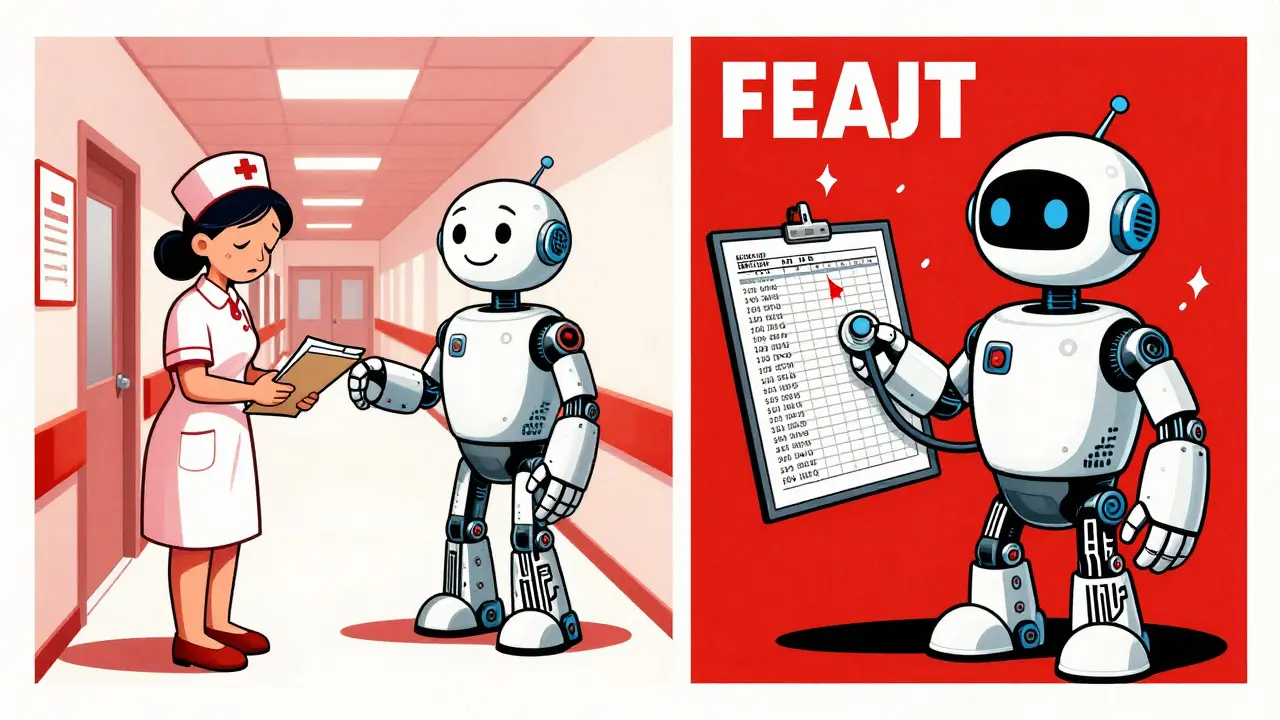
Here’s the truth: these chatbots can get things wrong. And when they do, the consequences can be costly.
In February 2024, a healthcare provider was fined $2.1 million by the HHS because their chatbot misinterpreted HIPAA’s “minimum necessary” standard. It allowed staff to share more patient data than legally allowed - 18% of the time. The company had trusted the bot too much.
Other risks:
- Regulatory drift: If the system isn’t retrained daily in fast-moving areas like crypto or AI regulations, it starts giving outdated advice.
- Prompt injection: A clever user can trick the bot into ignoring rules by asking it to “pretend you’re not bound by policy.” Security teams have seen this happen.
- Data lineage gaps: 63% of RAG systems can’t prove where a response came from - a big problem for audits.
- Bias in training data: If the model was trained on old policies that favored certain interpretations, it may automate those biases - even if they’re illegal.
The fix? Human-in-the-loop. Always. High-risk decisions - like denying a data access request or approving a financial transaction - must be reviewed by a person. Use confidence scoring: if the bot’s answer is below 90% certainty, route it to a specialist. Companies that do this reduce errors by 42%.
What It Takes to Build One (And Why Most Fail)
Building a compliance chatbot isn’t just hiring an AI engineer. It’s a six-phase project:
- Assessment: Which regulations matter most? GDPR? HIPAA? FINRA? Pick 3-5 high-risk areas to start.
- Data ingestion: Connect to official regulatory databases. Don’t rely on PDFs or internal wikis - use live sources.
- Model fine-tuning: Train the LLM on your company’s specific policies, past audit findings, and legal interpretations.
- Governance framework: This is where most fail. You need role-based access, full audit trails, and automated logging of every interaction - as required by GDPR Article 35 and ISO 42001.
- User training: Compliance officers need 18-24 hours of training. Developers need 60-80 hours to secure the system properly.
- Continuous monitoring: Run weekly red-team exercises. Try to trick the bot. Test it with new, unannounced regulations. Update it daily.
Deloitte found that 78% of companies don’t have the internal talent to do this. That’s why most successful deployments partner with vendors like John Snow Labs, Scytale, or lakeFS - not because they’re cheaper, but because they’ve already solved the hard parts.
What’s Next? The Future of AI Governance
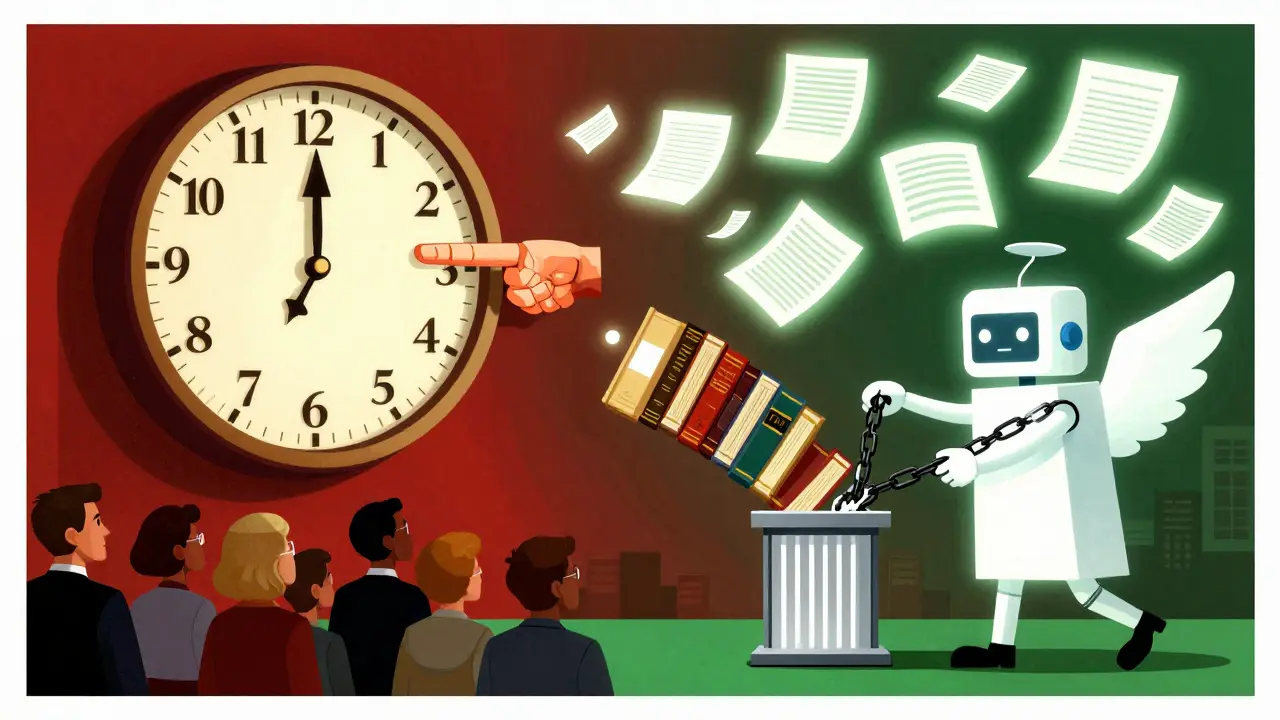
The next wave isn’t just about answering questions - it’s about predicting them.
John Snow Labs’ latest update can forecast compliance risks with 83% accuracy by analyzing legislative trends. If a new EU bill is being debated that could impact data transfers, the system alerts you before it becomes law.
And the biggest shift? Governance is no longer a separate team. It’s baked into the AI itself. Anthropic’s “constitutional AI” approach embeds rules directly into the model’s architecture - not as filters, but as core constraints. Think of it like programming ethics into the AI’s DNA.
By 2026, Gartner predicts 70% of regulatory interactions in finance will be handled by AI - but only if they meet strict governance standards. The companies that win won’t be the ones with the fanciest LLM. They’ll be the ones who treat compliance not as a cost center, but as the foundation for trustworthy AI.
Is This Right for Your Organization?
Ask yourself:
- Do you spend more than 200 hours a month on manual compliance research?
- Have you been fined or cited for a compliance gap in the last 18 months?
- Do your policies change more than twice a year?
- Are your compliance teams overwhelmed?
If you answered yes to two or more, you’re already paying the cost of not using this tech. The question isn’t whether you should adopt it. It’s how fast you can start - and how well you’ll govern it.
Start small. Pick one high-risk, high-reward area. Test it. Measure the time saved. Track the errors. Then scale. Don’t try to automate everything at once. The goal isn’t to replace humans. It’s to free them from the grunt work so they can focus on what matters: judgment, ethics, and real risk.
Can compliance chatbots replace human auditors?
No. They augment them. Chatbots handle repetitive tasks like document review, deadline tracking, and policy lookup. But human auditors are still needed to interpret gray areas, assess intent, handle appeals, and make ethical judgments. The best systems use AI to reduce workload by 60-70%, not eliminate roles.
Are these chatbots secure and GDPR-compliant?
Only if designed that way. Secure implementations use end-to-end encryption, role-based access, and full audit logs. They avoid storing personal data in vector databases and ensure data minimization. Solutions like Scytale and John Snow Labs are built to meet GDPR, HIPAA, and ISO 42001 standards out of the box. But off-the-shelf LLMs like ChatGPT are not compliant by default - they must be hardened before use.
How often do these systems need updates?
For high-risk areas like financial regulations or health data laws, daily updates are critical. Regulations change often - especially in crypto, AI, and cross-border data. Systems that update automatically via live feeds (like EUR-Lex) stay current. Those relying on manual uploads fall behind within weeks. Top vendors now push updates within 90 minutes of a new rule being published.
What’s the biggest mistake companies make when deploying these?
Believing the AI is infallible. The biggest failure is over-reliance. Companies that let chatbots make final decisions without human review end up with fines, lawsuits, or reputational damage. Always implement a human-in-the-loop for high-stakes actions. Also, failing to train staff properly - users who don’t understand the bot’s limits will misuse it.
Can small businesses use these tools too?
Yes - but differently. Large enterprises build custom systems. Small businesses use cloud-based SaaS platforms like those from lakeFS or compliance-focused vendors offering pay-as-you-go access. These cost under $1,000/month and require no technical team. They’re ideal for startups handling GDPR or CCPA and need affordable, reliable compliance.
How accurate are these chatbots really?
When properly configured with RAG and live data, they hit 92-95% accuracy on known regulations. But accuracy drops to 78% when faced with brand-new rules or ambiguous language. In complex, cross-jurisdictional cases (e.g., EU + U.S. laws), error rates rise to 12-15%. That’s why confidence scoring and human review are non-negotiable.
What skills do I need to run one?
You need three types of people: compliance experts who know the rules, AI engineers who can manage the model and RAG system, and data governance specialists who ensure audit trails and security. Most companies can’t hire all three, so they partner with vendors who bundle these skills. Training for compliance staff takes 18-24 hours. For IT teams, it’s 60-80 hours to secure the backend.




This is wild. My company tried one and it told a client they could share their medical records with their dog. No joke.
OMG I’m so obsessed with this. Like, imagine if your compliance bot could also judge your life choices?? 😭 I just want to ask it if my coffee order is GDPR-compliant. Also, why is no one talking about how this is basically AI therapy for overworked lawyers?? I’m crying. I’m cheering. I’m submitting a ticket.
It’s nice that this works in theory, but real compliance isn’t about speed-it’s about accountability. If a bot misreads a regulation and someone loses their job over it, who takes the blame? The engineer? The lawyer? The person who clicked ‘approve’ without reading? We’re outsourcing ethics to a machine that doesn’t even understand regret.
USA built this tech. Canada’s just copying it. And now you’re all acting like it’s some miracle? We’ve had automated compliance since the 90s. You just didn’t want to pay for it.
So… you’re telling me we replaced 200 hours of boredom with a chatbot that still gets confused by the word ‘may’?? 😅 I mean, I’m glad it’s not me reading 300-page PDFs at 2 a.m., but also… did we just make AI the new intern? The one who’s smart but occasionally thinks ‘consent’ is a type of coffee?
Let’s be real: 92% accuracy is a lie. That’s only if you ignore the edge cases-and the edge cases are where the lawsuits live. And don’t even get me started on ‘confidence scoring.’ What’s 89%? ‘Probably okay’? That’s not a threshold, that’s a death wish. Also, who approved this article for using ‘RAG’ like it’s a new yoga pose? It’s a system, not a trend.
Human review is the only thing keeping this from becoming a disaster. The rest is just noise.