How AI High Performers Capture Value from Generative AI: Workflow Redesign and Scaling
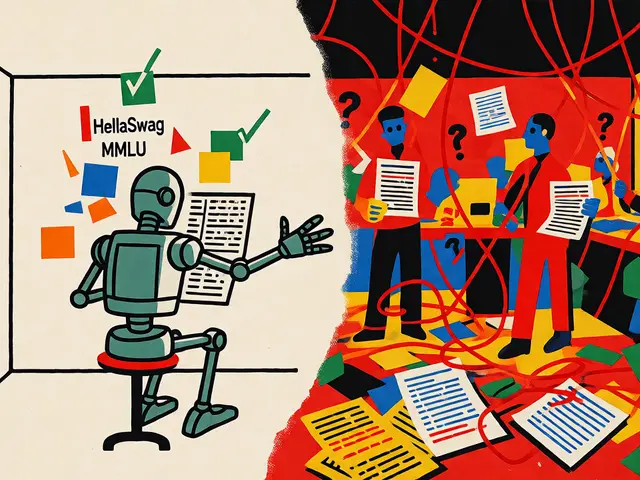
Most companies think generative AI is about automation. They plug it into existing processes and expect magic. But the 95% failure rate tells a different story. The real winners-those pulling in real ROI-aren’t automating. They’re redesigning. They’re rebuilding how work gets done from the ground up.
It’s Not About Tools, It’s About Tasks
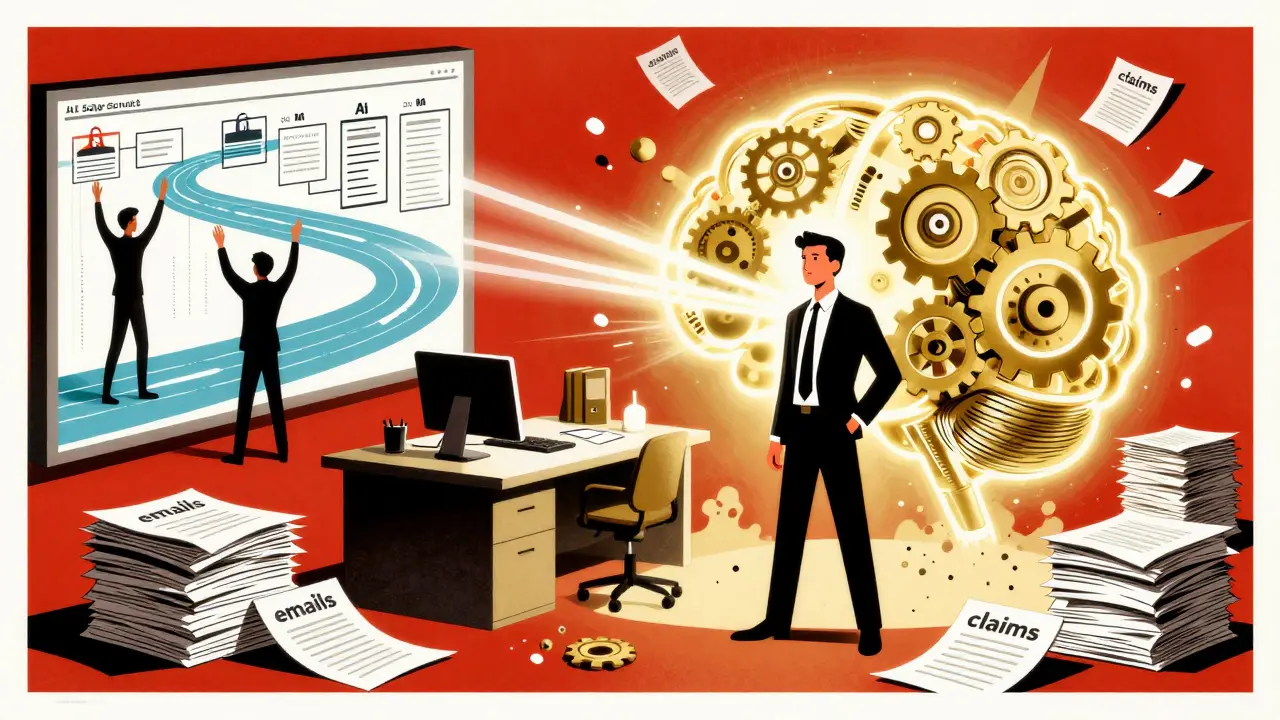
Companies that treat AI like a fancy copy-paste button fail. They ask AI to write emails, summarize meetings, or generate images-but leave the rest of the workflow untouched. That’s not innovation. That’s decoration. The high performers? They start with one broken task. Something slow, repetitive, or error-prone. Not ‘all marketing content’-but ‘how we write product descriptions for 500 new SKUs every quarter.’ Not ‘customer service’-but ‘handling the 70% of returns that are just asking for a return label.’ Klarna did this. Instead of dumping AI into their chatbot, they fed it 10,000 past customer conversations. They trained it to spot which questions needed a human. The rest? Handled by AI. Result? Faster response times, lower costs, and support agents focusing on the angry customers who actually needed empathy-not scripts. Five Sigma did the same with insurance claims. Before, adjusters spent hours verifying documents, checking policies, and hunting down signatures. Now, AI pulls all that data, flags inconsistencies, and surfaces only the cases needing human review. Error rates dropped 80%. Productivity jumped 25%. And claims closed 10% faster. This isn’t about AI doing more. It’s about humans doing better.Workflow Redesign: The Hidden Blueprint
High performers don’t just add AI. They rewire the entire flow. Think of it like upgrading from a horse-drawn cart to a Tesla-not just adding an engine, but redesigning the chassis, suspension, and fuel system. Colgate-Palmolive didn’t ask AI to summarize market reports. They built a system where employees type natural questions into a chat interface-like, ‘What do parents in Texas think about mint-flavored toothpaste for kids?’-and the AI pulls from proprietary research, social trends, Google search data, and competitor reviews-all in seconds. No more flipping through 200-page PDFs. No more waiting for analysts. Just answers. Rivian used Gemini inside Google Workspace to let engineers, designers, and supply chain teams ask questions like, ‘Show me all delays in battery sourcing from suppliers in Mexico last quarter.’ The AI didn’t just answer-it connected the dots across departments that used to work in silos. The pattern? Replace manual data hunting with instant querying. That’s the core of workflow redesign.Scaling Isn’t About More AI, It’s About More People
Scaling AI isn’t buying more licenses. It’s letting more people use it effectively. Gazelle, a real estate firm in Sweden and Norway, built an AI tool that extracts key details from property documents-title history, zoning rules, renovation permits. Before, agents spent four hours per listing. Now? Ten seconds. Accuracy jumped from 95% to 99.9%. And instead of hiring more agents, they launched four new services in under a year. How? They didn’t train 100 agents on AI. They trained the system to be foolproof. The AI became the expert. The agent became the decision-maker. MAS, a marketing agency, uses AI as a creative partner. Their team doesn’t write ads. They talk to AI. ‘What if we made this campaign feel like a late-night phone call with a friend?’ The AI generates 10 variations. They pick one. Refine it. Push back. The AI adapts. It’s not replacing creativity. It’s accelerating it. The secret? High performers design AI tools that require zero coding skills. Training takes 15-20 hours. Not because the AI is simple-but because it’s built to match how people already think.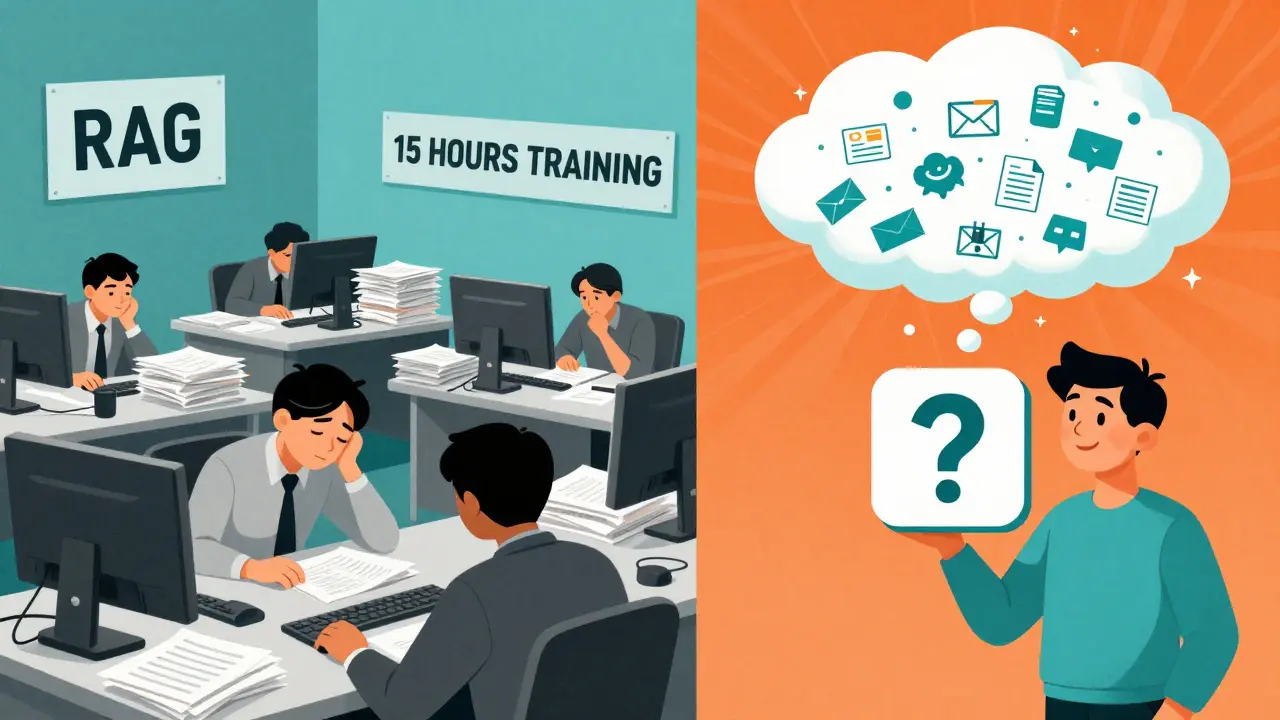
Why Most Companies Fail (And How to Avoid It)
The biggest mistake? Trying to do everything at once. McKinsey found 80% of companies set ‘efficiency’ as their AI goal. But only the ones who picked one high-impact task and obsessed over it succeeded. Toyota didn’t roll out AI across the factory. They started with one line: maintenance. Workers used Google Cloud’s AI tools to build models that predicted when a machine would fail. Result? 10,000 man-hours saved per year. Downtime cut by half. Siemens did the same with their Senseye system. Instead of hiring data scientists, they gave engineers a drag-and-drop interface to train AI on vibration patterns. Now, they spot failures before they happen. Productivity up 55%. Costs down 40%. The lesson? Start small. Measure relentlessly. Then expand. Companies that fail try to ‘go enterprise.’ They create AI steering committees. They demand ROI projections for 50 use cases. They wait for perfect data. Meanwhile, startups with 19-year-old founders are hitting $20 million in revenue by solving one problem better than anyone else.Scaling Across Functions: The Domino Effect
Once one team succeeds, others notice. That’s when scaling happens organically. MERGE, a marketing agency, started using Gemini to summarize meetings and auto-generate action items. Then sales copied it. Then client services. Then HR. Within six months, every team was using it-because it saved them 30 minutes a day. FinQuery, a fintech startup, began with AI helping engineers debug code. Then marketers used it to draft emails 20% faster. Then product managers used it to map out project timelines. Each use case built on the last. ROSHN Group in Saudi Arabia started with AI for real estate insights. Now it’s used in finance, HR, and construction planning. Why? Because the system was built on a common foundation: retrieval-augmented generation (RAG). It pulls from internal documents, emails, project logs, and supplier data-no matter the department. The key? Don’t build 10 separate AI tools. Build one smart system that can be adapted. RAG is the glue. It lets AI understand context, not just keywords.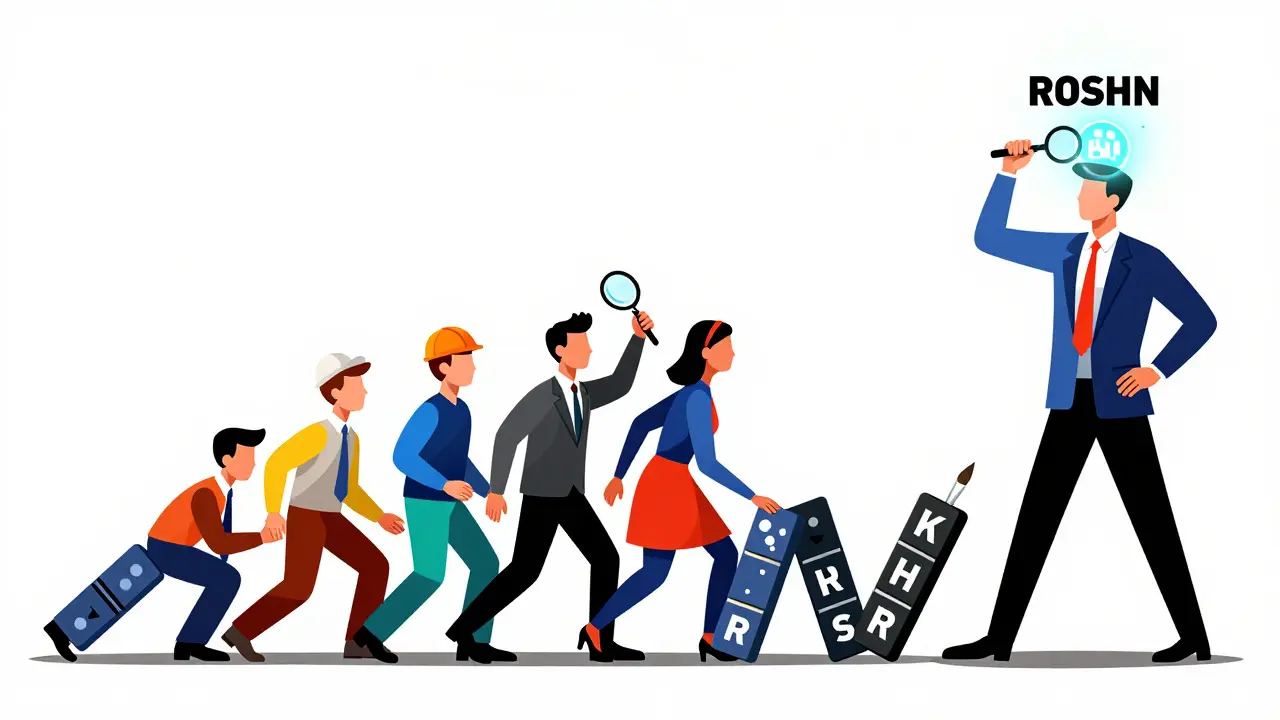
Human + AI: The Only Winning Formula
AI doesn’t replace people. It redefines their role. At Ferrari, customers use AI to design their dream car. They tweak colors, materials, wheel designs-all in real time. The AI shows options, predicts how changes affect cost and delivery time. But the final call? Always human. Result? 20% faster configuration. 40% more engagement. At Seguros Bolivar in Colombia, AI helps design insurance products with partner companies. It pulls data from past policies, claims, and market trends. But the human teams decide what to offer, how to price it, and how to explain it to customers. Collaboration improved. Costs dropped 20-30%. HBR warned that AI can lower motivation if it feels like surveillance. But when it feels like a teammate? Productivity soars. Teams save 105 minutes a day. Output increases by 66%. The best AI systems don’t ask, ‘What can you automate?’ They ask, ‘What can you empower?’What to Do Next
If you’re stuck in pilot purgatory, stop looking for more AI tools. Start looking for one broken task. 1. Find the pain point-What task takes too long, costs too much, or causes errors? Pick one. 2. Map the workflow-Who does what? Where do delays happen? What data gets passed around? 3. Design the new flow-Where can AI handle the grunt work? Where do humans need to step in? 4. Build with RAG-Connect the AI to your internal documents, emails, and databases. No more guesswork. 5. Train, don’t replace-Give your team 15-20 hours to learn how to talk to the AI. Not how to code it. 6. Measure and expand-Track time saved, errors reduced, revenue impact. Then repeat. The companies winning with AI aren’t the ones with the biggest budgets. They’re the ones who stopped trying to automate and started redesigning.Frequently Asked Questions
What’s the biggest mistake companies make with generative AI?
They try to automate existing workflows instead of redesigning them. Adding AI as a side tool-like a fancy spellchecker-doesn’t move the needle. The winners rebuild how work gets done, replacing manual tasks with AI-powered workflows that let humans focus on judgment, creativity, and empathy.
How do I know if my AI project is a pilot or a real transformation?
If your team still has to manually feed data into the AI or review every output, it’s a pilot. If the AI is embedded in daily work-like asking questions in a chat window, pulling data from internal systems, and producing outputs that go straight into your workflow-it’s a transformation. Real transformation doesn’t require extra steps. It just works.
Do I need data scientists to make this work?
No. The most successful implementations-like Toyota, Colgate, and Gazelle-used tools that required no coding. Employees with domain knowledge trained the AI using simple interfaces. The key isn’t technical skill. It’s clarity: knowing exactly what problem you’re solving and what data matters.
Why is RAG so important for scaling AI?
RAG lets AI pull answers from your own documents, emails, and databases-not just generic internet knowledge. That means it can answer questions like, ‘What did we promise client X in the contract signed last June?’ or ‘Which supplier missed delivery last quarter?’ Without RAG, AI is just guessing. With it, AI becomes a trusted internal expert.
How long does it take to see results?
With the right focus, you can see results in 6-8 weeks. Gazelle cut document processing from four hours to 10 seconds in under two months. Klarna cut customer service costs within three months. The fastest wins come from solving one urgent, measurable problem-not from building a grand AI strategy.
Can small teams compete with big companies on AI?
Absolutely. Startups with 19- to 20-year-old founders have gone from zero to $20 million in revenue in a year by focusing on one specific problem-like automating real estate document analysis or generating hyper-local ad copy. You don’t need a big budget. You need clarity, speed, and a willingness to kill ideas that don’t move the needle.




Redesigning workflows? Please. Most of this is just corporate jargon dressed up like innovation. AI doesn't rewrite processes-it just automates the lazy parts that should've been fixed decades ago. The real winners? The ones who fired the middle managers who insisted on 200-page PDFs in the first place.
Also, RAG isn't magic. It's just keyword matching with a fancy name. Stop pretending it's a revolution.
And no, you don't need 15 hours of training. You need to stop hiring consultants who charge $500/hour to say 'ask questions.'
They’re all lying. This isn’t about AI. It’s about corporations using AI as a scapegoat to fire people. You think Klarna’s agents are happier? Nah. They’re just stressed because now they have to babysit a bot that keeps misreading ‘I want my money back’ as ‘I love your mint toothpaste.’
And RAG? That’s just corporate surveillance with a chatbot interface. Your emails, your documents, your internal chatter-all feeding some Silicon Valley algorithm that doesn’t care if you get laid off next quarter.
They’re not empowering you. They’re training you to be a glorified moderator for a machine that doesn’t understand sarcasm, grief, or why someone actually hates mint toothpaste.
Wake up. This isn’t progress. It’s digital serfdom with a UI.
Let me be very clear: this article is correct in its essence but completely naive in its execution. You cannot redesign workflows without first understanding the organizational DNA. In India, we have companies that tried this exact approach-Colgate, Klarna-style-and failed because HR refused to let frontline staff access internal data. Why? Because 'security protocols.'
AI doesn't care about your policy manuals. It cares about data. If your company hoards information in silos guarded by middle management with PowerPoint titles, no amount of RAG will save you.
Also, '15-20 hours of training'? That’s a joke. In my team, it took 3 months of daily friction before people stopped saying 'I don't know how to ask.' The tool was fine. The culture was broken.
And please-stop calling engineers 'decision-makers.' They’re still just clicking buttons while the VPs take credit.
I want to express my sincere appreciation for this thoughtful, well-researched piece. It is rare to encounter such a nuanced and balanced perspective on the practical application of generative AI in enterprise environments.
The emphasis on workflow redesign-not automation-is not merely insightful; it is essential. Too many organizations fall into the trap of treating AI as a plug-and-play solution, when in reality, it demands a fundamental rethinking of human-machine collaboration.
The examples of Gazelle, Rivian, and MAS are particularly compelling because they illustrate how AI, when properly integrated, amplifies human potential rather than displacing it. The use of Retrieval-Augmented Generation as a unifying architectural principle is not just technically sound-it is strategically brilliant.
Furthermore, the point about scaling through organic adoption, rather than top-down mandates, aligns perfectly with organizational behavior theory. Change is most sustainable when it emerges from the ground up.
I would encourage every leader reading this to pause, reflect, and identify one broken task-not five, not ten, but one-and begin there. The rest will follow.
Thank you for this invaluable contribution to the discourse.
ok so like… i just read this and my brain went ‘wait, so ai is actually kinda cool now??’
like i thought it was all just chatbots saying ‘i’m sorry, i can’t help with that’ and then charging you $19.99/month for ‘premium insights’
but this? this is like… giving your grandma a magic wand that finds her lost glasses instead of making her walk 3 miles to the store.
also i love how they said ‘train the system, not the people’-that’s the whole secret. stop making everyone take 3-hour zoom trainings and just make the tool dumb enough to work even if you type ‘how do i not die’
also why is everyone still using pdfs?? who made that decision??
also also-can we make an ai that auto-replies to my boss’s ‘u up?’ texts with ‘no, but my ai is’??
Just wanted to say this is the first article about AI that didn’t make me want to throw my laptop out the window.
Finally someone gets it: it’s not about doing more, it’s about doing differently.
Also, ‘10 seconds per document’? That’s life-changing for someone who spends 20 hours a week digging through contracts.
And yes-RAG is the quiet hero here. No one talks about how much time we waste just searching.
Thank you for not calling it ‘disruption.’