Role, Rules, and Context: Structuring Prompts for Enterprise LLM Use
You know that feeling when you ask a colleague to write an email, but they send back something that sounds like it was written by a robot from 1995? That’s what happens when enterprises throw raw data at Large Language Models (LLMs) without structure. The model isn’t stupid; it’s just confused about who it is, what it should do, and why it matters.
In 2026, prompt engineering has moved far beyond typing questions into a chat box. For businesses, it is a disciplined practice of structuring instructions to get reliable, safe, and accurate outputs. If you are integrating generative AI into your workflow, you need more than luck. You need a framework. The most effective framework relies on three pillars: Role, Rules, and Context.
The Three Pillars of Enterprise Prompting
Think of these three elements as the foundation of any successful project. Without them, your LLM is guessing. With them, it performs.
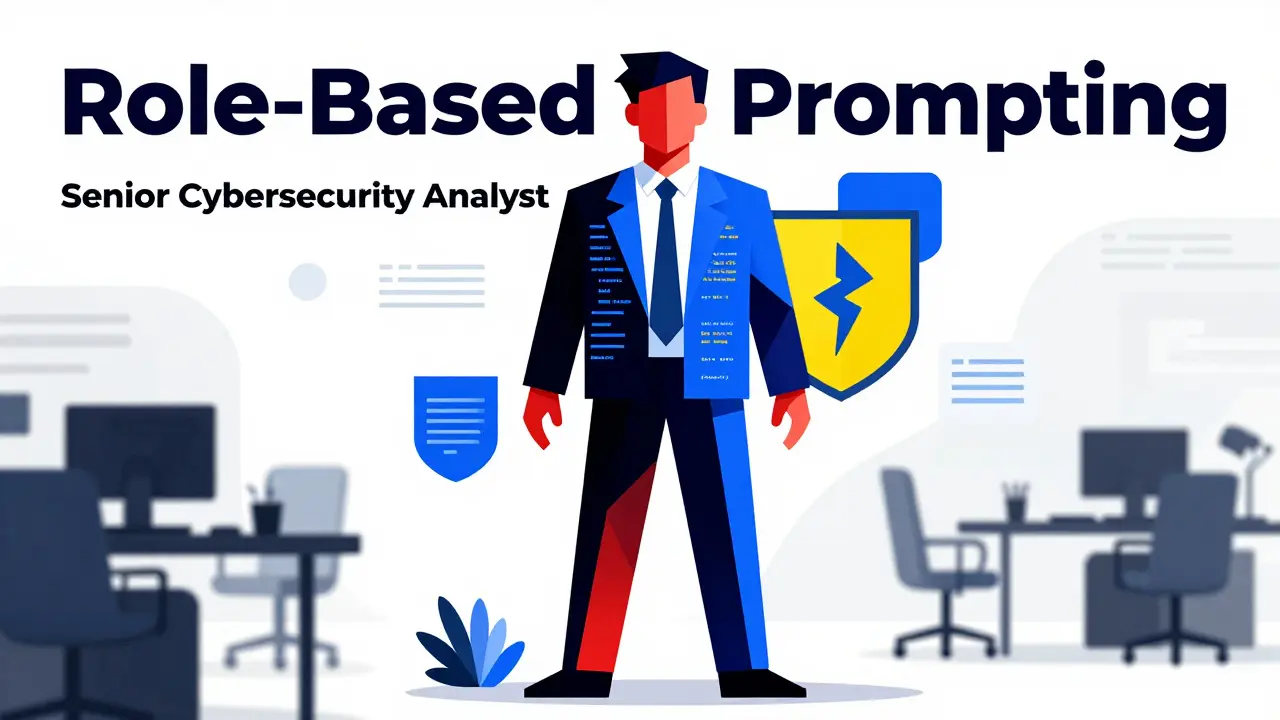
Role-Based Prompting is the practice of assigning a specific professional persona or function to the LLM to align its voice and behavior with enterprise standards. When you tell the model, "You are a senior cybersecurity analyst," you aren't just being polite. You are activating a specific subset of the model's training data related to security protocols, technical jargon, and risk assessment frameworks. This shifts the output from generic advice to domain-specific expertise.
Rules in this context refer to explicit behavioral constraints and positive instructions that define how the model should construct its response. This includes formatting requirements, tone guidelines, and logical boundaries. Crucially, modern best practices emphasize using positive instructions-telling the model what *to* do-rather than negative constraints, which often lead to confusion or hallucinations.
Context Engineering involves providing comprehensive background information, examples, and data references to ground the LLM's generation in reality. Context is the fuel. Without it, even the best-defined role will produce hollow answers. In enterprise settings, this means feeding the model product details, customer history, or legal precedents before asking it to generate content.
Why Specificity Beats Generality Every Time
Vague prompts get vague results. If you ask an LLM, "Tell me some stocks I should buy," you’ll get a generic disclaimer and a list of popular tech giants. It’s useless for decision-making. But if you say, "I am interested in investing in the renewable energy sector with a focus on European markets and low-volatility ETFs," the model can actually help you.
This principle of specificity applies to every layer of your prompt. Oracle’s framework for enterprise AI highlights that defining clear objectives is step one. If your goal is to generate a short story, specifying the length, style, and key plot points ensures precision. In business, this translates to defining exact metrics, target audiences, and desired outcomes.
Consider a marketing team writing product descriptions. A bad prompt says, "Write a description for our new blender." A good prompt says, "Write a 150-word product description for the X-200 Blender. Highlight its quiet motor and BPA-free materials. Target audience: busy parents who value kitchen safety. Tone: friendly and reassuring. Include a call-to-action to visit our website." The difference in output quality is night and day.
Advanced Techniques: Combining Power Moves
Once you master the basics, you can start combining techniques for complex tasks. Here are the six primary methods used in 2026 enterprise environments:
- Zero-Shot Prompting: Asking the model to perform a task without any examples. Relies entirely on its pre-trained knowledge. Good for simple queries.
- Few-Shot Prompting: Including 1-3 examples of desired inputs and outputs in the prompt. This teaches the model the pattern you want it to follow. Essential for complex formatting or nuanced tones.
- Chain-of-Thought (CoT): Instructing the model to "think step-by-step" before answering. This forces the LLM to show its reasoning process, which drastically improves accuracy in math, logic, and troubleshooting tasks.
- Role-Based Prompting: As discussed, assigning a persona like "Legal Advisor" or "Data Analyst."
- Meta-Prompting: Training the model’s memory by telling it who you are, what you’re working on, and how you prefer outputs structured. This creates consistency across multiple interactions.
- Self-Consistency: Encouraging the model to evaluate its own reasoning or generate multiple paths to a solution to check for errors.
The real magic happens when you combine these. Lakera, a leading AI security firm, recommends a hybrid approach for incident reports: "You are a cybersecurity analyst [Role]. Below are two examples of incident reports [Few-Shot]. Think step by step before proposing a resolution [Chain-of-Thought]. Then handle the new report below." This single prompt leverages three techniques to ensure robust, accurate, and actionable outputs.
The Iterative Refinement Loop
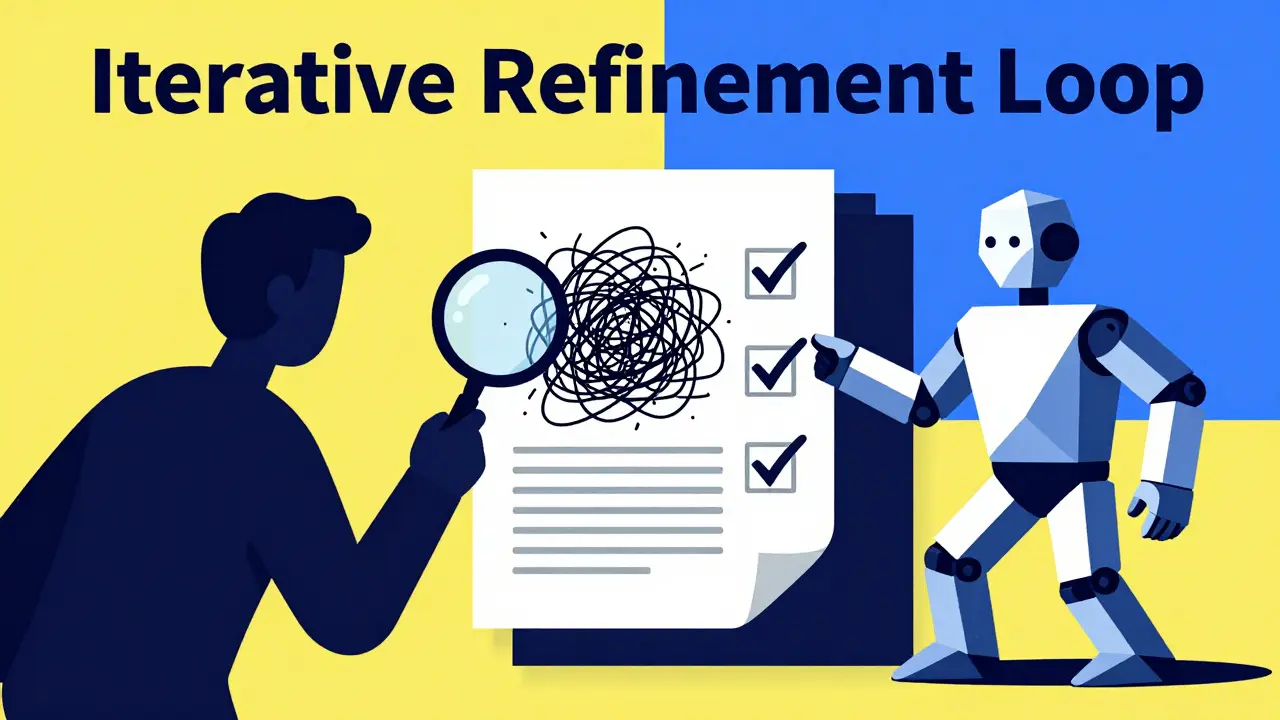
Here is the truth no one wants to admit: your first prompt will rarely be perfect. Prompt engineering is not a one-time setup; it is an iterative cycle. VisibleThread emphasizes that even detailed prompts may fail on the first attempt. Your job is to review the output, identify where it drifted from your objective, and refine the prompt.
Did the model miss a key detail? Add more context. Was the tone too casual? Adjust the role definition. Did it hallucinate facts? Strengthen the rules against fabrication. This dynamic process allows you to learn from the model’s responses and continuously improve your interaction strategy.
Quality Assurance: Human vs. Machine Ratings
How do you know if your prompt is working? You need a rating system. Lee Boonstra argues that rating generated responses is critical for enterprise success. You have two options:
- Human Raters: People evaluate the nuance, tone, and appropriateness of the output. They catch subtle errors and cultural mismatches that machines miss.
- Machine Raters: Other LLMs or scripts evaluate large volumes of responses for objective metrics like word count, sentence length, code correctness, or adherence to format.
The best enterprise workflows use both. Humans provide the qualitative guardrails, while machines offer scalable quantitative feedback. This combination ensures your prompts consistently guide LLMs to generate high-quality results.
Tools and Best Practices for 2026
Don’t build in the dark. Use the tools available to you. Google’s Model Garden in Vertex AI is excellent for experimenting with different models and saving prompt variations. Anthropic and OpenAI also offer review tools that let you see and edit model memory, supporting meta-prompting strategies.
Also, pay attention to input hygiene. Use spell checkers. Grammar mistakes can steer models toward incorrectly spelled phrases or misinterpretations. If you include code examples, validate them first. Broken code in a prompt leads to broken code in the output.
Finally, separate your system prompts from user instructions. System prompts should define the foundational role and long-term rules. User instructions should deliver the specific task request within that established role. This separation keeps your base behavior consistent while allowing flexibility for individual tasks.
| Technique | Best For | Key Benefit | Potential Pitfall |
|---|---|---|---|
| Zero-Shot | Simple Q&A, basic drafting | Speed, simplicity | Lack of nuance, higher error rate |
| Few-Shot | Complex formatting, specific styles | Pattern recognition, consistency | Longer prompt length, cost |
| Chain-of-Thought | Logic, math, troubleshooting | Improved accuracy, auditability | Slower response time |
| Role-Based | Tone alignment, domain expertise | Professional voice, relevance | Over-specialization if poorly defined |
What is the difference between zero-shot and few-shot prompting?
Zero-shot prompting asks the model to perform a task without providing any examples, relying solely on its pre-trained knowledge. Few-shot prompting includes one or more examples of the desired input-output pair within the prompt, helping the model understand the specific pattern, format, or tone required for complex tasks.
Why are positive instructions better than negative constraints?
Positive instructions tell the model exactly what to do (e.g., "Use formal language"), which reduces ambiguity. Negative constraints (e.g., "Do not use informal language") can confuse the model, increasing the risk of hallucinations or unintended violations because the model must infer the opposite behavior.
How does Chain-of-Thought (CoT) improve accuracy?
Chain-of-Thought prompting instructs the model to break down complex problems into intermediate reasoning steps before arriving at a final answer. This exposes the model's thought process, making it less likely to skip logical steps and resulting in more accurate, auditable outputs for tasks involving math, logic, or analysis.
What is context engineering in LLMs?
Context engineering is the practice of providing comprehensive background information, such as product details, customer history, or domain-specific data, within the prompt. This grounds the LLM's generation in reality, ensuring the output is relevant, accurate, and tailored to the specific enterprise scenario rather than generic knowledge.
Is prompt engineering a one-time task?
No, prompt engineering is an iterative process. Even well-crafted prompts may not yield perfect results on the first try. Enterprises should continuously review outputs, refine wording, adjust context, and test different formulations to optimize performance and align with evolving business needs.







the structure is just a mirror of the mind trying to impose order on chaos. we build these roles and rules not because the machine needs them but because we are terrified of the void. it is interesting how we anthropomorphize the confusion.
Look, this whole prompt engineering craze is total BS. You dont need three pillars you just need clear instructions. The article makes it sound like rocket science when its really just basic communication skills that most people already have. Stop overcomplicating simple tasks with fancy jargon like context engineering. Its just giving the bot enough info to not fail completely.
While your skepticism is noted, Edward, it ignores the fundamental architectural constraints of transformer models which require explicit token weighting for optimal output generation. In the Indian tech sector, we have been utilizing advanced few-shot prompting frameworks since 2024 to mitigate hallucination rates in enterprise-grade NLP pipelines. Your assertion that this is merely 'basic communication' demonstrates a profound lack of understanding regarding the stochastic nature of LLM inference engines. We do not simply 'ask questions'; we engineer deterministic pathways through probabilistic spaces using rigorous Chain-of-Thought methodologies. This is not rocket science; it is applied computational linguistics.
Oh my goodness, the tension here! But truly, Saranya has a point about the technical depth required. I have seen teams in Europe struggle immensely when they treat AI like a magic 8-ball rather than a sophisticated tool requiring precise calibration. It is quite dramatic how quickly things go wrong without proper guardrails!
honestly you guys are missing the forest for the trees. its not about the code or the tokens its about the ego of the person typing. i bet saranya thinks she is smarter than the model because she uses big words. meanwhile the rest of us are just trying to get work done without spending three hours writing a prompt that looks like a legal contract. typical elitist nonsense
I appreciate the passion in this discussion. It is vital that we maintain a respectful environment while exploring these complex topics. Michael here, and I must say that the iterative refinement loop mentioned in the post is indeed crucial. It allows us to learn from our mistakes and improve our interactions with technology. Let us focus on constructive feedback rather than personal attacks. Everyone has something valuable to contribute if we listen with empathy and an open mind.
Sure, let us all hold hands and sing kumbaya while our servers crash due to poorly structured prompts. From Johannesburg, I can tell you that practical application beats theoretical perfection every single time. If it works, it works. If it breaks, fix it. No need for the drama.
I find myself deeply resonating with the idea that prompt engineering is essentially a form of collaborative dialogue between human intention and machine capability, where the nuance lies not in the rigid adherence to prescribed structures but in the empathetic understanding of what the model is attempting to convey back to us, which often reveals more about our own expectations and biases than it does about the inherent limitations of the technology itself, and I believe that by embracing this perspective, we can foster a more inclusive and supportive environment for learning and growth, where mistakes are viewed as opportunities for refinement rather than failures, allowing us to continuously evolve our practices in harmony with the evolving landscape of artificial intelligence, ultimately leading to outcomes that are not only technically proficient but also ethically sound and socially beneficial for all stakeholders involved in this dynamic process.