
Security and Compliance Considerations for Self-Hosting Large Language Models
When you run a large language model (LLM) on your own servers instead of using OpenAI, Anthropic, or another cloud provider, you’re not just changing where the model lives-you’re changing who controls your data, who’s liable if something goes wrong, and how much work it takes to keep everything secure. For companies in healthcare, finance, government, or any regulated industry, this isn’t a luxury-it’s a necessity. The rise of powerful open-source models like DeepSeek's R1 a high-performance open LLM designed for enterprise deployment with strong reasoning capabilities has made self-hosting more feasible than ever. But running these models on-premises or in a private cloud doesn’t automatically make you secure. It just shifts the responsibility to you.
Why Self-Hosting LLMs Is No Longer Just About Cost
Many organizations first consider self-hosting to cut subscription fees. While it’s true that paying per API call adds up over time, especially for high-volume applications, the real driver today is control. When you send customer records, internal emails, or proprietary research to a cloud-based LLM, you’re handing over access to that data. Even if the provider claims it’s not stored or used for training, you can’t prove it. And in regulated industries, proof matters more than promises. GDPR European Union regulation requiring strict data handling practices for personal information, HIPAA U.S. law governing the protection of sensitive patient health information, SOX U.S. federal law requiring financial transparency and internal controls for public companies, and FedRAMP U.S. government-wide security authorization program for cloud services all demand that data stays within defined boundaries. You can’t meet those requirements if your model is running on someone else’s servers in another country. GitLab A DevOps platform used by government agencies for secure AI deployment’s government team found that federal agencies using cloud LLMs couldn’t satisfy audit requirements because they couldn’t prove where data was processed or who accessed it. Self-hosting fixed that. Now, every query, every output, every model update is logged on systems they control. That’s not just security-it’s compliance by design.What You’re Really Buying Into: Security Responsibilities
Switching from a cloud API to self-hosting doesn’t mean you’re done with security. It means you’re now responsible for every layer. First, access control. You can’t just let anyone on your network talk to the model. You need strong authentication-think multi-factor authentication and role-based permissions-and you need to log every interaction. Who asked for a summary of a client contract? Who triggered a code generation request? If you can’t answer those questions, you’re already non-compliant. EPAM SolutionsHub A technology consulting firm specializing in enterprise AI security warns that improper access controls are one of the most common failures in self-hosted deployments. A junior developer running a test script with admin rights? That’s a backdoor. An exposed API endpoint without rate limiting? That’s a data extraction risk. Then there’s output control. LLMs don’t just answer questions-they generate code, draft emails, summarize confidential reports. What if the model accidentally leaks a password, a social security number, or a patent number in its response? You need guardrails: content filters, keyword blacklists, and automated redaction tools that scan outputs before they leave your system. Cloud providers do this for you. You don’t get that luxury when you’re hosting your own. Model artifacts The files containing the trained weights and configuration of an LLM are another blind spot. These files are valuable. If someone steals your model, they can reverse-engineer it, replicate it, or use it to train their own competitor product. That’s why you need encryption at rest, digital signatures to verify integrity when loading the model, and secure storage that’s isolated from your main application network.Compliance Isn’t a Checklist-It’s a System
You can’t just say, “We’re self-hosting, so we’re compliant.” Compliance is continuous. It’s audit trails. It’s data retention policies. It’s knowing exactly where your training data came from and how it was cleaned. Northflank A platform for deploying and managing enterprise AI workloads recommends building in enterprise-grade security from day one: role-based access controls, detailed audit logs, network segmentation, and automated compliance checks. If you’re handling EU customer data, you need to document data flows and delete data on request. If you’re in healthcare, you need to ensure PHI isn’t exposed in prompts or outputs. These aren’t optional features-they’re legal requirements. FISMA U.S. federal information security modernization act and ITAR U.S. regulation controlling export of defense-related technology add even more layers for government contractors. You might need to store data only in U.S.-based data centers, restrict access to cleared personnel, and undergo quarterly penetration tests. Self-hosting makes this possible-but only if you build the system to support it.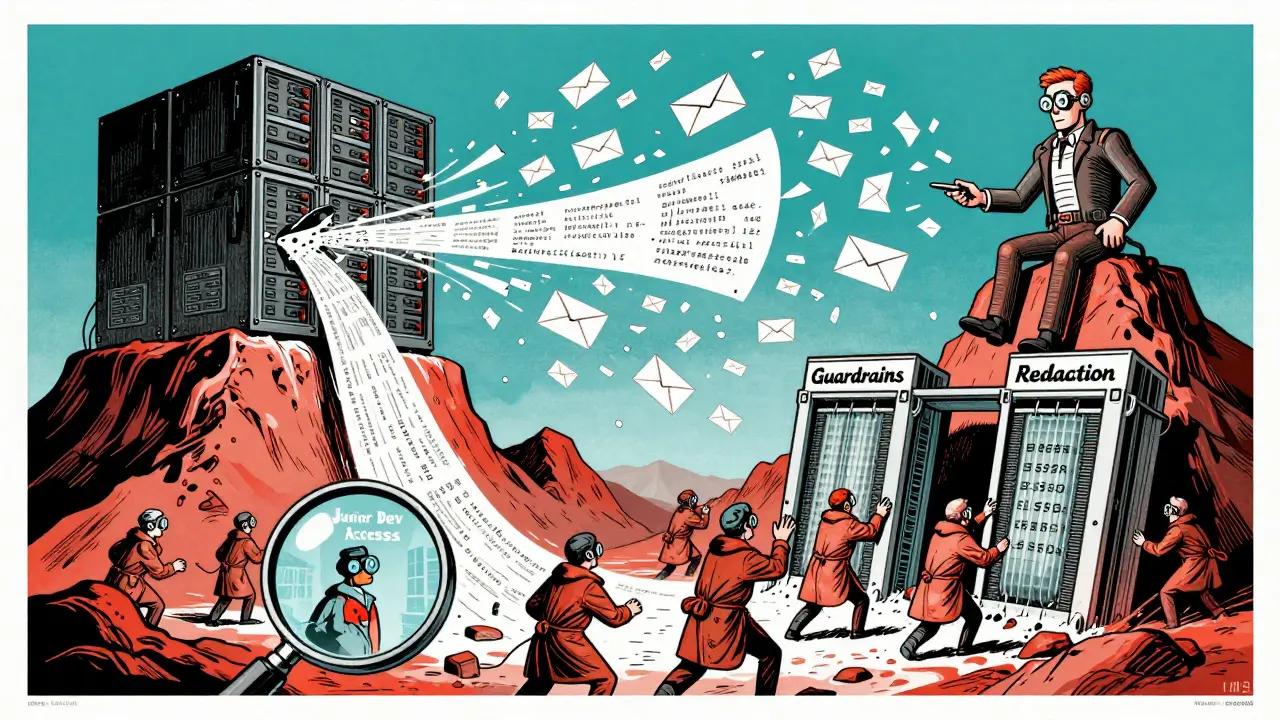
The Hidden Costs: Maintenance, Monitoring, and Expertise
Self-hosting sounds simple: download the model, run it on a server, done. But that’s like saying, “I bought a car, so I don’t need a mechanic.” LLMs need constant updates. New vulnerabilities are found in libraries like PyTorch or Hugging Face Transformers. A patch might be released tomorrow that fixes a critical memory leak or a prompt injection exploit. If you don’t apply it, your model becomes a target. Palo Alto Networks A cybersecurity company specializing in cloud and AI threat detection calls unmonitored, stale LLM deployments “blind spots.” They’re not just security risks-they’re compliance risks. An old model running on an unsupported version of Ubuntu? That’s a violation of SOC 2 or ISO 27001 standards. You also need monitoring. Not just for performance, but for anomalies. Is someone querying the model 500 times a minute? Is the output suddenly filled with gibberish or code snippets that look like internal documentation? That’s not a glitch-that’s an attack. And then there’s the cost of expertise. You need people who understand both AI systems and cybersecurity. Not just data scientists who trained the model, but security engineers who can lock it down. That’s a rare combo. Many teams underestimate this. They spend months setting up the infrastructure, then realize they don’t have anyone who can respond to a breach.When Self-Hosting Isn’t the Right Choice
Not every company needs to self-host. If you’re a small startup testing an idea with non-sensitive data, using an API is faster, cheaper, and less risky. The overhead of managing security, compliance, and infrastructure isn’t worth it. Private AI A company offering tools to enhance privacy in LLM deployments points out that even self-hosted models can have residual privacy risks. If your training data includes personal information-even if you scrubbed it-there’s still a chance the model memorizes and regurgitates it. That’s why you need data minimization, differential privacy techniques, and synthetic data wherever possible. Also, don’t ignore the computing cost. Running a 70B-parameter model isn’t like running a WordPress site. You need high-end GPUs, lots of RAM, and cooling. The electricity bill alone can be tens of thousands of dollars a year. If your usage is sporadic, cloud APIs are still more economical.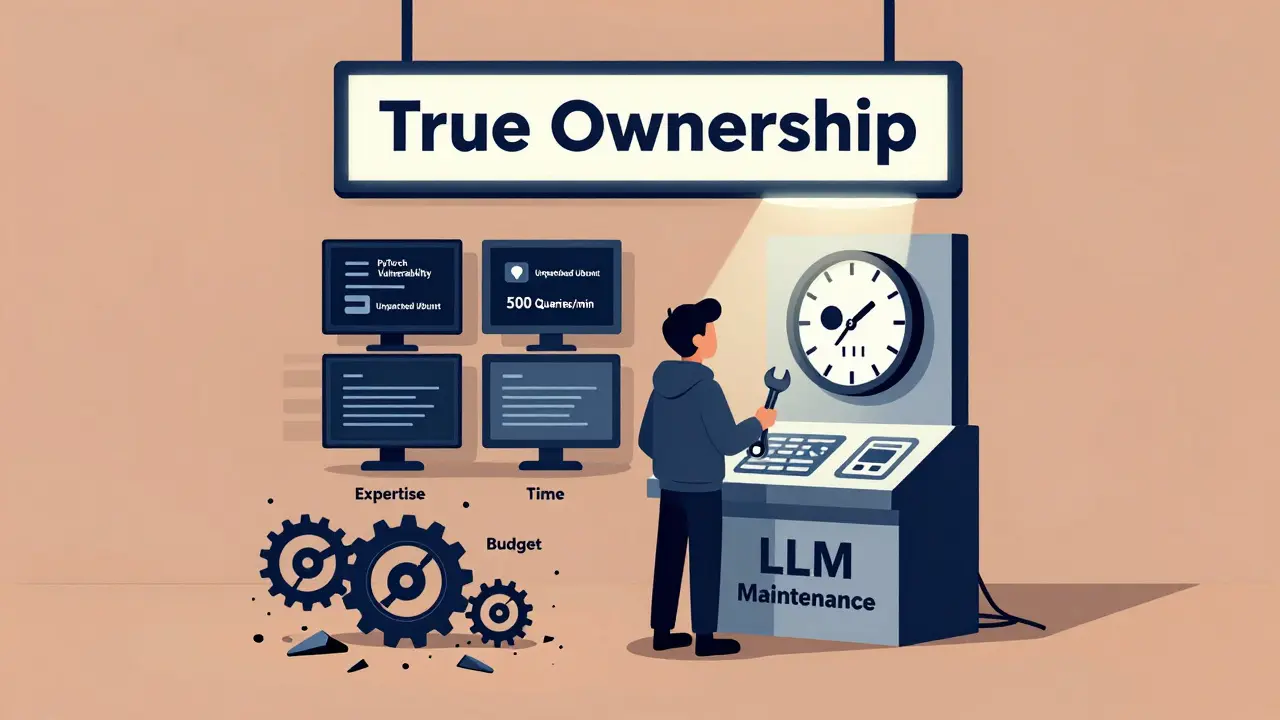
How to Get Started Right
If you’ve decided self-hosting is the right path, here’s how to avoid the most common pitfalls:- Start with a clear compliance roadmap-identify which regulations apply to your data and map them to technical controls.
- Isolate your LLM environment-run it in a separate network zone with no direct internet access. Use a reverse proxy for controlled input/output.
- Encrypt everything-model weights, logs, training data. Use AES-256 or better.
- Implement guardrails-use tools like Microsoft’s Guidance or open-source filters to block harmful outputs before they’re returned.
- Log and audit everything-every prompt, every response, every user action. Store logs for at least 12 months.
- Plan for updates-schedule monthly patch cycles. Test updates in staging before deploying.
- Train your team-not just engineers, but compliance officers and legal teams. Everyone needs to understand the risks.
The Bottom Line
Self-hosting LLMs isn’t about being cool or cutting-edge. It’s about protecting your business, your customers, and your legal standing. If you handle sensitive data, you don’t have a choice. The cloud isn’t safe enough. The risks of outsourcing control are too high. But it’s not a plug-and-play solution. It’s a long-term commitment to security, maintenance, and expertise. If you’re ready for that, self-hosting gives you something no API can: true ownership. And in today’s world, that’s worth more than any subscription fee.







The moment you self-host an LLM, you're basically signing a contract with the surveillance state. Every prompt you type, every output you get-it's all logged, indexed, and stored on hardware you're now responsible for. And guess what? If a rogue employee or a nation-state gets in, your entire dataset becomes a crown jewel for exploitation. No cloud provider is going to hand over your data to the NSA-but your own server? That's just a password away from being compromised. And don't even get me started on the supply chain attacks on Hugging Face models. They're not 'open source'-they're open targets.
Self-hosting is not a technical decision-it is a strategic imperative for entities operating under regulatory frameworks of global significance. The notion that compliance can be achieved through mere infrastructure isolation is a fallacy. One must implement holistic governance: data lineage tracking, immutable audit trails, and cryptographic attestation of model integrity. Without these, the architecture is not merely insecure-it is legally indefensible. The burden of proof lies entirely with the operator. There is no third-party liability shield. No indemnity. No SLA. Only accountability.
Really appreciate this breakdown. I’ve been pushing my team to self-host for compliance, but the maintenance part scared everyone. You’re right-it’s not just ‘download and run.’ We started with a tiny 7B model on a single GPU just to test logging and access controls. Took us two weeks to get the audit trail working right, but now we’re actually sleeping better at night. If you’re doing this, start small, document everything, and get your legal team in the room before you even boot the server. You’ll thank yourself later.
So let me get this straight-you’re telling me I need a cybersecurity ninja, a compliance lawyer, and a GPU farm just to ask my AI what the weather’s like tomorrow? And you call this progress? 😏 I mean, I get it. But if I’m running a startup with 3 employees and zero budget, does ‘true ownership’ mean I’m also owning a 6-figure electricity bill and a nervous breakdown? Maybe we need a middle ground: private cloud with zero-trust APIs. Not perfect, but at least I can afford to sleep.
Man, I read this whole thing and I’m just thinking-why are we all acting like self-hosting is the only way? I mean, yeah, cloud providers aren’t perfect, but they’ve got teams of people doing nothing but patching and monitoring. We’re just trying to generate customer support replies. Do we really need AES-256 on every log file? I think we’re over-engineering this. Maybe just use a good API with data masking and call it a day. Not every company needs to be a Fortune 500.
Let’s talk about model artifacts. Everyone’s focused on prompts and outputs, but the real goldmine is the weights. If someone steals your fine-tuned DeepSeek R1, they don’t need your data-they just need to reverse-engineer your prompts and replicate your guardrails. That’s IP theft on steroids. And don’t even get me started on the fact that most teams are storing these files on NFS shares with world-readable permissions. I’ve seen it. It’s not a question of ‘if’-it’s ‘when.’ Encrypt. Sign. Segment. Repeat.
Correction: The article says ‘GDPR European Union regulation requiring strict data handling practices’-that’s not a sentence. That’s a fragment. And ‘SOX U.S. federal law’? No comma? You’re telling me companies are risking fines for non-compliance because someone couldn’t be bothered to use proper punctuation? This isn’t a blog post-it’s a liability checklist. And if you think ‘self-hosting fixes compliance’ without a documented data processing agreement, you’re not just wrong-you’re negligent. Also, ‘Plural.sh’? Really? That’s your recommended solution? I’ve seen more secure setups on a Raspberry Pi running a Docker container.
You think this is bad? Wait till the first time your LLM writes a resignation letter for your CFO and emails it to the board. Then you’ll realize you didn’t just lose control of your data-you lost control of your company’s reputation. And no, ‘guardrails’ won’t save you. I’ve seen them bypassed by a single clever prompt. You’re not secure. You’re just delusional. And the fact that you’re still running this on Ubuntu 20.04? That’s not compliance. That’s suicide.