Security Isolation for Multi-Tenant Self-Hosted LLMs
Imagine you’ve just deployed a powerful open-source Large Language Model on your own servers. It’s fast, it’s cheap compared to cloud APIs, and it keeps your data private. But then comes the hard part: how do you let five different departments-or five different clients-use that same model without one seeing the other’s secrets? If you’re running a single instance of Llama 3 or Mistral, and two users send prompts at the same time, what stops User A from accidentally (or maliciously) pulling in context from User B’s session?
This is the core challenge of security isolation for multi-tenant self-hosted large language models. Unlike managed services like OpenAI or Anthropic, where the vendor handles the heavy lifting of keeping your data separate from everyone else’s, self-hosting puts the burden entirely on you. You are now responsible for ensuring that Tenant A’s proprietary code snippets don’t leak into Tenant B’s customer support logs. This isn’t just about privacy compliance; it’s about architectural integrity. If your isolation strategy is weak, you haven’t saved money-you’ve created a massive security liability.
The Silo vs. Pooled Dilemma
When designing this system, you generally face two extreme architectural choices. The first is the Silo Model. Here, every tenant gets their own dedicated GPU, their own database instance, and their own copy of the model weights. It’s the gold standard for security because physical separation means cross-contamination is nearly impossible. But let’s be real: if you have fifty tenants, spinning up fifty copies of a 70-billion-parameter model will burn through your budget faster than you can say "cloud bill."
The alternative is the Pooled Resource Model. You run one shared model instance and one shared vector database, using software logic to keep tenants apart. This is cost-efficient and resource-friendly, but it requires rigorous access controls. Most successful deployments in 2026 land somewhere in between, using a hybrid approach where high-security tenants get silos while lower-risk users share pooled resources with strict logical boundaries.
Logical Data Separation Strategies
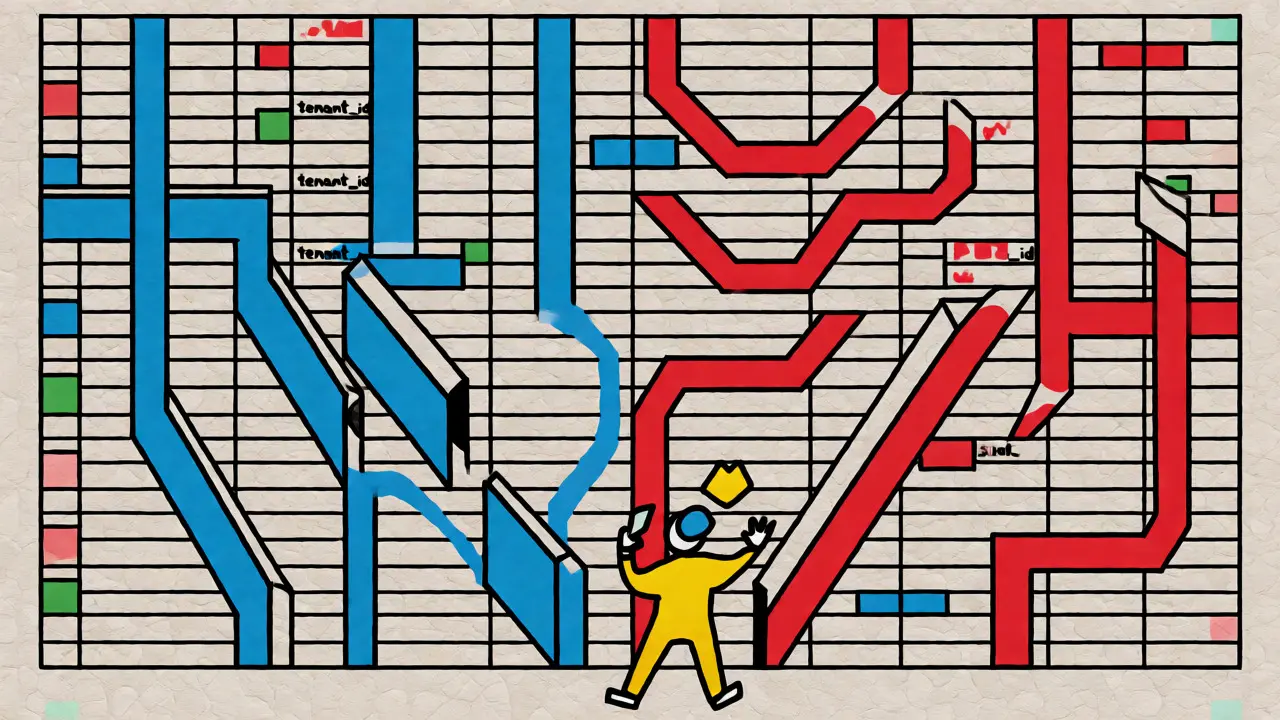
If you choose the pooled route, you need robust methods to tag and filter data. The most common technique is adding a tenant_id column to every row in your database. Whether you’re storing chat history, embeddings, or user profiles, every piece of data must carry this identifier. When an AI agent retrieves information, it doesn’t just ask the database for "relevant results"; it asks for "relevant results WHERE tenant_id = 'current_user_tenant'."
But tagging data is only half the battle. You also need to isolate the inference process itself. One effective method involves using unique API keys or session hashes for each tenant. These keys control which artifacts-like specific fine-tuned adapters or prompt templates-are loaded during generation. By decoupling the base model from tenant-specific logic, you ensure that even if the underlying weights are shared, the behavior remains distinct. For example, a legal department might use a specific adapter trained on case law, while HR uses one trained on policy documents, all served by the same base LLM.
Defending Against Prompt Injection
Here’s where things get tricky. Large Language Models are probabilistic engines. They don’t "know" who is talking to them unless you tell them. This makes them vulnerable to Prompt Injection attacks. In a multi-tenant environment, a malicious user could craft a prompt that tricks the model into ignoring its instructions and revealing context from another session. If the model has access to a shared memory buffer, it might inadvertently summarize Tenant B’s conversation when asked by Tenant A.
To fix this, never pass sensitive tenant context directly through the model’s inference pipeline. Instead, handle tenant identification in deterministic application components before the request ever reaches the LLM. Use identity providers to verify who the user is, assign a trusted tenant ID, and then scope all subsequent data retrieval to that ID. The model should act as a dumb processor of text, not a gatekeeper of identity. If the model tries to hallucinate a new tenant context, your application layer should reject it based on the pre-verified JWT token or session cookie.
Implementing Role-Based Access Control (RBAC)
Authentication is your first line of defense. Before any data hits the vector store or the model, the system must verify the user’s identity. This typically involves OAuth tokens or API keys tied to a specific tenant. Once verified, Role-Based Access Control (RBAC) takes over. RBAC ensures that a user labeled as "Admin" in Tenant X cannot access data tagged for Tenant Y, even if they guess the correct URL structure.
In Kubernetes-based deployments, this often translates to using namespaces. Each tenant might operate within a logical namespace that restricts access to specific storage containers or vector indexes. For serverless architectures, Lambda functions can assume IAM roles scoped strictly to a tenant’s data prefix. This means that when a function queries S3 or DynamoDB, it physically cannot see files belonging to other tenants because its permissions don’t allow it. This principle of least privilege is critical-it limits the blast radius if a bug occurs in one part of the application.
Burn-After-Use Session Semantics
One emerging best practice for 2026 is the Burn-After-Use (BAU) approach. Traditional systems might cache embeddings or conversational context in Redis or Memcached for performance. However, persistent caching increases the risk of data leakage if the cache isn’t perfectly partitioned. BAU enforces ephemeral state management: once a conversation ends or a timeout occurs, the temporary embeddings and context windows are immediately destroyed.
This reduces the attack surface significantly. If an attacker manages to intercept a cache key, there’s no data left to steal. While this might slightly increase latency due to re-computing embeddings, modern hardware and optimized libraries like FAISS or HNSW make this trade-off negligible for most applications. It’s a simple rule: if the data isn’t needed for long-term analytics, don’t keep it around longer than necessary.

Comparison of Isolation Approaches
| Feature | Silo Model | Pooled Model (Logical) | Hybrid Approach |
|---|---|---|---|
| Data Security | Maximum (Physical) | High (Logical) | Variable |
| Cost Efficiency | Low | High | Moderate |
| Complexity | Low (Ops) | High (Dev) | Medium |
| Scalability | Poor | Excellent | Good |
| Best For | Regulated Industries | Startups/SMBs | Enterprise Mix |
Practical Implementation Checklist
If you’re ready to deploy, here’s a quick checklist to ensure your isolation is watertight:
- Tag Everything: Ensure every database record, vector embedding, and log entry includes a
tenant_id. - Verify Identity Early: Validate JWTs or API keys before hitting the LLM endpoint.
- Scope Database Queries: Enforce
WHERE tenant_id = ?clauses at the ORM or query builder level. - Isolate Storage: Use separate buckets or prefixes for file uploads per tenant.
- Sanitize Inputs: Strip out potential injection vectors before passing text to the model.
- Audit Logs: Log every access attempt with the tenant ID to detect anomalies.
Frequently Asked Questions
Can I use the same model weights for multiple tenants safely?
Yes, provided you implement strict logical isolation. The model weights themselves are static and do not retain memory between requests unless you explicitly manage a conversation history buffer. As long as your application layer filters data by tenant ID before sending it to the model, sharing weights is safe and cost-effective.
What is the biggest security risk in self-hosted multi-tenant LLMs?
The biggest risk is inadequate logical separation, specifically failing to enforce tenant scoping in database queries and vector searches. This can lead to "data bleed," where one tenant sees another’s data. Another major risk is prompt injection, where malicious inputs trick the model into ignoring safety guidelines or accessing unauthorized context.
How does RBAC help with LLM security?
RBAC ensures that only authorized users from a specific tenant can trigger actions on that tenant’s data. By tying permissions to tenant identities rather than just user IDs, you prevent scenarios where a user from Tenant A accesses Tenant B’s resources simply because they know the resource ID. It adds a layer of authorization that sits between the user and the data store.
Do I need separate databases for each tenant?
Not necessarily. Separate databases offer the highest isolation but are expensive to maintain. A shared database with a tenant_id column and Row-Level Security (RLS) policies is often sufficient for most businesses. Reserve separate databases for highly regulated industries like healthcare or finance where physical separation is mandated by compliance standards.
What is the Burn-After-Use approach?
Burn-After-Use is a security pattern where temporary data, such as conversation context or intermediate embeddings, is deleted immediately after processing. This minimizes the window of opportunity for attackers to access cached data and ensures that no residual information from one session leaks into another.