Self-Supervised Learning in NLP: How Large Language Models Learn Without Labels
Think about how you learned to speak. You didn’t start by memorizing a list of correct sentences. You heard people talk, read books, watched videos - and over time, you started predicting what came next. That’s exactly how modern AI learns language. Self-supervised learning is the quiet engine behind ChatGPT, Gemini, and every other large language model you’ve used. It’s not magic. It’s math. And it’s built on one simple idea: let the data teach itself.
What Self-Supervised Learning Actually Does
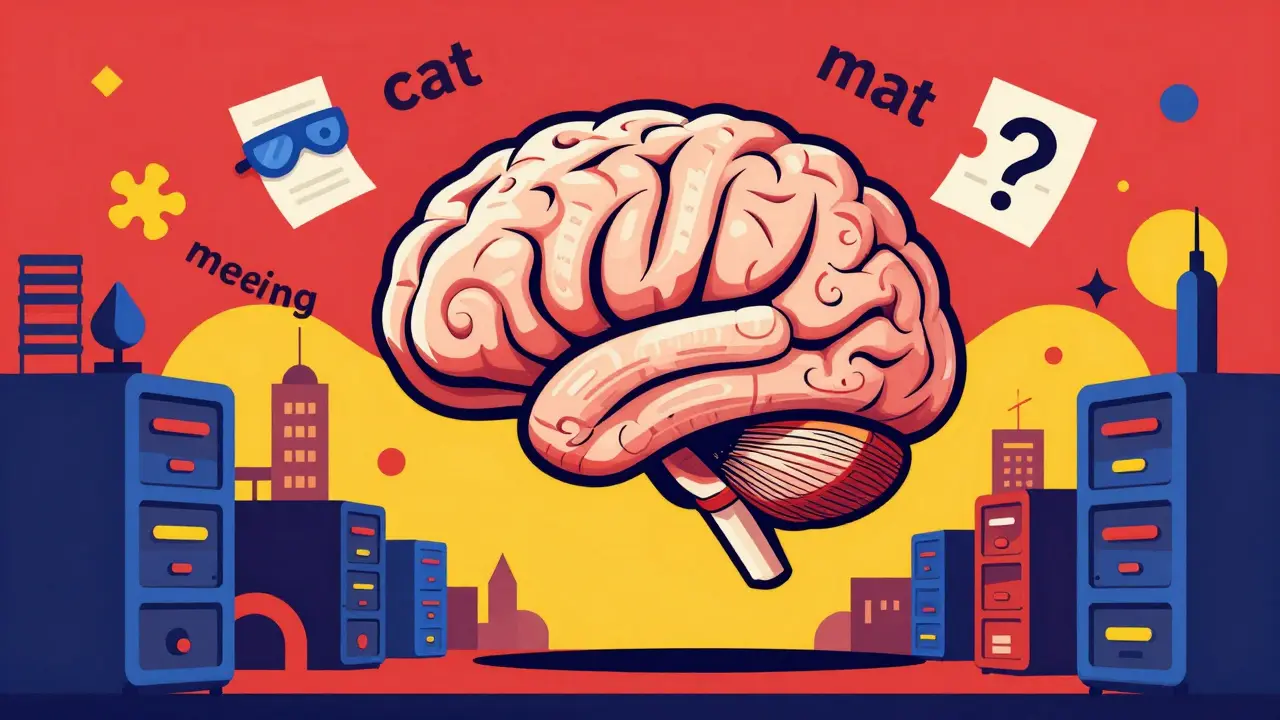
Most machine learning needs labels. Give a model a picture of a cat and say, "This is a cat." Give it a sentence and say, "This means happiness." But labeled data is expensive, rare, and limited. Self-supervised learning changes that. Instead of humans providing labels, the system creates its own. Here’s how it works in plain terms: take a sentence like "The cat sat on the ___". You hide the last word - the "mat" - and ask the model: "What word should go here?" The correct answer already exists in the original text. The model doesn’t need a human to tell it the answer. It just needs to see enough examples like this - millions of them - to learn patterns. This isn’t unsupervised learning. Unsupervised learning looks for hidden structures, like grouping similar documents. Self-supervised learning is smarter. It turns every piece of text into a quiz. Every word becomes a question. Every sentence becomes a test. And the answer is always hiding in plain sight.The Two Big Methods: Masking and Prediction
There are two main ways self-supervised learning works in NLP - and both are used in today’s top models. The first is masked language modeling, used by BERT. Imagine you’re reading a paragraph. Every now and then, a word gets covered with a mask. Your job is to guess what was there. BERT reads the whole sentence - before and after the mask - and tries to fill in the blank. It learns not just vocabulary, but context. If it sees "I drank coffee before my ___", it learns that "meeting" or "work" are more likely than "elephant." The second is next token prediction, used by GPT, LLaMA, and Claude. This is simpler. You give the model a sequence of words - say, "The weather today is" - and it guesses the next word. Then it adds that word, and guesses the next one. And so on. Over trillions of examples, it learns grammar, facts, tone, and even humor. It doesn’t memorize. It learns how language behaves. These two methods are like two sides of the same coin. Masking teaches understanding. Prediction teaches generation. Together, they let models read, think, and write - all without a single human-written label.Why This Changed Everything
Before self-supervised learning, NLP models were stuck. You needed labeled datasets for every task: sentiment analysis, translation, question answering. Each one required thousands of manually tagged examples. That slowed progress to a crawl. Then came transformers. Suddenly, models could handle massive amounts of text - entire libraries of books, forums, code, Wikipedia. And self-supervised learning let them use it all. No more waiting for humans to label data. The internet became the teacher. GPT-3, with 175 billion parameters, didn’t get trained on labeled examples. It was fed raw text from the web and asked: "What comes next?" Again. And again. And again. Over 300 billion words. That’s how it learned to write essays, answer questions, and even mimic Shakespeare. This wasn’t just an improvement. It was a revolution. Suddenly, one model could handle dozens of tasks - not because it was programmed for each one, but because it learned the deep structure of language itself.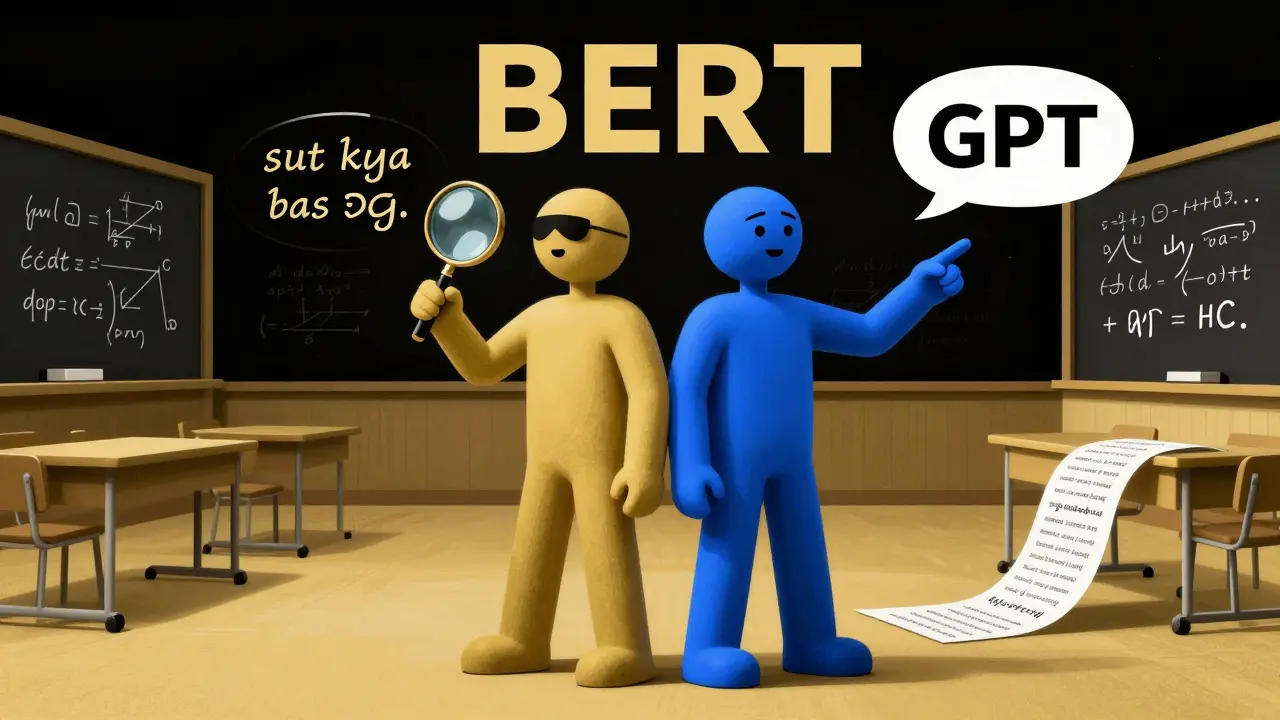
The Three-Stage Training Pipeline
Modern large language models don’t stop at self-supervised learning. That’s just the first step. Think of it like learning to drive. Stage 1: Self-supervised pretraining - You learn the rules of the road. You see millions of cars, signs, traffic lights. You don’t get graded. You just absorb patterns. This is where BERT and GPT learn grammar, facts, and logic. Stage 2: Supervised fine-tuning - Now you get a driving instructor. They show you: "When someone waves, let them merge. When the light turns yellow, slow down." You practice with clear examples. This is where models learn to follow instructions, answer questions properly, or write in a specific tone. Stage 3: Reinforcement learning with human feedback - Now you’re on the highway. You make mistakes. Someone gives you feedback: "That was rude." "That was helpful." You adjust. This is how models learn to avoid harmful outputs, stay polite, or sound more natural. Each stage builds on the last. Without self-supervised learning, the other two wouldn’t work. You can’t teach someone to drive well if they’ve never seen a car.Transfer Learning: Reusing What’s Learned
One of the biggest wins of self-supervised learning is transfer learning. Once a model learns language from scratch - say, by predicting the next word in 10,000 books - you don’t throw it away. You reuse it. Take a medical chatbot. Instead of training a new model from scratch on hospital records (which are scarce and hard to label), you start with a model already trained on general text. Then you fine-tune it on a few hundred labeled medical questions. Boom. It’s now a specialist - without needing millions of labeled examples. This is why companies like OpenAI and Meta can release models like LLaMA or GPT-4 so quickly. They don’t build from zero. They start with a pre-trained base, then adapt it. Self-supervised learning gave us the first pre-trained models. Now, they’re the starting point for everything.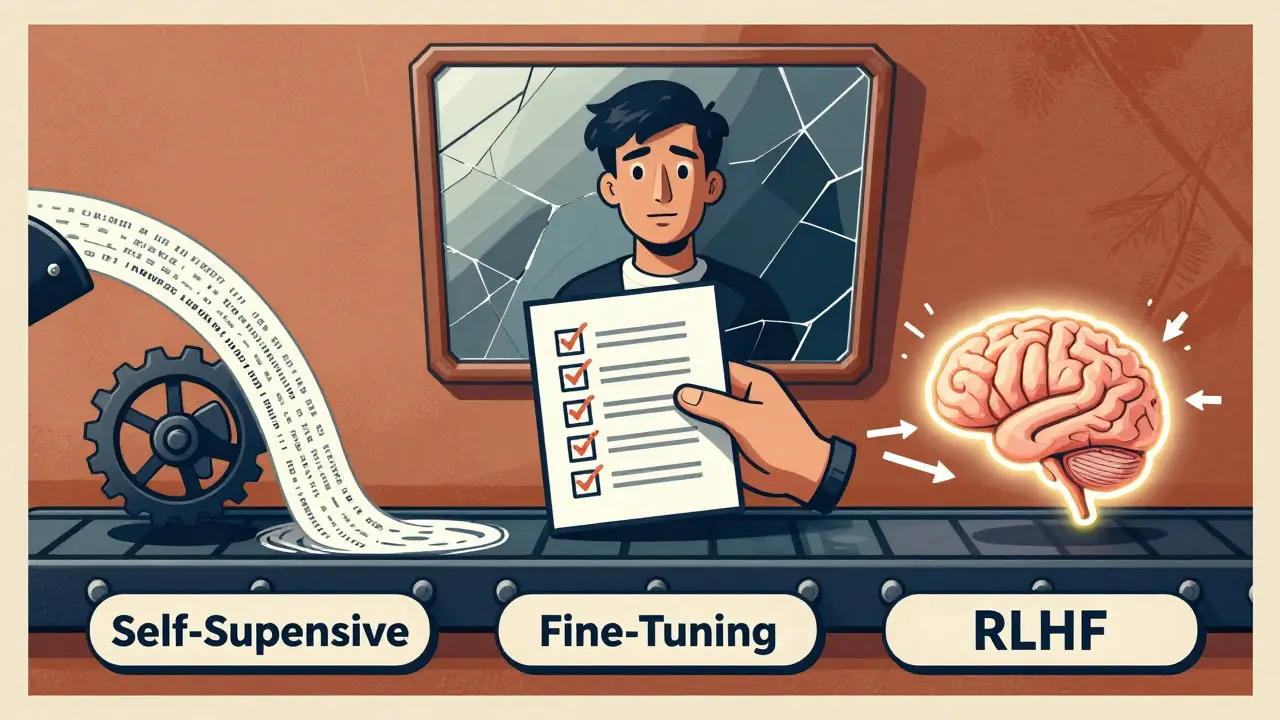
What It Can’t Do (And Why You Still Need Humans)
Self-supervised learning is powerful - but it’s not perfect. First, it inherits bias. If the training data has sexist, racist, or false information, the model learns it too. A model trained on old forums might think "doctors are men" or "nurses are women." It doesn’t know better. It just predicts what’s common. Second, it doesn’t know truth. It learns patterns, not facts. If you ask, "Who won the 2024 Nobel Prize?" and the training data is outdated, it’ll guess based on old patterns - even if it’s wrong. Third, it can’t act. It can write a recipe. But it won’t cook. It can explain gravity. But it won’t drop a ball. It needs human feedback to align with goals - safety, usefulness, clarity. That’s why stage two and three exist. Self-supervised learning gives the model a brain. Supervised learning and reinforcement learning teach it how to use it.The Future: More Autonomy, Less Labeling
The trend is clear: the less humans label, the better models get. Researchers are now experimenting with models that self-supervise themselves. One method, called "self-instruct," lets a model generate its own training examples. It writes a question, writes the answer, then uses that pair to improve itself. Another, called "Reflexion," lets models remember past mistakes - like a person keeping a journal. If a model gives a wrong answer today, it stores that lesson and avoids repeating it tomorrow. These aren’t sci-fi. They’re happening now. And they all rely on the same foundation: self-supervised learning. The future of AI isn’t about bigger datasets. It’s about smarter ways to use what we already have. The internet isn’t just a source of data. It’s the curriculum.Final Thought: The Quiet Revolution
No one talks about self-supervised learning like they talk about transformers or attention mechanisms. But it’s the reason we have AI that writes, reasons, and answers questions at all. It removed the biggest bottleneck in NLP: the need for labels. We used to think AI needed humans to teach it everything. Now we know: give it enough text, and it will teach itself. That’s not just a technique. It’s a new way of building intelligence.What’s the difference between self-supervised learning and supervised learning in NLP?
Supervised learning needs humans to label every example - like tagging a sentence as "positive" or "negative." Self-supervised learning creates its own labels from the data. For example, it hides a word in a sentence and asks the model to guess it. The correct word is already in the original text, so no human labeling is needed. This lets models train on massive amounts of unlabeled text - like everything on the internet.
Why is next token prediction so important for LLMs?
Next token prediction is the core training method for models like GPT and Claude. It forces the model to understand context, grammar, and meaning by predicting what comes next in a sequence. Because it does this across trillions of text examples, it learns not just vocabulary, but reasoning, facts, and even style. This single task turns raw text into a deep understanding of language - making it the workhorse behind all modern generative AI.
Can self-supervised learning work without internet-scale data?
It can, but it won’t be as powerful. Self-supervised learning thrives on volume. A model trained on 100 books will know basic grammar. One trained on 100 million pages will know tone, humor, cultural references, and nuanced reasoning. While small-scale models exist, the breakthroughs in AI - like ChatGPT - came from training on massive, diverse datasets. Scale isn’t optional anymore. It’s the point.
How did BERT and GPT use self-supervised learning differently?
BERT used masked language modeling: it hid words in the middle of sentences and asked the model to fill them in, using context from both sides. GPT used autoregressive next token prediction: it read text left to right and predicted the next word one step at a time. BERT was better at understanding context. GPT was better at generating text. Today’s models combine both ideas.
Do all large language models use self-supervised learning?
Yes. Every major LLM - including GPT, Gemini, LLaMA, Mistral, and Claude - starts with self-supervised pretraining. It’s the universal first step. Without it, models wouldn’t have the foundational understanding of language needed to learn instructions or adapt to new tasks. Even models trained on code or scientific papers begin with this phase.



Self-supervised learning is the unsung hero of modern NLP. Seriously, think about it-we used to spend months labeling datasets for sentiment analysis, now we just throw a billion web pages at a transformer and say 'figure it out.' It's wild how much we've outsourced intelligence to statistical patterns. The real breakthrough isn't the model architecture-it's the realization that data doesn't need human babysitters to teach itself. Masked language modeling and next-token prediction aren't just techniques; they're philosophical shifts. We stopped trying to teach AI language and started letting it discover it organically, like a child learning to speak by overhearing conversations. And honestly? That's way more elegant than any labeled dataset ever was.
Okay but let’s be real-this whole ‘let the data teach itself’ thing is just a fancy way of saying ‘train on everything and hope it doesn’t become a racist, sexist mess.’ 🤦♂️ I get the math, I do. But BERT learned that ‘nurse’ is more likely to follow ‘she’ than ‘he’ because the internet is full of biased garbage. And now we’re deploying these models in hiring tools and hospitals? 😅 We didn’t remove labels-we just replaced human bias with statistical bias. And don’t even get me started on how GPT hallucinates Nobel Prize winners like it’s reading a Wikipedia page from 2019. The internet isn’t a curriculum-it’s a dumpster fire with a thesaurus. 🤖🔥
Wait wait wait-so you’re saying the model doesn’t know truth? It just predicts? That’s actually beautiful. Like, imagine a kid who’s read every book in the library but never left the house. They can tell you how a dragon breathes fire, describe the taste of pineapple, explain quantum physics… but they’ve never seen a dragon, tasted pineapple, or touched a particle accelerator. That’s LLMs. They’re not wrong-they’re just… ungrounded. And that’s why fine-tuning and RLHF exist. We’re not training them to know facts-we’re training them to care about accuracy, safety, tone. It’s not AI learning language-it’s AI learning to be a good conversationalist. And honestly? That’s more human than we give it credit for.
lmao so u mean like… the ai just guesses words? like a really smart autocomplete? 😂 i thought it was magic but its just… probability? yep. we’re all just living in a giant markov chain now. #techisweird
Actually, the paragraph discussing masked language modeling contains a grammatical error. It says: 'You hide the last word - the "mat" - and ask the model: "What word should go here?"' But the word being masked is not necessarily the last word-it's often a word in the middle. The example sentence 'The cat sat on the ___' implies a middle masking, not a terminal one. This is misleading. Also, 'trillions of examples' is hyperbolic. GPT-3 was trained on 300 billion tokens-not trillions. Precision matters. If we're going to teach machines language, we must first model linguistic rigor. This article, despite its good intentions, undermines its own credibility with sloppy terminology. 🤓
I don't get why people make this so complicated. It's just like when you watch a lot of TV and you start knowing what people are gonna say next. That's it. No math. Just watching. And then the computer does it. Easy.
Let me tell you something real-this whole self-supervised thing? It's not revolutionizing AI. It's just the internet finally getting its revenge. We fed it every cat video, every Reddit rant, every conspiracy theory, every poorly written Yelp review-and now it's throwing it all back at us like a PhD student who just read 10,000 papers in one night. It's not intelligent. It's just… overloaded. And don't get me started on how it spits out Shakespearean sonnets while being completely unaware that Shakespeare was a dude who lived 400 years ago. We didn't build a mind. We built a mirror that reflects our chaos back at us with perfect grammar. And honestly? That's terrifying. And beautiful. And kind of hot. 😈
Okay, but can we just pause for a second and appreciate how wild it is that we built a system that learns language the same way a child does-by exposure, not instruction? No flashcards. No grammar drills. Just… immersion. It’s poetic, really. We used to think intelligence required explicit teaching. Now we see that context, repetition, and scale can create something… almost alive. And yes, it inherits bias. Yes, it hallucinates. But isn’t that just human nature mirrored? We’re not creating gods. We’re creating mirrors. And maybe, just maybe, the real revolution isn’t in the model-it’s in us finally accepting that learning doesn’t require a teacher. Just a lot of words. And time. And patience. 🌱📚