CCPA Compliance for Vibe-Coded Web Apps: How to Handle Do Not Sell and User Requests
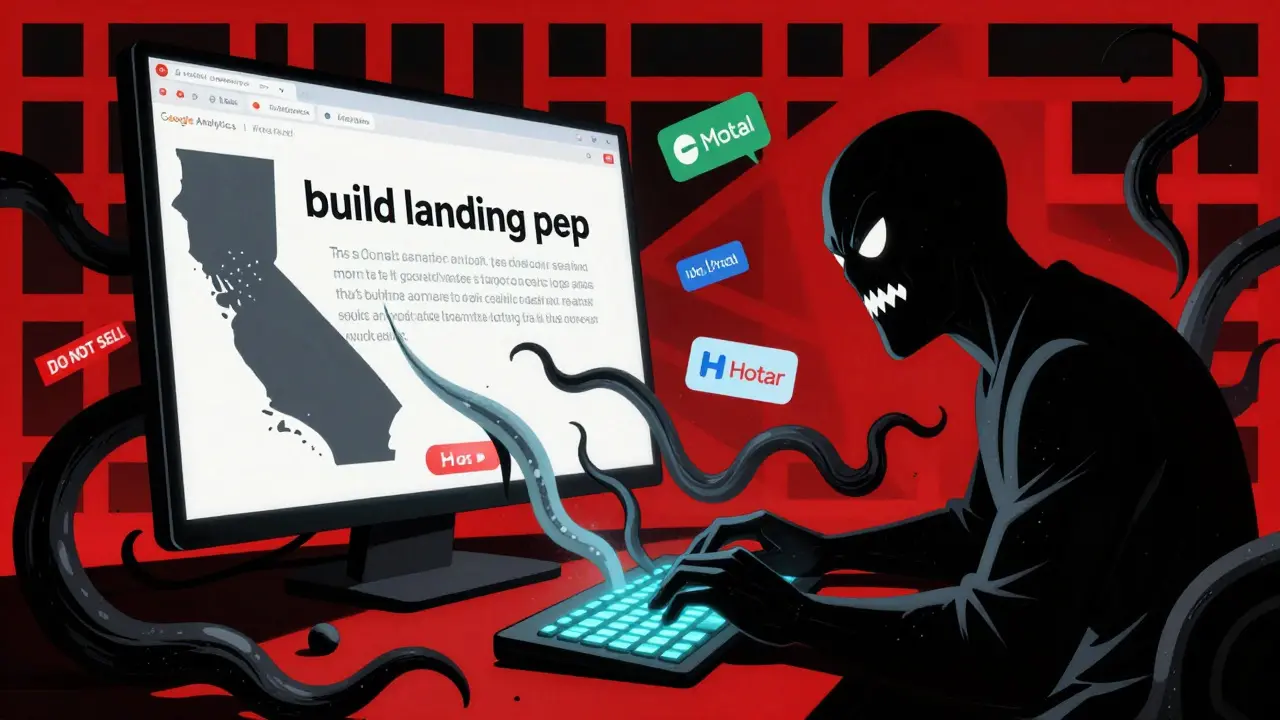
When you use AI to write your website’s code-typing a prompt like "build a landing page with newsletter signup" and letting an LLM generate the whole thing-you’re not just saving time. You’re also blindly handing over control of your users’ data. And if you’re based in California or serve California residents, that’s a legal risk you can’t afford to ignore.
What Is Vibe Coding, and Why It Breaks CCPA
Vibe coding is when developers use tools like GitHub Copilot or Amazon CodeWhisperer to generate web code from plain English prompts. No deep review. No manual checking. Just paste a request, get JavaScript, HTML, and CSS back, and deploy it. It’s fast. It’s tempting. And according to Feroot’s January 2025 report, 68% of these AI-generated sites include hidden tracking scripts that violate the California Consumer Privacy Act (CCPA).
CCPA doesn’t just ask you to be honest about data collection. It gives users the right to say, "Don’t sell or share my information." That means every website serving Californians must display a clear "Do Not Sell or Share My Personal Information" link-usually on the homepage footer-and it must actually work. No login required. No hidden settings. Just one click, and the tracking stops.
But here’s the problem: LLMs don’t know CCPA. They don’t know what "sale" means under California law. When you ask for a "contact form," the AI might throw in Google Analytics, Meta Pixel, or Hotjar-all of which transmit personal data like IP addresses, device IDs, and browsing behavior to third parties. Under CCPA, that counts as a "sale." And if there’s no opt-out link, or if the link doesn’t block those scripts, you’re in violation.
The Compliance Gap: Hand-Coded vs. Vibe-Coded Sites
Traditional web development doesn’t have this problem-not because developers are smarter, but because they’re slower. They review every script. They ask: "Who’s this analytics tool sending data to?" "Does it need user consent?" "Is this tracking sensitive info like location?"
The numbers show the difference:
- 82% of hand-coded websites are CCPA compliant
- Only 37% of vibe-coded sites are
And it gets worse. Only 28% of AI-generated sites properly honor Global Privacy Control (GPC) signals-a browser setting that tells websites users don’t want their data sold. Traditional sites? 79% respect it.
Why? Because vibe coders treat AI output like a prototype. They think, "I’ll clean it up later." But "later" never comes. And when a compliance audit hits-boom-you’re facing penalties. The California Attorney General’s office has already fined three companies using vibe coding a total of $2.3 million in 2025.
What Triggers CCPA Obligations in Vibe-Coded Apps
Not every website needs a "Do Not Sell" link. If your app doesn’t collect personal information, you’re fine. But most vibe-coded apps do. Here’s what turns a simple page into a compliance minefield:
- Google Analytics 4 (used by 86% of websites)
- Meta Pixel or TikTok Pixel
- Third-party ad networks like AdRoll or Criteo
- Chat widgets (e.g., Intercom, Drift)
- Heatmaps or session recorders (e.g., Hotjar, FullStory)
These tools don’t just track page views. They collect IP addresses, device fingerprints, cookies, and sometimes even geolocation-classified as "sensitive personal information" under the CPRA amendment. If any of these are present and not blocked on opt-out, you’re violating CCPA.
And here’s the kicker: AI doesn’t tell you what it’s adding. You might ask for a "responsive contact form," and get a full tracking stack you didn’t know existed. One developer on Reddit said they deployed a client site using vibe coding-only to find Meta Pixel buried in the code during a compliance audit. No one noticed until it was too late.

How to Fix It: A Real-World Compliance Workflow
You can still use vibe coding. But you can’t skip the guardrails. Here’s how to do it right, based on Feroot’s certified training program and real enterprise practices:
- Scan the code before deployment - Use Snyk (version 5.12.0 or later), which now includes CCPA-specific checks. It flags unauthorized tracking scripts before they go live.
- Test the opt-out link - Click it. Does it just show a message? Or does it actually stop data from flowing to Google, Meta, etc.? Use the IAB Tech Lab’s CCPA Compliance Framework test suite. It’s free. Use it.
- Block scripts by default - Don’t load third-party scripts until the user consents. Tools like OneTrust or Didomi let you toggle scripts based on user choice. If someone clicks "Do Not Sell," those scripts vanish.
- Monitor in production - Use client-side security tools like Feroot Audit (now $1,450/month as of Jan 2026). It catches scripts that sneak in after deployment-like when a marketing team adds a new pixel via a CMS.
- Document everything - California’s new emergency regulations (Dec 2025) require proof you’ve verified your opt-out mechanisms. Keep logs of scans, tests, and fixes.
It adds time. It adds cost. But it’s cheaper than a $500,000 fine.
Who’s at Risk? Who’s Safe?
Not every business is equally exposed.
High risk: Small businesses using vibe coding to build e-commerce sites, lead gen pages, or apps with user accounts. These collect data. They don’t have legal teams. They assume "AI knows best." 73% of small businesses using vibe coding have no compliance process, according to Saastr’s March 2025 study.
Lower risk: Static informational sites-blogs, portfolios, brochures-with no forms, no tracking, no user logins. If you’re not collecting data, CCPA doesn’t apply. But even here, beware: AI might still inject analytics. Always check.
Safest: Enterprises with existing privacy programs. 85% of Fortune 500 companies now require AI-generated code to pass automated compliance checks before deployment. They treat vibe coding like any other tool-useful, but dangerous if unmanaged.

The Future: Will AI Ever Get Privacy Right?
Some argue it’s possible. Andrew Ng’s AI Fund claims properly constrained prompts can generate compliant code. But their test cases were simple: no login, no payments, no third-party scripts. Real-world apps aren’t that clean.
Meanwhile, the California Privacy Protection Agency is pushing for change. New rules effective March 1, 2026, will require businesses using AI-generated code to prove they’ve verified their opt-out mechanisms. That means documentation. That means testing. That means accountability.
The W3C is also working on a new standard-Privacy Control API v1.0-expected in Q3 2026. It’s meant to standardize how browsers and websites handle opt-out signals, even when code is auto-generated. But until then, you’re on your own.
The truth? Vibe coding isn’t going away. 42% of new web apps in 2025 were built this way, per Evans Data. And by 2027, Forrester predicts 60% of sites will use some form of AI-assisted development.
But only 28% of those will be fully CCPA compliant without specialized tools.
What You Need to Do Today
If you’re using vibe coding:
- Run every generated site through Snyk’s CCPA checker.
- Click your "Do Not Sell" link. Does it work? Test it with a browser extension that sends GPC signals.
- Remove any tracking script you didn’t explicitly ask for.
- Install a consent manager if you’re collecting any data.
- Train your team. 78% of web dev job postings now require CCPA knowledge.
If you’re hiring a developer or agency:
- Ask: "How do you ensure CCPA compliance in AI-generated code?"
- Don’t accept "We use GitHub Copilot" as an answer.
- Require proof of testing and documentation.
AI can help you build faster. But it can’t help you stay legal. That’s still your job.
Does vibe coding automatically make my site violate CCPA?
No, not automatically. But 68% of vibe-coded sites contain tracking scripts that trigger CCPA obligations. The AI doesn’t know what it’s adding. If your site collects any personal data-like IP addresses, cookies, or location-and doesn’t have a working "Do Not Sell" link, you’re in violation. The method of code generation doesn’t excuse compliance.
What happens if I don’t fix my vibe-coded site?
The California Attorney General can fine you up to $7,500 per intentional violation. In 2025, three companies using vibe coding were fined a total of $2.3 million. You could also face class-action lawsuits from users. Plus, your site could be flagged by privacy tools like Feroot or IAB, damaging your reputation and search rankings.
Can I just remove the "Do Not Sell" link if I don’t sell data?
No. Under CCPA, "selling" includes sharing personal data with third parties for advertising or analytics-even if you don’t get paid. If Google Analytics or Meta Pixel is on your site, you’re sharing data. That counts as a sale. You must display the link and honor opt-outs, regardless of intent.
Do I need a consent manager like OneTrust?
Not always, but it’s the easiest way to stay compliant. Consent managers let you block third-party scripts until users opt in. Without one, you have to manually code script-blocking logic, which is error-prone. Most vibe-coded sites use dynamic script injection, making manual control nearly impossible. A consent manager automates this and meets CCPA’s requirement for "clear, functional" opt-out.
Is there a free way to check if my vibe-coded site is compliant?
Yes. Use the IAB Tech Lab’s free CCPA Compliance Framework test tool. It checks for the presence of the opt-out link, validates GPC signals, and detects unauthorized tracking scripts. You can also use browser extensions like Privacy Badger or uBlock Origin to see what trackers are active. But for production sites, automated tools like Snyk or Feroot Audit are necessary to catch hidden issues.








Yo, this is wild but so real. I used Copilot for a client site last month and didn’t even know Hotjar was in there until the lawyer called. No joke, I thought I was just making a form. Now I scan every line like it’s a minefield. Thanks for the checklist.
i just clicked my do not sell link and nothing happened lol
Let me just say this: AI-generated code isn't the problem-lack of oversight is. You wouldn't hand a five-year-old a car key and say, 'Drive to the store!' So why hand your website to an LLM and say, 'Make it legal?' You need checks. You need layers. You need a human in the loop-period.
Wow. So we're supposed to pay $1,450/month to make sure AI doesn't break the law? Next you'll tell me I need a notary to sign my coffee order.
Just read this and had to reply. I’m from the UK, but my site gets traffic from California. I had no idea even IP addresses counted as ‘personal info’ under CCPA. I’ve been using GA4 like it’s free air. Now I’m scared. I’ll install Snyk tonight. Thank you for the wake-up call. 🙏
There’s a difference between building fast and building recklessly. I’ve seen too many devs treat AI like a magic wand. It’s a tool. Not a substitute for thinking. If you’re deploying without checking, you’re not a developer-you’re a liability.
Let’s be clear: the compliance gap isn’t a technical issue-it’s a cultural one. We’ve normalized speed-over-safety in dev culture. We celebrate ‘ship it’ without asking ‘should we?’ The AI didn’t create this problem; our collective negligence did. And until we start holding people accountable for deploying unvetted code, we’re just rearranging deck chairs on the Titanic.
Oh wow, so now we need consent managers just to stop AI from accidentally selling our users’ data? I guess next we’ll need a GDPR-certified toaster. At this point, the only way to be compliant is to not use the internet at all.
I used to think vibe coding was the future. Then I saw a startup get fined $800k because their ‘simple landing page’ had a hidden TikTok Pixel. That’s not innovation. That’s negligence dressed up as efficiency. We owe it to our users-not just the law-to do better.
Just wanted to say I appreciate the practical steps. Scanning code, testing the link, blocking scripts by default. These aren’t fancy, but they work. I’ve been putting off compliance because it felt overwhelming. This made it feel manageable. Thanks.