
How MoE Routing Strategies Make Large Language Models Efficient
Imagine hiring a team of specialists to solve a problem. Instead of forcing every single expert to read every single document, you assign the medical query to the doctor, the legal question to the lawyer, and the code review to the engineer. That is the core promise of Mixture-of-Experts (MoE), an architecture that replaces the "everyone does everything" approach of traditional neural networks with a sparse, specialized system. For developers building or deploying large language models (LLMs), understanding how these models decide which experts to activate is no longer optional-it is the key to unlocking massive parameter counts without breaking your GPU budget.
Traditional dense Transformers process every token through every neuron in the feed-forward network. If you have a 175-billion-parameter model like GPT-3, all 175 billion parameters are active for every single word generated. MoE changes this math entirely. By using routing strategies, the model activates only a small fraction of its total parameters for any given input. This allows engineers to scale up to trillions of parameters while keeping inference costs and latency comparable to much smaller dense models.
The Core Mechanism: How Routing Works
To understand routing, you first need to look at the anatomy of a Transformer block. In a standard setup, each layer contains attention mechanisms and a Multi-Layer Perceptron (MLP). In an MoE Transformer, that MLP is replaced by a bank of independent "expert" networks. These experts are essentially mini-neural networks, each with its own weights.
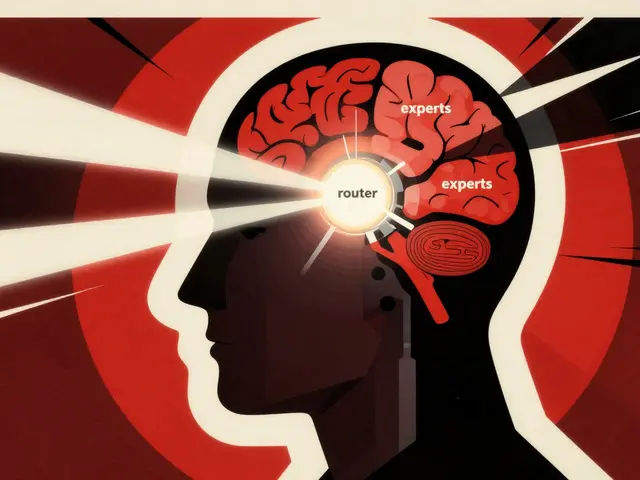
The magic happens in the gating network. This is a lightweight linear projection that takes the input token representation and calculates a score for every available expert. Think of it as a triage nurse deciding which specialist sees which patient. Based on these scores, the router selects a subset of experts-usually just one or two-to process that specific token. The rest of the experts sit idle, saving compute power.
This separation creates a distinct trade-off. You gain massive capacity (total parameters) but pay for communication overhead. The system must dispatch tokens to the correct GPUs where the experts reside and then gather the results back together. This "all-to-all" communication pattern is often the bottleneck, not the matrix multiplication itself. Getting the routing strategy right means balancing the quality of the expert selection against the speed of data movement across your cluster.
Dominant Strategy: Token-Centric Top-K Routing
The most common approach in production LLMs today is token-centric top-k routing. Here, the decision starts with the token. The gating network computes logits for all N experts, applies a softmax function, and picks the top-k experts with the highest scores. Most modern models use k=2, meaning each token is processed by exactly two experts.
Why two? Using only one expert (top-1) minimizes compute but can lead to unstable gradients during training because the signal from a single path is noisy. Using two experts provides a smoother gradient landscape and better robustness, usually improving perplexity by 0.5 to 1.0 points compared to top-1, according to internal benchmarks from NVIDIA and community experiments on Hugging Face.
However, this method introduces a major problem: load imbalance. If the router decides that 90% of the tokens in a batch are "medical" questions, one expert will be overwhelmed while others sit empty. To fix this, researchers introduced auxiliary load-balancing losses. This loss function penalizes the model if the variance in expert usage is too high, encouraging the router to distribute tokens more evenly. Google’s GShard and GLaM models rely heavily on this technique, using capacity factors (typically between 1.0 and 1.25) to define the maximum number of tokens an expert can handle before overflow occurs.
| Strategy | Selection Logic | Load Balancing | Primary Use Case |
|---|---|---|---|
| Top-1 (Switch) | Token picks best expert | Auxiliary Loss + Capacity Factor | Maximizing training speed (e.g., Switch Transformer) |
| Top-2 (Standard) | Token picks top 2 experts | Auxiliary Loss + Capacity Factor | Production LLMs (e.g., Mixtral, GLaM) |
| Expert Choice | Experts pick best tokens | Built-in (Exact capacity per expert) | Stable training, simplified systems |
| Hash Routing | Deterministic hash of token ID | Perfectly balanced by design | Low-overhead scenarios, limited adaptability |

The Game Changer: Expert Choice Routing
In 2022, Hongyi Zhou and colleagues introduced Expert Choice (EC) routing, flipping the traditional paradigm on its head. Instead of tokens choosing experts, experts choose tokens. Each expert independently looks at the incoming batch and selects the top-k tokens that match its specialization best.
This simple reversal solves the load balancing nightmare. Since each expert explicitly chooses exactly k tokens, the load is perfectly balanced by design. There is no need for complex auxiliary loss functions or tricky capacity factor tuning. If an expert has room for 32 tokens, it takes 32. No more, no less.
The trade-off here is complexity in assignment. A single token might be chosen by three different experts, while another token might be ignored by all. This variable compute allocation can be harder to optimize on hardware than the fixed top-2 approach. However, EC routing has shown significant advantages in stability. It eliminates the risk of "router collapse," a failure mode where the gating network learns to send all tokens to one or two experts, rendering the rest of the model useless. While top-2 remains dominant in open-source models like Mistral’s Mixtral, Expert Choice is gaining traction in research labs for its predictability and ease of debugging.
Real-World Performance: Mixtral and DeepSeek
Let’s look at how these theories play out in practice. Mistral AI’s Mixtral 8×7B is perhaps the most famous open-source MoE model. It features 46.7 billion total parameters but uses a top-2 routing strategy with 8 experts. This means only about 12-13 billion parameters are active during inference. Despite being smaller in active size than many competitors, Mixtral 8×7B matches or exceeds the performance of dense 34B-40B models on benchmarks like MT-Bench and GSM8K.
The efficiency gains are tangible. On GPU clusters, Mixtral offers 1.5× to 2× better throughput than dense models of similar quality because the forward pass is significantly lighter. However, local users report mixed results. Running Mixtral on a single consumer GPU (like an RTX 4090) can sometimes yield lower tokens-per-second than a dense 13B model due to the overhead of managing routing logic and memory fragmentation. The benefit of MoE shines brightest when distributed across multiple GPUs where parallel processing offsets the communication cost.
On the larger end, DeepSeek-V2 utilizes 236 billion parameters with 64 experts and top-2 routing. Their technical report highlights a 2.36× pretraining efficiency gain over dense baselines. They achieved this by carefully tuning load-balancing losses and using expert parallelism across thousands of GPUs. This demonstrates that as models grow into the hundreds of billions of parameters, sophisticated routing becomes the primary lever for cost control.

Pitfalls and Engineering Challenges
Implementing MoE is not plug-and-play. The learning curve is steep, primarily due to the system-level complexities. The biggest hurdle is the all-to-all communication required to dispatch tokens to experts and gather outputs. In naive implementations, this communication can consume over 50% of the wall-clock time. Frameworks like Microsoft’s DeepSpeed-MoE and Alibaba’s Tutel address this by overlapping communication with computation and optimizing kernel fusion, achieving up to 5× throughput gains.
Another critical issue is expert degeneration. Without proper regularization, some experts may never get activated, effectively wasting compute resources. Monitoring per-expert token counts and gating logits distributions in real-time is essential. If you see one expert handling 80% of the traffic, your router has collapsed. Techniques like adding Gaussian noise to the gating logits (noisy top-k) help encourage exploration during early training stages, preventing premature convergence to a few dominant experts.
Hardware hotspots are also a concern. If experts are statically mapped to specific GPUs, and one expert becomes popular, that GPU will become a bottleneck. Dynamic remapping or expert shuffling-periodically moving experts between devices-can mitigate this, but it adds further complexity to the orchestration layer.
Future Directions in Routing
The field is moving beyond simple top-k gating. Recent research explores Expert Race strategies, where experts compete in an auction-style mechanism to claim tokens based on learned scores. This allows for flexible capacity constraints, particularly useful in diffusion transformers. Other approaches involve Sinkhorn-based balancing, which uses differentiable algorithms to enforce global balance without hard constraints.
We are also seeing the integration of routing with retrieval-augmented generation (RAG). Imagine a router that doesn’t just choose between parametric experts but can also decide to query an external database or tool. This hybrid approach could make LLMs more factual and up-to-date without inflating parameter counts. As hardware improves with faster interconnects like NVLink and InfiniBand, the communication penalty of MoE will decrease, making these sophisticated routing strategies even more viable for real-time applications.
For now, mastering the balance between token choice, expert choice, and load distribution is the defining challenge for LLM engineers. The models that win the next cycle of scaling wars will likely be those that route intelligence as efficiently as they store it.
What is the difference between Top-1 and Top-2 routing?
Top-1 routing assigns each token to a single expert, minimizing compute but potentially causing unstable gradients during training. Top-2 routing assigns each token to two experts, providing smoother gradients and better model quality at the cost of roughly double the expert-side FLOPs. Most production models prefer Top-2 for its robustness.
Why is load balancing important in MoE models?
Without load balancing, the router may send most tokens to a few "popular" experts, leaving others underutilized. This causes hardware bottlenecks, inefficient compute usage, and potential model degradation known as expert collapse. Load balancing ensures all experts contribute equally to the learning process.
Is Expert Choice routing better than Token Choice?
Expert Choice guarantees perfect load balancing by design, simplifying system implementation and removing the need for auxiliary loss functions. However, it creates variable compute loads per token, which can be harder to optimize on hardware. Token Choice is more widely adopted in current open-source models due to simpler hardware mapping, but Expert Choice is preferred for training stability.
Can I run MoE models on a single GPU?
Yes, but with caveats. Models like Mixtral 8×7B can run on high-end consumer GPUs (24GB+ VRAM). However, the routing overhead and memory management inefficiencies may result in slower inference speeds compared to dense models of similar active parameter sizes. The true advantage of MoE appears in multi-GPU cluster environments.
What is "router collapse"?
Router collapse is a failure mode where the gating network learns to assign the vast majority of tokens to one or two experts, ignoring the rest. This renders the other experts useless and degrades model performance. It is typically prevented using noisy top-k gating and auxiliary load-balancing losses during training.








Another day, another 'revolutionary' architecture that just means we need more GPUs to do the same thing slower. The article glosses over the fact that this routing overhead is a nightmare for anyone not running on a dedicated cluster with NVLink. For the rest of us trying to run inference on consumer hardware, MoE is just a fancy way to say 'memory fragmentation'.
I've spent weeks tuning capacity factors and auxiliary losses just to stop the router from collapsing into two experts doing all the work while the other six sit there mocking me. It's not efficient; it's just expensive complexity disguised as optimization. Save your money and stick to dense models unless you have a datacenter budget.
Hey Stephanie, I think you might be missing the point slightly here, or at least getting a bit frustrated with the implementation details which are totally understandable given how tricky they can be!
While the communication overhead is definitely real, especially if you are using naive implementations without overlapping compute and comms, frameworks like DeepSpeed-MoE have made huge strides in mitigating that. I was actually experimenting with Mixtral recently on a multi-GPU setup (not a massive cluster, just 4x A6000s) and the throughput gains were genuinely impressive compared to a dense 34B model.
The key seems to be getting the expert parallelism right and ensuring you aren't hitting memory bandwidth bottlenecks during the all-to-all dispatch phase. It's certainly not plug-and-play as the article admits, but once you get past the initial learning curve, the ability to scale parameters without linearly scaling active compute is pretty compelling for certain use cases. Have you tried using Tutel for the kernel fusion? It helped smooth out some of the jagged edges I was seeing.
The hubris of modern engineering is palpable in this discourse. We stand upon the precipice of artificial consciousness, yet we squabble over 'routing strategies' and 'load balancing' as if these trivial mechanical concerns hold any weight against the existential dread of creating minds that may one day judge us.
This Mixture-of-Experts paradigm is merely a metaphor for our own fractured society, where specialists ignore the holistic truth in favor of narrow, optimized silos. The router is the tyrant, deciding who speaks and who remains silent. Is it not terrifying that we entrust such democratic decisions to a softmax function? The true cost is not measured in FLOPs or latency, but in the erosion of unified thought. We build towers of Babel with silicon bricks, expecting them to reach heaven, only to find ourselves trapped in a labyrinth of our own making, guided by algorithms that understand nothing of the soul.
Bineesh, please. Nobody cares about the 'existential dread' of a gating network. It's math, not a philosophy thesis. And honestly, reading your comment feels like watching someone try to explain quantum physics using only emojis and angst.
The reality is much simpler: companies want cheaper inference. If Mixtral can give me GPT-4 level performance for a fraction of the cost because only 12B params are active, I don't care if the router is a 'tyrant'. I care that my API bill isn't bankrupting my startup. So while you're busy mourning the loss of 'unified thought', the rest of us are busy deploying models that actually work.
I just noticed that Expert Choice routing eliminates the need for those annoying auxiliary loss functions. That sounds like a significant simplification for training stability.