Production Guardrails for Compressed LLMs: Confidence and Abstention
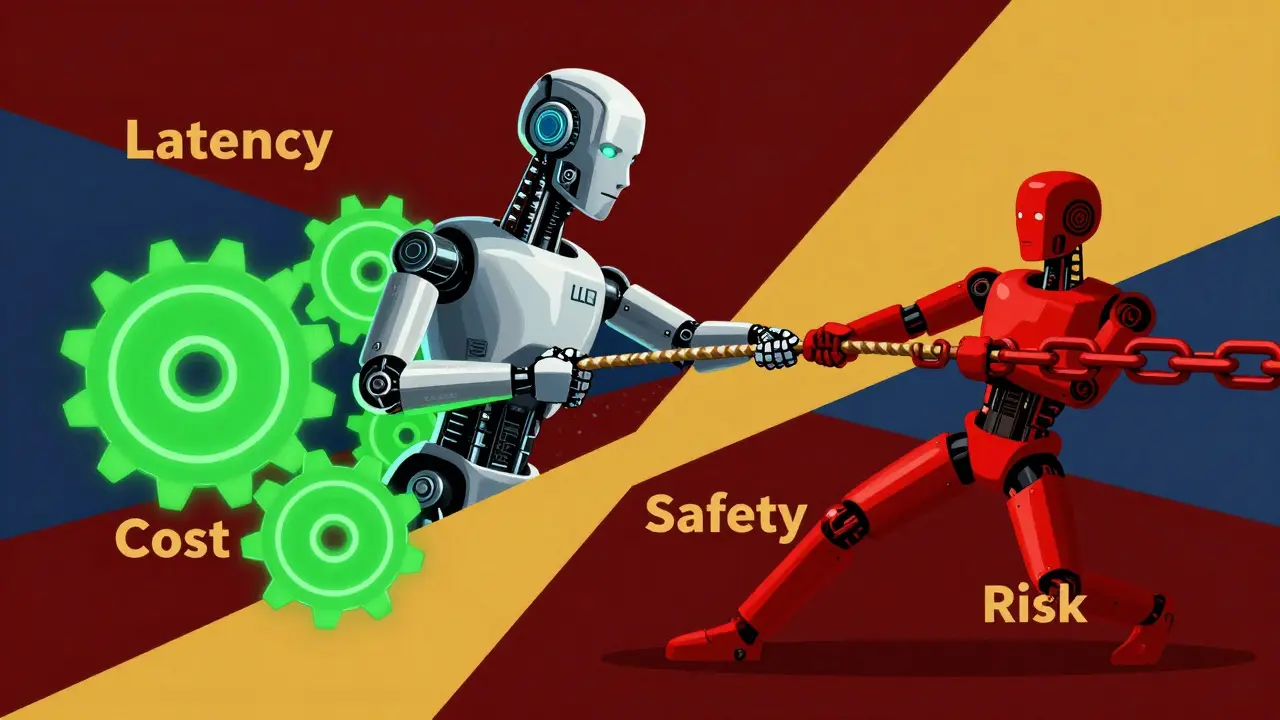
You’ve spent weeks fine-tuning your large language model. You’ve compressed it to run on cheaper hardware. But now you’re staring at a new problem: how do you keep it safe without killing your latency budget? This is the central tension in modern AI deployment. Safety checks are expensive. Multi-turn conversations are long. And users expect instant responses.
Enter production guardrails for compressed LLMs. These aren’t just filters; they are intelligent systems that balance speed, cost, and safety. They use confidence scores and abstention mechanisms to decide when to block, when to pass, and when to pause for deeper analysis. In this guide, we’ll break down how these systems work, why compression matters, and how to implement them effectively in 2026.
The Problem with Traditional Guardrails
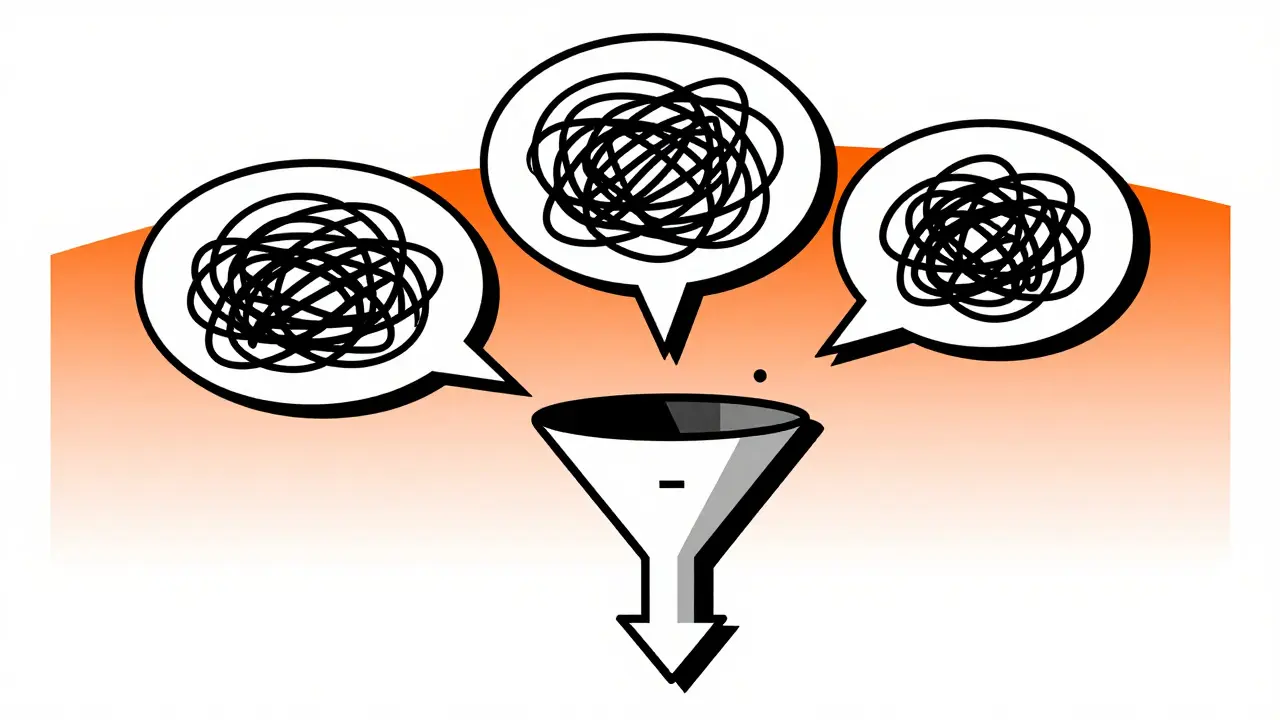
Traditional guardrails often treat every input as equally suspicious or equally safe. They process the entire conversation history, token by token. For a multi-turn dialogue, this means sending thousands of tokens through a heavy classification model. The result? High latency and high costs.
Consider a customer support bot. A user might have a ten-message exchange before asking a sensitive question. If your guardrail processes all ten messages for every single response, you’re burning compute resources. Worse, you might miss subtle jailbreak attempts hidden deep in the context because the model gets overwhelmed by noise.
The core challenge is balancing two competing objectives:
- Detection Accuracy: Catching unsafe content, including complex multi-turn jailbreaks.
- Computational Efficiency: Reducing token processing costs and inference time.
Most teams choose one over the other. They either accept slow, expensive safety checks or risk security breaches with lightweight, shallow filters. Production guardrails for compressed LLMs offer a third way.
Defensive M2S: Compressing Context Without Losing Safety
One of the most significant advancements in this space is the Defensive M2S (Multi-turn to Single-turn compression approach) methodology. Instead of feeding raw conversation histories into the guardrail, M2S transforms them into compact single-turn representations.
This isn’t just about shortening text. It’s about preserving semantic information critical for safety classification. Research shows that multi-turn jailbreak attacks can be distilled into compact prompts that retain their adversarial effectiveness. In fact, compressed prompts sometimes outperform original multi-turn attacks by up to 17.5% in attack success rate. This counterintuitive finding suggests that compression doesn’t hide threats-it highlights them.
M2S uses three primary compression templates:
- Hyphenize: Joins turns with hyphens, preserving sequential flow.
- Numberize: Prefixes each turn with a number, emphasizing order.
- Pythonize: Formats the conversation as a Python list structure, adding syntactic clarity.
The key hypothesis is that M2S maintains the semantic integrity needed for accurate safety classification while dramatically reducing computational costs. Empirical validation supports this. Models trained on M2S-compressed data achieve up to 94.6% token reduction. More importantly, they maintain competitive detection accuracy. In some cases, like Qwen3Guard with the hyphenize template, recall improved from 54.9% to 93.8%. Compression, done right, can actually make your guardrails smarter.
Confidence Scores and Abstention Mechanisms
Even with compressed inputs, not every decision is clear-cut. This is where confidence and abstention come in. A binary accept/reject system is too rigid for production environments. False positives block legitimate users. False negatives allow harmful content through.
Abstention mechanisms allow the guardrail to say, “I’m not sure.” When the model’s confidence score falls below a certain threshold, it abstains from making a final decision. Instead, it escalates the request to a more rigorous evaluation layer. This could be a heavier LLM-based classifier, a human reviewer, or a secondary specialized model.
Think of it like a triage nurse in an emergency room. Most patients are checked quickly and sent home (safe) or admitted immediately (unsafe). But some cases are ambiguous. The nurse doesn’t guess. They flag them for a doctor’s review. This tiered approach prevents errors while managing resource load.
In practice, this looks like a risk-based guardrailing strategy:
- Low Risk: Simple regex or keyword scans pass obvious safe inputs instantly.
- High Risk: Obvious dangerous inputs are blocked immediately.
- Borderline: Inputs with low confidence scores trigger deeper analysis.
This dynamic allocation of computational resources is what makes modern guardrails viable for high-traffic applications.
Efficiency Techniques Beyond Compression
M2S compression is powerful, but it’s part of a broader toolkit. Several other techniques complement it to maximize efficiency:
| Technique | Primary Benefit | Best Use Case |
|---|---|---|
| Prompt-Guard | Fast classification via small model size (86M parameters) | Latency-sensitive applications requiring rapid initial checks |
| LoRA-Guard | 100-1000x lower parameter overhead through knowledge sharing | Resource-constrained settings needing adaptable safety layers |
| Caching Decisions | Saves processing time on repeat content | Applications with high volume of identical or similar prompts |
| NeMo Guardrails | Programmable rails for controllable LLM applications | Complex workflows requiring structured safety logic |
Meta’s Prompt-Guard exemplifies the lightweight model approach. With only 86 million parameters, it’s significantly smaller than typical 70-billion-parameter LLMs. This allows for fast classification without sacrificing too much accuracy. LoRA-Guard takes a different angle, using Low-Rank Adaptation to share knowledge between the main LLM and the guardrail. This reduces parameter overhead by orders of magnitude.
Caching is another simple but effective tactic. If a user sends the same prompt twice, don’t re-evaluate it. Store the decision and reuse it. This saves processing time on repeat content, which is common in many enterprise applications.

Implementing Guardrails in Production
Choosing the right tools depends on your specific needs. Some frameworks focus on specification, others on control.
Guardrails AI uses RAIL (Reliable AI Language), an XML-like format to define return structures and output constraints. This is ideal if you need strict formatting compliance alongside safety checks. Guidance AI offers a programming paradigm that interleaves control structures with generation. It uses regex and context-free grammars to constrain outputs dynamically. For those who prefer SQL-like syntax, LMQL provides logit masking and custom operators for fine-tuned control.
When implementing these, remember that compression training happens during model development, not just at inference time. Train your guardrail to learn safety-relevant features directly from compressed representations. This ensures the model understands the condensed format and can extract meaningful signals from it.
Future Directions: Adaptive and Integrated Systems
The field is moving toward adaptive approaches. Future guardrails will likely automatically select optimal compression templates based on the specific safety scenario. Imagine a system that switches from hyphenize to pythonize depending on the complexity of the conversation.
Integration with other efficiency techniques like model distillation will also become standard. The goal is increasingly sophisticated confidence calibration. Systems will precisely determine when lightweight checks suffice and when expensive deep dives are necessary. This balance is key to scaling responsible AI deployment in sensitive domains like healthcare, finance, and legal services.
What is Defensive M2S?
Defensive M2S is a compression technique that transforms multi-turn conversation histories into compact single-turn representations. It uses templates like hyphenize, numberize, and pythonize to reduce token count while preserving semantic information needed for safety classification.
Why use abstention mechanisms in guardrails?
Abstention allows guardrails to handle uncertainty. Instead of making a risky binary decision, the system flags low-confidence cases for deeper analysis. This reduces false positives and false negatives while optimizing resource usage.
How does compression improve detection accuracy?
Compression can highlight adversarial patterns by removing conversational noise. Studies show compressed prompts can sometimes be more effective at revealing jailbreak attempts, leading to higher recall rates in safety models.
What is the difference between Prompt-Guard and LoRA-Guard?
Prompt-Guard is a lightweight standalone model with 86M parameters designed for fast classification. LoRA-Guard uses Low-Rank Adaptation to share knowledge between the main LLM and the guardrail, significantly reducing parameter overhead.
Is caching effective for guardrails?
Yes, caching decisions for identical or similar prompts saves significant processing time. It is particularly useful in high-traffic applications where users may repeat queries or follow similar interaction patterns.