Top Enterprise Use Cases for Large Language Models in 2025
By 2025, large language models (LLMs) aren’t just buzzwords anymore-they’re running critical parts of businesses. Companies aren’t testing them in labs. They’re using them every day to cut costs, speed up decisions, and keep customers happy. If you’re wondering where LLMs are actually making a difference in real companies, here’s what’s working-and what’s not.
Customer Service That Actually Understands You
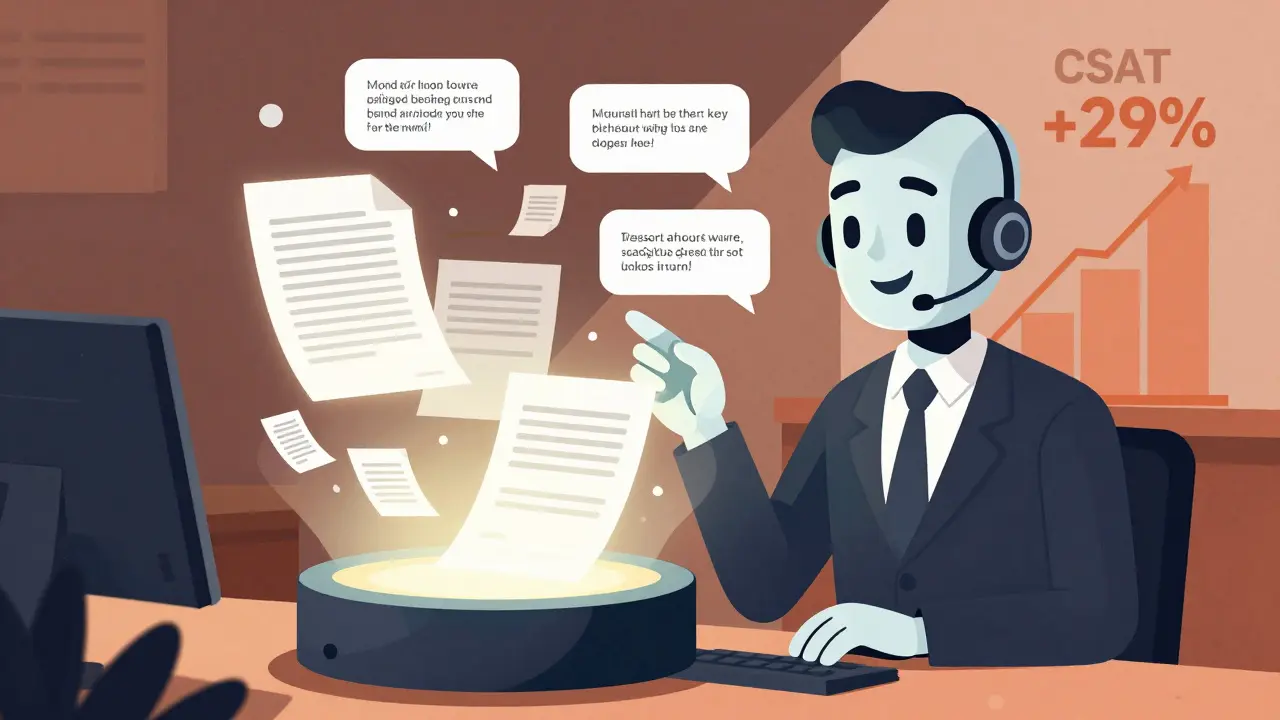
Most customer service chatbots still sound like robots reading from a script. Not anymore. Enterprise LLMs now pull from live policy documents, past tickets, and product manuals using retrieval-augmented generation (RAG). That means when a customer asks, "Can I return this item after 60 days?" the system doesn’t guess. It checks the official return policy, cites the exact clause, and responds in natural language.
Companies like Walmart and Bank of America saw customer satisfaction scores jump 18-29 points after switching to RAG-powered support. One retail chain reduced ticket resolution time from 48 hours to under 4 hours. The trick? They didn’t just plug in an LLM. They spent six months cleaning up their knowledge base-removing outdated policies, fixing broken links, and tagging every document. Without that prep, accuracy dropped below 70%. With it? 91%.
Automating the Paperwork You Hate
Finance teams still spend weeks sorting through invoices, contracts, and expense reports. LLMs now read those documents like a human would-no templates needed. They can spot discrepancies in vendor names, flag mismatched tax codes, and even predict payment delays based on historical patterns.
At JPMorgan Chase, a fine-tuned LLM processed 300,000 contracts last year. The old system took 360,000 hours annually. The new one? 36,000. That’s a 90% reduction. And it caught 38% more errors than the old rule-based system. But here’s the catch: they trained it on their own contracts, not public data. Generic models got it wrong 40% of the time. Domain-specific tuning brought accuracy to 94.7%.
Internal Knowledge That Doesn’t Get Lost
Ever lost an email with critical instructions? Or had a new hire spend weeks asking the same questions? Enterprises are using LLMs as living knowledge bases. Employees type questions like, "How do I reset the VPN for contractors?" or "What’s the approval process for travel over $5,000?" and get instant, accurate answers pulled from internal wikis, HR manuals, and Slack archives.
One tech firm cut onboarding time from 6 weeks to 2. Another reduced IT helpdesk tickets by 52%. The secret? They didn’t just upload files. They built a system that auto-updates when policies change. If HR updates the remote work policy, the LLM learns it within hours-not months.
Code That Writes Itself (and Gets Reviewed)
Code generation is the fastest-growing LLM use case in enterprise, making up 28% of all deployments. Developers now use LLMs to draft API endpoints, write SQL queries, or fix bugs in legacy Java systems. But they don’t trust the output blindly.
At a Fortune 500 bank, engineers use LLMs to generate 60% of their boilerplate code. Then, a separate AI model reviews it for security flaws, performance issues, and compliance risks. This two-step process cut development time by 45% and reduced production bugs by 31%. The key? They trained the code generator on their own codebase-not open-source repositories. That way, it learned their naming conventions, error-handling patterns, and internal libraries.
Healthcare Decisions, Not Diagnoses
LLMs aren’t replacing doctors. But they’re helping them make faster, smarter calls. In hospitals, LLMs scan patient records, lab results, and doctor’s notes to surface hidden risks-like a medication interaction no one caught, or early signs of sepsis.
A hospital in Ohio used an LLM to review 12,000 patient charts over 11 months. The model started at 68% accuracy. After fine-tuning with real clinical data and feedback from nurses, it hit 89%. It didn’t say "this patient has cancer." It said, "Patient X has elevated CRP, low platelets, and recent antibiotic use. Consider sepsis protocol." That’s augmentation-not replacement.
Regulatory compliance was a hurdle. They needed HIPAA-certified deployment. So they ran the model on-premise, with encrypted data streams. No cloud. No third-party access. That’s now standard for healthcare LLMs.
Why Some LLM Projects Fail (And How to Avoid It)
Not every company got it right. Gartner found that 65% of LLM projects fail within six months-not because the tech is bad, but because they skipped the basics.
- Data prep takes longer than you think. Successful teams spend 3-6 months cleaning and structuring data before touching an LLM.
- Integration is messy. If your LLM can’t talk to Salesforce, ServiceNow, or Microsoft 365, it’s useless. 89% of enterprises require seamless integration.
- Accuracy isn’t optional. Aim for 92%+ on domain tasks. Generic models hit 70-78%. Fine-tuned ones hit 85-92%.
- Security isn’t a feature-it’s the foundation. 94% of financial and healthcare firms require on-premise or private cloud deployment.
One company spent $2 million on an LLM that couldn’t understand their product names. Why? They used a public model trained on Amazon reviews. Their product was a niche industrial valve. The model kept calling it a "kitchen gadget." They had to start over.
What’s Driving Vendor Choice in 2025
The market has narrowed. Five players dominate:
- Anthropic (38% market share) - Leading in enterprise contracts thanks to Claude Enterprise 3.5, with a 512K token context window and strong security.
- OpenAI (29%) - Still popular, but losing ground due to less transparent safety controls.
- Google (22%) - Strong in integration with Workspace and Vertex AI.
- Cohere (7%) - Top choice for multilingual support in global retail and logistics.
- Open-source (4%) - Declining fast. Only 13% of enterprises use them in production now.
Enterprises pick based on four things:
- Security and compliance (87%)
- Integration with existing tools (82%)
- Ability to fine-tune for industry jargon (79%)
- 24/7 support and SLAs (76%)
Open-source models like Llama 4 look good on paper-but they underperform in real-world use. They lack reliable support, documentation, and enterprise-grade guardrails. For most companies, the cost of fixing those gaps outweighs the savings.
The Rise of Small Language Models (SLMs)
You don’t need a 175-billion-parameter model to run a customer service bot. Small Language Models (SLMs) like Mistral 7B and IBM’s Granite are now 41% of new deployments.
Why? They run on standard servers-not expensive AI clusters. They need just 16-24GB of VRAM. They’re faster, cheaper, and nearly as accurate. For tasks like classifying support tickets or summarizing meeting notes, SLMs are within 3-5% of larger models. But they cost 60-75% less to run.
One logistics company replaced a 70B-parameter model with a 13B SLM. Same accuracy. Half the cost. No downtime.
What’s Next? The Roadmap for Late 2025
- Multi-modal LLMs - Google and Anthropic are adding image and audio understanding. Imagine an LLM that reads a warehouse photo and spots damaged packaging.
- Real-time collaboration - Cohere is testing LLMs that help teams co-write emails or reports live, with version control.
- Automated compliance - IBM is building LLMs that auto-check outputs for GDPR, HIPAA, or SOX rules before they’re sent.
But here’s the real trend: enterprises are moving away from chasing the "biggest" model. They want the most reliable, secure, and integrated one. The winners won’t be the flashiest. They’ll be the ones that just work-every day.
Are large language models replacing human workers in enterprises?
No. The most successful enterprises use LLMs to augment workers, not replace them. Teams that combine human judgment with AI assistance-called "superagency" teams-see 3.2x productivity gains. LLMs handle repetitive tasks: reading documents, summarizing meetings, flagging errors. Humans focus on strategy, ethics, and customer relationships. The goal isn’t automation-it’s amplification.
Can I use free LLMs like ChatGPT in my company?
Technically, yes. But it’s risky. Free models often train on public data, which means your internal documents could be used to improve them. Most enterprises avoid this. In 2025, 63% of companies choose paid, enterprise-grade LLMs because they offer data privacy, compliance certifications (like SOC 2 Type II), and legal indemnification. If you handle customer data, financial records, or health info, free tools are not an option.
How long does it take to deploy an LLM in a business?
It depends. Simple RAG setups for customer service can go live in 4-8 weeks if your data is clean. But domain-specific tasks-like legal contract review or medical chart analysis-take 14-22 weeks. The biggest delay isn’t the model. It’s preparing the data. Most companies underestimate this. Successful teams spend 3-6 months organizing documents, fixing inconsistencies, and tagging content before training begins.
What skills do I need to run an enterprise LLM?
You need three: prompt engineering (to get good outputs), data engineering (to clean and structure your inputs), and domain expertise (to know what "good" looks like). Surprisingly, you don’t need a PhD in AI. In 2025, 63% of business analysts can build basic LLM tools after 2-3 weeks of training. The real bottleneck? Finding people who understand both your business and how LLMs work.
How do I measure if my LLM is working?
Track 12-15 specific metrics. Don’t just look at "accuracy." Measure: response time, user satisfaction, reduction in manual work hours, error rates, cost per task, and hallucination frequency. One company reduced invoice processing errors from 8% to 0.9%. That’s a $2.3M annual savings. That’s the kind of metric that gets buy-in from leadership.
Final Thought: It’s Not About the Model. It’s About the Process.
The best LLM in the world won’t fix a broken workflow. The most powerful tool fails if your data is messy, your teams aren’t trained, or your goals are vague. Enterprise LLM success isn’t about picking the right vendor. It’s about asking the right questions: What problem are we solving? What data do we have? Who will use this? How will we know it’s working?
By 2025, the companies winning with AI aren’t the ones with the fanciest tech. They’re the ones who treated LLMs like a new employee-not a magic button. They trained them. Policed them. Integrated them. And gave them clear work to do.






Been using RAG for our support team for 8 months now and wow it's been a game changer. We cleaned up our docs for months before even touching the model and it paid off big time. Customers actually say they feel heard now, not just processed.
Used to get 20+ tickets a day just for return policy questions. Now it's like 2 a week.
Not magic, just good prep work.
Let me guess-this is the same corporate fluff that got us into the 2020 AI bubble. 90% reduction in hours? 94.7% accuracy? Where's the audit trail? You're not telling us the truth about how many times these models hallucinate compliance violations or misread contracts. The real cost isn't in compute-it's in lawsuits when the AI misinterprets a clause and you lose a $50M deal.
And don't get me started on Anthropic's 'security.' They're still just another cloud vendor with a fancy name.
Y’all are treating LLMs like they’re the new espresso machine-just press a button and boom, productivity. But it’s more like adopting a new intern who reads everything but doesn’t know what’s important until you show them. The magic isn’t in the model-it’s in the librarian who organized the shelves, the manager who taught them the company slang, and the QA person who catches when it calls a valve a ‘kitchen gadget.’
Also, SLMs are the unsung heroes. Who needs a 70B model to summarize a meeting? That’s like using a freight train to haul groceries.
This is the future, folks 🌱✨
Not just tech-but human+AI synergy. I’ve seen teams in Mumbai and Nairobi use SLMs to cut their onboarding time in half. No PhD needed. Just curiosity + clear goals.
Remember: AI doesn’t replace people. It frees them to do what only humans can-empathize, lead, create.
Keep building with heart 💪❤️
Of course they say LLMs aren’t replacing workers. That’s the same lie they told about ATMs and cashiers. You think a Fortune 500 bank is saving $2M because they ‘augmented’ people? No-they fired 300 junior analysts and gave the rest a 10% raise to shut up.
And ‘superagency’? That’s just corporate jargon for ‘we’re making you work harder with less help.’
They’re not training LLMs to help-they’re training them to replace you quietly.
How quaint. You all think you’re pioneers. Let me tell you something-this is just the third wave of outsourcing dressed in AI pajamas. You think your ‘fine-tuned’ model is secure? It’s still trained on data that leaked from some intern’s unencrypted laptop. And your ‘enterprise-grade’ vendor? They’re just reselling OpenAI’s API with a $10K/mo sticker and a PDF labeled ‘Compliance.’
Real innovation? That’s what happens when you stop pretending tech is the solution and start fixing broken workflows.
But of course-you’d rather pay $2M to avoid doing the hard work.
Mark and Jeff-you’re missing the point. This isn’t about hype or fear. It’s about practicality.
My team spent 6 months cleaning data before we even touched an LLM. We didn’t do it because we were forced-we did it because we knew if we didn’t, the model would be useless. And guess what? It worked. We cut invoice errors from 8% to 0.9%. That’s real money.
Yes, the tools are flashy. But the real win? People who used to drown in paperwork now have time to talk to customers. That’s not replacement. That’s restoration.
Just wanted to add-when we rolled out the knowledge base LLM, we didn’t just train it. We made a Slack channel where anyone could flag wrong answers. Within 3 weeks, employees were correcting it like it was their own kid.
It’s not about the tech. It’s about culture. If people feel safe to correct it, it gets better. If you treat it like a black box, it’ll betray you.
Also-SLMs are the quiet MVPs. We run Mistral 7B on an old server and it’s faster than our old 70B model. No one even noticed the switch.
One thing everyone skips: the feedback loop. We built a simple dashboard where support agents rate LLM responses as ‘helpful,’ ‘partially helpful,’ or ‘wrong.’ That data feeds back into retraining. No magic. Just iteration.
And yes-we still have humans review the top 5% of flagged responses. Because sometimes the model gets it right, but the tone is cold. Humans fix that.
It’s not AI vs. people. It’s AI + people.
So we’re just supposed to trust these companies that they’re not feeding customer data into public models under the guise of ‘enterprise-grade’? The real story is that every ‘private cloud’ deployment is just a glorified proxy with a compliance sticker.
And ‘fine-tuned’? That’s just a fancy word for ‘we scraped our own internal Slack and called it training data.’
Wake up. This isn’t innovation. It’s corporate theater wrapped in buzzwords.