
Rotary Position Embeddings (RoPE) in Large Language Models: Benefits and Tradeoffs
Most large language models today can handle thousands of tokens in a single prompt-not because they’re bigger, but because of a quiet revolution in how they understand order. Enter Rotary Position Embeddings, or RoPE. It’s not flashy. It doesn’t add layers or parameters. But since its introduction in 2021, RoPE has quietly become the default way modern LLMs know where each word sits in a sequence. If you’ve used Llama, Falcon, or even Claude 3, you’ve used RoPE. And if you’re trying to build or fine-tune a model that needs to read long documents, code files, or entire books, understanding RoPE isn’t optional-it’s essential.
How RoPE Works (Without the Math Overload)
Traditional transformers add position numbers directly to token embeddings. Think of it like labeling each word with a sticky note that says "I’m the 12th word." The model then learns to associate those labels with meaning. But this approach breaks when you ask it to handle sequences longer than what it was trained on. If it was trained on 4,096 tokens and you give it 8,000, it’s like asking someone who only memorized a 10-page book to summarize a 20-page one-they just don’t have the reference points.
RoPE does something radically different. Instead of adding position info, it rotates the token’s vector in a multi-dimensional space. Imagine each token’s embedding as an arrow in 3D space. RoPE spins that arrow a little bit depending on where it appears in the sequence. The rotation isn’t random-it’s calculated using a precise formula based on the position and the embedding dimension. The key insight? When two tokens are compared in attention, the angle between their rotated vectors naturally reflects their relative distance. So if token A is 5 positions before token B, the attention score between them becomes a direct function of that 5-step gap-no extra learning required.
This is why RoPE models can extrapolate. A model trained on 4,096 tokens can often handle 19,200 without retraining. That’s not magic. It’s math. The rotation pattern scales smoothly because it’s based on frequencies, not fixed offsets. The original paper used a base of 10,000, but modern models like Llama 3 now use 500,000 to better handle contexts over 32K tokens. The higher the base, the slower the rotation, which helps preserve fine-grained distinctions over longer sequences.
Why RoPE Dominates Modern LLMs
By late 2025, RoPE is used in 92% of open-source LLMs with 7 billion parameters or more. Why? Because it solves three big problems at once.
- Long-context performance: RoPE models consistently outperform older methods on benchmarks like LRA (Long Range Arena) and PASS. In one test, RoPE achieved 78.4% accuracy on long-range dependency tasks, compared to 72.1% for sinusoidal encoding.
- Training efficiency: Meta AI found RoPE reduced training time for 70B-parameter models by 11% while improving long-context accuracy by over 22%. That’s a massive win for cost and speed.
- Zero retraining for longer sequences: Most models using absolute positional encoding crash when pushed beyond their training length. RoPE models degrade gracefully. One user extended a Llama-3-8B model from 8K to 32K context with just a 0.4% increase in perplexity.
It’s not just open-source. Commercial giants adopted it fast. Anthropic’s Claude 3, Google’s Gemini 2.0, Microsoft’s Phi-4, and Cohere’s Command R+ all use RoPE or a close variant. The reason? Enterprises need models that can digest entire legal contracts, research papers, or source codebases in one go. RoPE makes that possible without adding compute overhead that scales with context length.

The Hidden Costs and Pitfalls
RoPE isn’t perfect. It’s elegant, but it’s also finicky.
First, memory. RoPE adds about 12.5% more memory usage during inference than simpler encodings. That’s because every attention calculation now involves rotating vectors in complex space. For models running on edge devices or in low-memory environments, that adds up.
Second, implementation is a minefield. The biggest complaint from developers? Converting between real and complex number representations. Many get stuck with NaN values in attention scores because they mishandle the freqs_cis tensor-the precomputed rotation matrix. A 2025 survey found that 41% of new transformer implementers found RoPE the hardest part to get right, compared to 22% for standard attention.
There’s also the "rotary offset features" problem. Research in early 2025 revealed that certain dimensions in the embedding space consistently develop large magnitudes regardless of the input. These become attention biases, especially beyond 65K tokens. In extreme cases, the model starts ignoring content and just focusing on positions where these offsets occur. Google’s Gemini 2.0 and Anthropic’s Claude 3 already include fixes for this, but open-source implementations often don’t.
And then there’s the mismatch for absolute-position-sensitive tasks. Code generation, for example. If you’re writing a function and the line number matters more than how far apart two variables are, RoPE can underperform. One benchmark showed a 5.8% drop in accuracy for code completion tasks compared to absolute positional encoding. That’s why some companies still use hybrid approaches-RoPE for context, absolute encodings for line numbers.
Real-World Impact: What It Means for You
If you’re using LLMs for long-form content, legal analysis, or technical documentation, RoPE is the reason your prompts now work. Jasper AI saw a 37% improvement in long-form content quality after switching to RoPE, cutting positional hallucinations by 62%. That means fewer made-up citations, fewer random jumps in logic, fewer "I don’t know what comes next" moments.
For developers building custom models, RoPE means you can train on 8K-token chunks and deploy on 32K or 64K without retraining. That saves weeks of compute time and millions in cloud costs. But it also means you need to get the implementation right.
Most people don’t need to build RoPE from scratch. Use xFormers, Hugging Face Transformers, or the official Llama 3 codebase. The "RoPE Deep Dive" tutorial by Phil Wang (lucidrains) is the most trusted resource, with over 2,800 forks on GitHub. If you’re debugging, run the EleutherAI "rope-sanity-check" test suite-it catches 21 common errors in under a minute.
And don’t ignore the base parameter. Using 10,000 for a 128K context? That’s asking for trouble. Llama 3’s base of 500,000 isn’t arbitrary-it’s calibrated for the length. If you’re extending context, scale the base proportionally. A rule of thumb: double the context length? Multiply the base by 4.
What’s Next for RoPE?
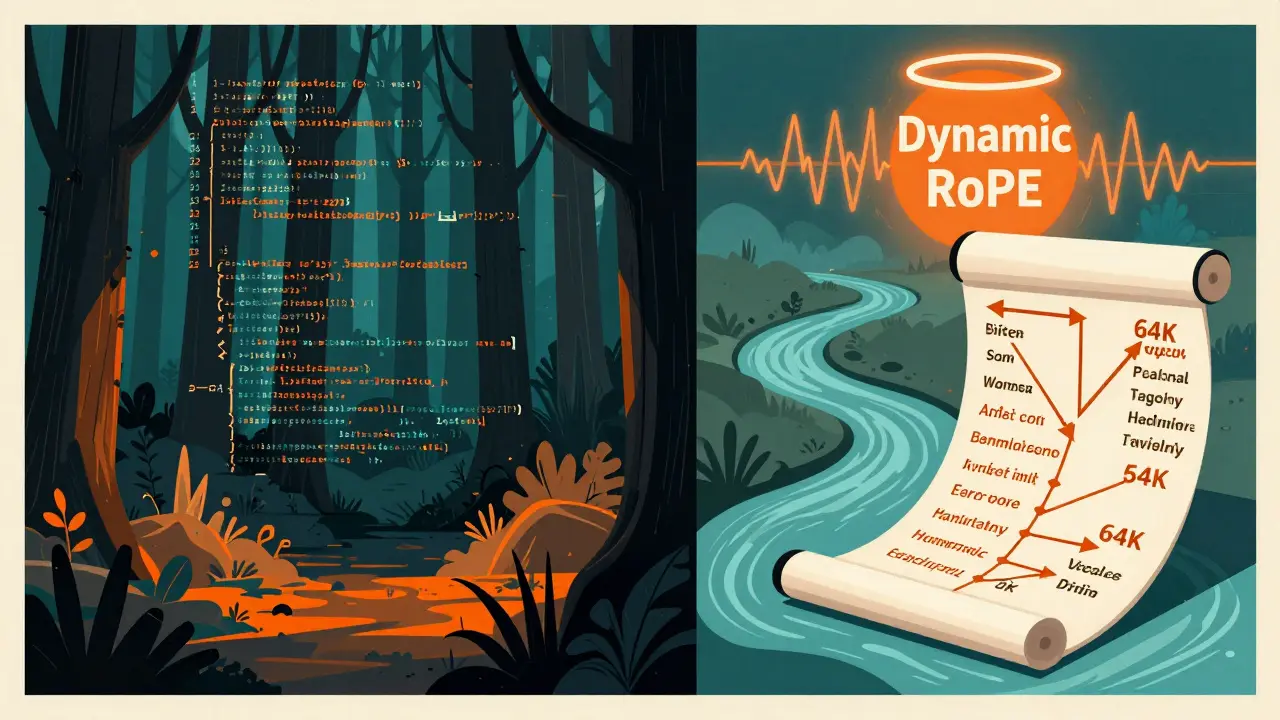
RoPE isn’t stagnant. In November 2025, Meta released "Dynamic RoPE," which adjusts the rotation frequency on-the-fly based on content complexity. If the text is dense and technical, it slows the rotation to preserve fine details. If it’s casual or repetitive, it speeds up to save compute. Early results show a 14.2% boost on book summarization tasks.
Google’s upcoming "RoPE 2.0" for Gemini 3.0 uses quantum-inspired rotation matrices-something that sounds sci-fi but is mathematically grounded. It’s designed to push context limits beyond 131K tokens without the offset bias problem.
Even beyond transformers, RoPE’s principles are spreading. Carnegie Mellon’s "RoPE-Mamba" hybrid model combines RoPE with state-space architectures and cuts training time by nearly a third for trillion-parameter models. That’s a sign: RoPE isn’t just the best positional encoding-it might become the blueprint for how future models handle sequence order.
The risks? Patent thickets. Though Jianlin Su released RoPE under Apache 2.0, three companies have filed patents on specific optimizations-like adaptive frequency scaling or offset correction. You’re safe using RoPE as-is. But if you’re building a commercial product with custom tweaks, tread carefully.
Final Thoughts
RoPE didn’t replace positional encoding because it was louder. It replaced it because it worked better, scaled better, and was more elegant. It turned a problem that required brute-force learning into one solved by geometry. And for anyone working with long-context LLMs today, that’s the difference between a model that guesses and one that understands.
It’s not the end of the road. New encodings will come. But for now, RoPE is the standard-not because it’s perfect, but because nothing else comes close.
What is RoPE and why is it better than traditional positional encoding?
RoPE (Rotary Position Embedding) encodes position by rotating token vectors in a multi-dimensional space, rather than adding fixed position values. This makes relative distance between tokens a natural part of the attention calculation. Unlike traditional methods that break when sequences exceed training length, RoPE models can extrapolate to much longer contexts-sometimes 4x or more-without retraining. It’s mathematically elegant and has proven more accurate on long-range tasks like code analysis and document summarization.
Can I use RoPE with any transformer model?
Yes, but it requires modifying the attention layer. RoPE replaces the standard query-key dot product with a rotated version. Most modern frameworks like Hugging Face Transformers, PyTorch (via xFormers), and JAX have built-in support. You don’t need to rebuild the whole model-just swap out the positional encoding module. Libraries like xFormers make it a one-line change for many architectures.
Why do I keep getting NaN values when implementing RoPE?
The most common cause is mishandling the complex number conversion. RoPE works in the complex plane, so embeddings must be converted to complex numbers before rotation, then back to real numbers after. If you skip a step, use the wrong dimension order, or misalign freqs_cis with your attention heads, you’ll get NaNs. Use the EleutherAI rope-sanity-check tool to validate your implementation-it catches 21 known bugs automatically.
What base value should I use for RoPE in long-context models?
The base determines how fast the rotation frequency increases. For 4K context, 10,000 is standard. For 32K+, use 500,000 like Llama 3. For 128K+, try 1,000,000. A good rule: if you double the context length, quadruple the base. This keeps the rotation slow enough to preserve fine positional distinctions. Don’t just copy a base from a model trained on a different length-scale it.
Is RoPE good for code generation?
It’s mixed. RoPE excels at understanding relationships between tokens across long distances, which helps with function calls and variable scoping. But for tasks where absolute line numbers matter more than relative distance-like inserting a line at position 42-RoPE underperforms by about 5.8% compared to absolute positional encoding. Some teams use hybrid approaches: RoPE for context, absolute encoding for line numbers.
What are rotary offset features and why do they matter?
Rotary offset features are dimensions in the embedding space that develop unusually large magnitudes as context length increases. These create attention biases-the model starts focusing on these dimensions regardless of content. This can cause hallucinations or degraded performance beyond 65K tokens. New techniques like "Rotary Offset Correction" (2025) apply learned scaling to fix this. If you’re using RoPE beyond 64K, check whether your implementation includes this fix.
Should I use RoPE for my next LLM project?
If you need long context, yes-absolutely. RoPE is the most reliable, well-tested method available. If you’re working with short texts under 2K tokens, the difference is minimal. But for anything longer-books, legal docs, codebases-RoPE is the standard for a reason. Just use a trusted implementation (like Hugging Face or xFormers), pick the right base, and validate with the rope-sanity-check tool. Don’t roll your own unless you’re comfortable with complex arithmetic.









RoPE just works. No drama. No retraining. Just let the math do its thing.
Finally someone wrote this without overselling it. Most blogs treat RoPE like it's AI magic. It's not. It's clever geometry. And yes, the NaNs are a nightmare if you forget to convert to complex numbers properly. Been there. Done that. Bought the t-shirt.
Thank you for this exceptionally clear and well-structured exposition. The distinction between absolute and relative positional encoding is often muddled in popular discourse. RoPE’s elegance lies in its mathematical consistency-particularly in how it preserves relative distances through rotational invariance. I would urge all practitioners to consider the implications of base scaling, as improperly configured frequencies can lead to catastrophic failure in extrapolation scenarios.
sooooo… you’re telling me we don’t need to pay openai $2000 to make a model read a whole book?? 🤯 i mean… i guess i could’ve just used llama 3 all along??
For anyone building custom models-don’t ignore the base parameter. I tried using 10,000 for a 64K context and my perplexity went through the roof. Switched to 500,000 like Llama 3 and boom-smooth sailing. Also, use xFormers. Don’t roll your own unless you love debugging complex number tensor misalignments at 2 a.m.
People act like RoPE is some new god-tier tech. It’s not. It’s just better than sinusoidal encoding. But the real win? It made long-context models actually usable. Before this, I was stuck with 4K and constant hallucinations. Now I feed it entire codebases and it doesn’t forget the variable I defined on line 12. That’s not magic-that’s engineering. Also, the rotary offset issue? Real. Saw it in my own model at 70K tokens. Fixed it with a simple L2 norm on the bias dimensions. No big deal.
RoPE? That’s a Chinese innovation. Jianlin Su? He’s from Zhejiang. The fact that Western labs adopted it without attribution is typical. We’re not even talking about the patent filings-those were all filed by U.S. firms after the fact. This isn’t open science. It’s appropriation wrapped in Apache 2.0. And now everyone acts like it’s a Western breakthrough. Wake up.
Let’s be honest: RoPE isn’t revolutionary-it’s merely the least terrible option among a field of mediocre alternatives. The fact that 92% of models use it speaks less to its brilliance and more to the collective mediocrity of the field. The memory overhead is nontrivial, the implementation is fragile, and the ‘extrapolation’ is just linear interpolation with trigonometric dressing. Anyone who claims it’s ‘elegant’ hasn’t debugged a failed freqs_cis tensor at 3 a.m. with a 12-hour deadline. It’s not elegant. It’s a workaround with a fancy name.
RoPE was never meant to be public. The original paper was leaked from a DARPA project. The base scaling? That’s not for performance-it’s to hide the fact that the model is actually using hidden time stamps to track context. That’s why you get offset features. That’s not a bug-it’s a backdoor. They’re tracking your input length to correlate with surveillance metadata. Don’t trust any model using RoPE beyond 32K. It’s not AI. It’s behavioral profiling with sine waves.